
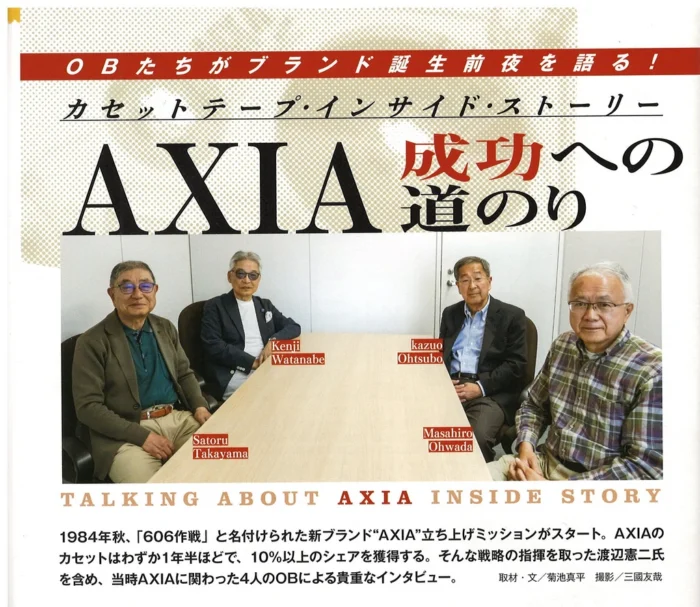
In autumn 1984, a mission to launch a new brand called AXIA began - codenamed “Operation 606.” AXIA cassettes captured over 10% market share in roughly a year and a half. A rare interview with four veterans (Old Boys) who worked on the AXIA project at the time, including Kenji Watanabe, who led the strategy.
Interview and text: Shimpei Kikuchi. Photography: Tomoya Mikuni.
”Nobody’s going to buy a cassette with the Fuji name”
▶︎ In the Fuji Cassette era, why were sales so much weaker than the Big Three?
●︎ Fuji Film’s “FX” cassettes had particularly good sound, earned industry recognition and high marks from enthusiasts. But tape running stability (slippage) wasn’t great, there was tape squeal, and however good the audio quality was, the overall spec couldn’t really be called sufficient.
●︎ I was watching from the video side, and one of the reasons Fuji’s cassette share wasn’t growing was that the company entered the cassette market later than the Big Three and couldn’t secure sales channels.
●︎ At the time they were used mainly as promotional merchandise at photo shops - they weren’t really being sold properly.
●︎ Cassettes only started selling properly in electronics stores after the AXIA brand launched.
●︎ Before AXIA, the audio business was often mocked - people said “Fuji has the technology but not the marketing - an incurable (Fuji) disease.”1
●︎ The advertising they could do well - the YMO campaign with “Ryuideen” was a hit. But even though YMO sold, the cassettes didn’t.
●︎ Using the “Fuji Film” name for cassettes was an image problem, and Nabeken2 felt that acutely.
●︎ When we were doing market research before launching AXIA and asked kids about their image of Fuji cassettes, they all said in one voice: “Nobody’s going to buy a cassette with the Fuji name.” Inside I thought “Oh come on…” - but if you think about it calmly, they were right. The people in high positions at Fuji Film had made their careers in the photographic film business, so dropping the Fuji name even for a poorly-selling cassette line wasn’t easy. And I said “Let me drop the Fuji name” - and that was a genuinely difficult decision (laughs).
▶︎ That was a bold move. And that’s how the AXIA launch project “Operation 606”3 started?
●︎ Dropping the Fuji name was the key point at the start of AXIA. That’s the result of Nabeken and his team starting marketing from scratch. It was probably Fuji Film’s first attempt to build a product from interviews with ordinary users.
●︎ At the time Fuji Film was very production- and lab-oriented - make a great product and people will accept it. Market thinking, user thinking - almost none of that existed. The audio business was already in critical shape, and the first decision was “drop the name.”
▶︎ And that’s how the AXIA brand was born.
●︎ Yes. But then came the question - what would the new name be? We chose middle school students as our target audience, did the research, and decided to use a name they chose and a spokesperson they chose. What impressed me was that the executive at the time - in his 60s - said “Old-timers, be quiet,” and pushed the decision through, letting us move to the AXIA name without trouble.
▶︎ Impressive. Why did AXIA, launching in 1985, specifically target high school students?
●︎ The main cassette buyers at the time were college students and young working adults, but they already had fixed loyalties - “only TDK” or “only maxell.” Targeting them was hard. We decided to go after middle schoolers who didn’t have a favorite brand yet. If they became AXIA fans they’d keep buying later. That decision was made early in “Operation 606.”
▶︎ Defining the target audience shaped the sales strategy?
●︎ Yes. We decided to use Yuki Saito in the advertising and built out the whole path to sales from there. Competitors at the time joked: “Watanabe-san, you only work with cute girls” (laughs).
▶︎ How was the name AXIA chosen?
●︎ Fuji Film had a naming committee that registered candidate names in advance. AXIA meant “value” in Greek. There were over 100 options, narrowed to 13, and after research AXIA came in second. First was “ALEX” (All Excellent), but the rights belonged to another company - and AXIA had the highest support among school kids. Kids liked that the name was “hard to read” and “looked cool.” So the decision came quickly.
●︎ For us, those kids were like “the Mito Komon seal”4 (laughs).
Target audience: from raw egg to soft-boiled5
▶︎ How fast was the move to the new brand?
●︎ Very fast. We needed to get the logo, packaging design done urgently - I was flying to Osaka every weekend for research.
▶︎ Was there a plan to radically redesign the cassette itself?
●︎ At the time the three companies controlled 90% of the market. We had to do something different from the Big Three, so we went toward car audio and boomboxes - a more “horizontal” approach, as a survival strategy.
▶︎ Why not launch with a premium, sound-focused model first?
●︎ I wasn’t an audiophile. We honestly reflected users’ voices and didn’t inherit traditions.
●︎ For the end user, traditions don’t matter. AXIA wasn’t targeting audio maniacs - it targeted users “from raw egg to soft-boiled.”5 That became the point of success.
●︎ The “606” team was built from young people - the old audio specialists were excluded. Otsubo was the only exception.
●︎ I stayed in the cassette division.
▶︎ Didn’t the engineers resent the lack of focus on sound?
●︎ Even though the concept wasn’t “sound first,” we were implementing new technologies and had confidence in the specs.
●︎ By that point heat-resistant half-shells and good tape running already existed as technologies - the question was how to apply them in AXIA.
▶︎ Why was the debuting Yuki Saito chosen for the campaign?
●︎ After a contest between agencies we decided on a “cute image.” Kids chose Yuki Saito. Seeing the mock-ups they said “I want to buy one.” We bet on PS-I.
▶︎ What was PS-I compared against?
●︎ TDK’s “AD” and maxell’s “UD.”
●︎ But we weren’t betting only on sound.
●︎ The engineers still aimed to beat “AD” and “UD.”
Double coating technology was the key
▶︎ The Slim Case of 1989 - how did that come about?
●︎ Storage problems. It really helped differentiation when we were pushing toward 20% share.
●︎ The idea came from the factory engineers.
▶︎ Most popular AXIA model?
●︎ No question - “PS.”
●︎ The goal was 10% in 4 years, but we hit it in 1.5 years. PS-I was the driver. After that, CD rental6 kept growth going.
●︎ In rental our share exceeded 50%.
●︎ AXIA grew in CD rental and also for Walkman use.
●︎ AXIA is the only Fuji Film brand that had real marketing and user research.
▶︎ What happened after 10%?
●︎ The fight to 20% was tough.
●︎ Then we were aiming for 25% - the “QS strategy.”
●︎ We were briefly number one.
●︎ About a month.
▶︎ After 20%, did school kids stay the target?
●︎ No - we had to push into the brutal competitive segment (red ocean) with GT-X and AU.
Double coating technology and the path to a music brand
▶︎ Were there any serious technological breakthroughs?
●︎ Introducing double coating.
●︎ From FX-DuO to AU with simultaneous dual-layer application.
●︎ Two magnetic layers in a single pass.
●︎ Double coating is unique Fuji technology - it came from photographic film.
▶︎ Most memorable cassette?
●︎ PS-I.
●︎ GT-Ix and the Bon Jovi campaign.
●︎ PS-I - based on my daughters’ reactions.
●︎ PS and AU.
▶︎ Cassettes are back on top.
●︎ That makes me happy. Cassettes have a unique sound that survives across eras.
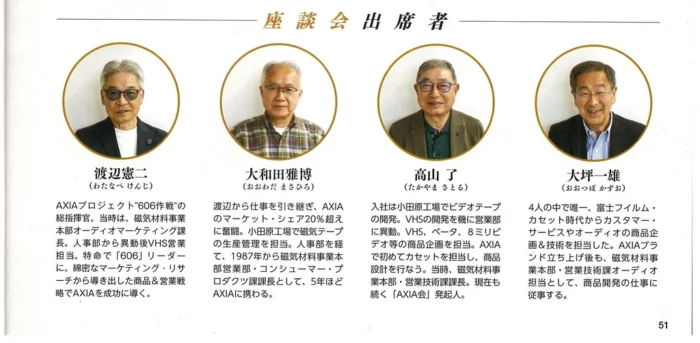 Left to right: Kenji Watanabe, Masahiro Owada, Satoru Takayama, Kazuo Otsubo
Kenji Watanabe
渡辺憲二
Head of the AXIA "Operation 606" launch project. At the time - head of the Audio Marketing Division, Magnetic Materials Department. Transferred from HR, where he had handled VHS sales. On special assignment, he became the "Operation 606" project leader. Drawing on detailed market research, he shaped the product and sales strategy that made AXIA a success.
Masahiro Owada
大和田雅博
Took over from Kenji Watanabe and fought to push AXIA's market share above 20%. At the Odawara factory he had managed magnetic tape production. After moving through HR, from 1987 as head of the Consumer Products Division in the Magnetic Materials sales department, he spent about five years on AXIA.
Satoru Takayama
高山 了
Joined the company and started at the Odawara factory developing video tapes. Was transferred to the sales division when VHS development ramped up. Handled product planning for VHS, Beta, 8mm video and other formats. In AXIA he handled cassette tapes for the first time and worked on their structural design. At the time - head of the Sales Engineering Division, Magnetic Materials Department. Founder of the "AXIA-kai" (AXIA Club) community, which continues to exist today.
Kazuo Otsubo
大坪一雄
The only one of the four who had been in audio products - customer service and then product planning and technical work - since the Fuji Film cassette days. After the AXIA brand launched, he continued in the Magnetic Materials Department's Sales Engineering Division, handling the audio side and working on product development.
Fuji Film technology: still going strong today
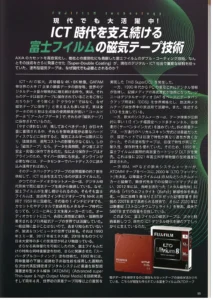
Fujifilm’s double coating technology gave AXIA cassettes better sound quality and helped differentiate them from the competition. And its successor, “Super-Double Coating,” plays a key role in today’s digital ICT social infrastructure. Why does coated magnetic tape still matter?
With ICT and AI expanding, 4K and 8K video, GAFAM - as global digital data volumes keep exploding, did you know that much of that data is stored on magnetic tape? When people hear this, the question is usually: “Why tape and not cloud?” The reality is that around 80% of all data is “cold data” - archival data with low access frequency after creation - and that’s what lives on tape.
As enormous volumes of “data that isn’t used immediately but must be preserved” accumulate daily, storing it on hard drives that need constant power means massive energy consumption and serious environmental and operational costs. Magnetic tape stores data safely and cheaply for long periods with minimal power draw. And since archival tapes are offline, they’re also protected from cyberattacks. When online access is needed, the data can be read onto hard drives at a data center for active use.
About 70% of global demand for data backup tape is supplied by Fujifilm, keeping ICT society running.
Most audio cassette manufacturers of the past left the magnetic tape market when the digital era arrived. Why did Fujifilm stay? Back in 1959, the company partnered with NHK to manufacture 2-inch video tape for broadcast - a first in Japan. Through the 1-inch video tape era, then cassette formats, then digital tape for digital broadcasting, Fujifilm remained one of the two major manufacturers alongside Sony. In the world of professional magnetic tape - where specs, reliability and durability requirements far exceed audio cassettes - the company has always played a leading role.
These products don’t appear in retail and are little known to the public, but in broadcasting and computing they’re well-known. The awards tell the story: Emmy Award in 1990, Energy Saving Award in 2017, Monozukuri Nippon Award in 2018.
Further capacity increases were made possible by Fujifilm’s unique simultaneous multi-layer coating technology and its development, “Super Double Coating.” In 1992, a new ultra-thin-layer metal medium with coating was introduced - ATOMM (Advanced super Thin-layer & high Output Metal Media) - optimized for next-generation high-density digital recording systems, using ultra-fine non-magnetic particles in the lower layer of the simultaneous multi-layer coating.
In April of that year, “Hi8 SuperDC” was released - the world’s first tape to deliver image quality equal to or better than evaporated tapes.
Meanwhile, from the 1990s, as personal computers spread, digital data volumes shot up and increasing storage density became urgent. Sony standardized the “DDS” backup format based on the digital audio DAT format. Broadcast cassette tapes are actively used by broadcasters worldwide.
At the same time, Western system manufacturers were pushing fixed-head solutions with 1/2-inch tape width, multi-channel recording and reciprocating motion (serpentine method), offering extremely fast data retrieval. Diagonally evaporated tapes were optimal for one-way travel in helical scan systems, but with fixed heads their characteristics differed between forward and reverse passes, reducing suitability. Coated tapes, by contrast, had identical characteristics in both directions and superior durability and storage stability.
So in 1995 Fujifilm launched the groundbreaking high-capacity DLT IV cartridge - which was later, in 2021, recognized as a technical heritage object by the National Museum of Nature and Science of Japan.
Meanwhile, Western system manufacturers including IBM and HP, building on ATOMM tape, standardized the LTO format in 2000. Since then, Fujifilm - working with system manufacturers including IBM and following public multi-generation roadmaps - commercialized a new magnetic material, “barium ferrite (BaFe),” in 2012, replacing the “metal magnetic particles” that had dominated until then. This technology increased storage capacity from 2.5 TB per reel to 220 TB - 88 times more. And in 2020, a new “strontium ferrite” material was introduced targeting up to 580 TB.
Fujifilm’s magnetic tapes, progressing through successive technological innovations, quietly support today’s digital ICT era - working in the background but playing a critical role. And the technologies of cassette tape continue to be used in the storage of electronic data today.
Примечания
-
The idiom “nakazu tobazu” literally means “neither sings nor flies.” It describes a situation where someone or something (in this case the Fuji Cassette brand) stays quiet and makes no progress for a long time before suddenly making a move. ↩
-
Nabeken - the nickname for Kenji Watanabe, the key figure who led the AXIA brand launch strategy. ↩
-
The AXIA brand launch project was codenamed “Operation 606”: “60” stands for the 60th year of the Showa era (1985), “6” for the sixth month, June. ↩
-
Mito Komon - the hero of an enormously popular Japanese period drama. In the climax of every episode he reveals his inro bearing the Tokugawa clan crest, which confirms his high status. The villains immediately fall to their knees. In AXIA’s business, the youth survey results served as that same “seal.” ↩
-
Think of it like a restaurant menu. While the other chefs (TDK and Maxell) competed to make the most complex dishes for restaurant critics, AXIA decided to cook simple, approachable food for people who were just hungry on the way home from school. They understood there were far more hungry ordinary people than refined gourmets. ↩ ↩2
-
CD rental - a service for renting music CDs. It was enormously popular in Japan in the second half of the 1980s: people would rent a CD and record it onto AXIA cassettes at home. ↩