
Text: Takuro Kawai
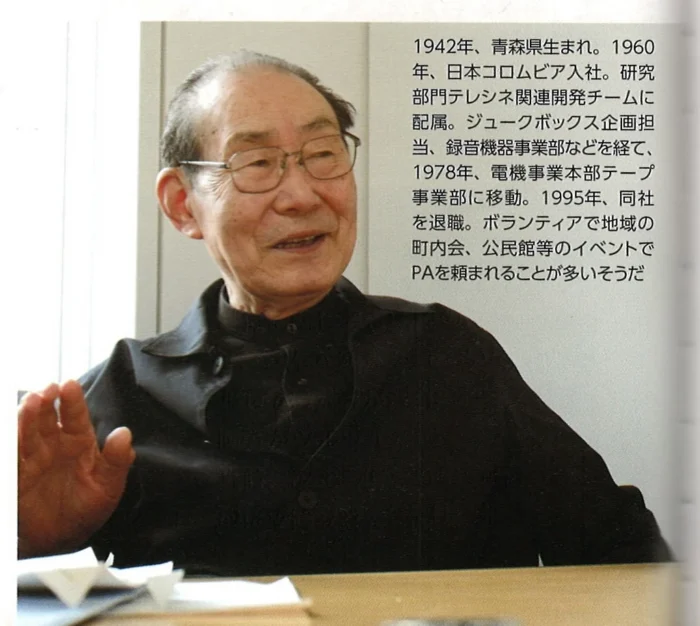
DENON entered the cassette tape market significantly later than its main competitors. By that point, the “Big Three” - TDK, Sony and Maxell - already dominated the segment with enormous, practically crushing market shares. How did DENON leverage the unique advantages of its parent Nippon Columbia - not just a legendary record label, but a company with serious achievements in high-end audio equipment? To shed light on those little-known pages of history, we spoke with Nippon Columbia veteran Hiroaki Suzuki, a direct participant and witness of that transformation.
Inactive in blank tape sales - a different starting point
The actual history of DENON-branded cassette products starts in 1969, when the company finally managed to produce its first cassette tape - three years after 1966, when the market leaders TDK, Sony and Maxell were already competing fiercely and had essentially shaped the consumer market. The brand started with products called “TRK,” released under the Nippon Columbia name. Only much later, in 1978, did the full and legendary “DX series” appear under the DENON brand. In the 1980s, when the Big Three were said to control roughly 90% of the entire world market, DENON continued fighting hard for its loyal customers, holding a stable “fifth player” position in the industry, just behind Fujifilm.
“From competitors - with whom, despite the market rivalry, we actually had quite good informal horizontal relationships - I would sometimes hear rather pointed remarks. They’d ask: ‘How on earth do you manage to survive, grow and pay your people with such a tiny market share?’” Hiroaki Suzuki recalls those years with a smile. He joined Nippon Columbia in 1960 and became the person who witnessed and lived through the entire lifecycle of this business - from its difficult birth to the very end of DENON’s cassette tape story.
“When I first joined the company in the early sixties, cassette tapes as a mass product didn’t exist yet. Open-reel tape was only just starting to become common in professional and amateur use,” says Suzuki. A graduate of an industrial technical school, he started his career as an engineer in the video division, working mainly on television equipment. But after the 1970s arrived, DENON began gradually winding down its video division, systematically shifting focus toward the promising audio equipment business. As a result of those major organizational changes, in 1977 the team of video division engineers that included Suzuki was officially transferred in full to the magnetic cassette tape division.
High stability and technical trust in DENON products
In 1978, the company released its iconic flagship - the DX3 cassette. But according to Suzuki, both in the TRK era and afterward, morale and enthusiasm inside the company’s leadership toward producing and directly selling blank tapes was, oddly enough, not very high. Behind this were the specific economic and cultural circumstances of Nippon Columbia as the parent organization. The company was first and foremost a world-class record label with a massive catalog of unique musical sources, including enka - hugely popular in Japan at the time.
“As you probably know, Nippon Columbia was the first company in Japan to mass-produce LP records. So even when the cassette format was just appearing on the horizon as a real technology in the early 1960s, management’s position was not to immediately rush into making blank tapes. The dominant thinking was: ‘We should record our exclusive sound onto cassettes and sell them as a finished product.’ Simply put, for Nippon Columbia at the time, any cassette tape was perceived exclusively as a pre-recorded tape - just another convenient medium for music, a modern replacement for the bulky SP and LP formats.”
To keep the open-reel factory lines running
“The mid-1960s was a period when Hi-Fi became enormously popular worldwide. But DENON at the time specialized almost exclusively in professional open-reel tapes in 5, 7 and 10-inch sizes for major broadcasting stations,” Suzuki explains. But even with that specialized and closed market, the products weren’t selling in the economically necessary volumes.
“First, the price of professional tape was extremely high for the time. Second, for broadcast stations, open magnetic tape was a very valuable, almost scarce resource. The industry norm was to continue using and not throwing away a single tape until it had at least five physical cuts and splices from editing,” he recalls.
In that difficult situation, in 1969 FM broadcasting began spreading rapidly across Japan - which, contrary to optimistic expectations, created an even deeper crisis for the already-struggling open-reel tape sector. “Originally the FM radio industry used a complex logistics system called ‘tape net.’ It meant that from an original master source at the studio, numerous copies were made onto magnetic tapes and physically trucked to regional FM stations across the country. DENON participated actively and successfully in this, supplying open-reel tapes for broadcasting popular classical music programs.” But as NTT’s new telecommunications technologies developed rapidly, the need to physically transport boxes of tape by truck suddenly disappeared. Professional open-reel tapes found themselves instantly obsolete for their former purpose.
“As a responsible corporation, we couldn’t simply throw away or forget the magnetic coating technologies and expertise we had carefully cultivated for years. And the factory employed about 200 highly skilled workers - we couldn’t just lay them all off for ethical and social reasons,” Suzuki emphasizes.
As a natural result of preserving production and jobs, blank cassette tape was chosen as the new product to fill the available capacity. Fortunately for the engineers, all the necessary base materials were already on hand. The technical process of repurposing was straightforward: precision-slit the existing surplus 1/4-inch (6.3mm) open-reel tape into narrower strips and pack them into standard cassette shells. That’s how the company’s first cassette tape, “TRK,” was released under the Nippon Columbia brand in 1969 - a product born of urgent necessity to save the factory in a systemic crisis.
OEM production and B2B: the foundation of economic stability
In the early days, TRK cassettes served fairly prosaic, utilitarian purposes: they were widely used for foreign language learning in language labs, for recording minutes of official meetings and political speeches. A significant portion of the factory’s cassette output was also supplied to other companies as OEM product for their pre-recorded music cassettes, and was actively exported overseas. As a “semi-finished good” for the dynamically growing B2B sector, DENON product enjoyed very high and stable demand thanks to its industrial quality. Even when the mid-1970s arrived and the aggressive Big Three competitors started massively pushing blank tapes in not just normal type but also the more advanced High Position tapes, for Nippon Columbia the main priority product remained pre-recorded music cassettes.
“When portable radio cassette players spread everywhere like a wave in the mid-seventies, our pre-recorded music cassettes were selling like hot cakes,” Suzuki notes.
The demand for recording FM broadcasts and the technological “printing press”
Yet precisely in this period, interest in the new “air check” culture was rapidly growing in Japanese society - recording quality FM broadcast programs onto blank cassettes at home. DENON as a technology leader couldn’t endlessly ignore this powerful trend. “Of course, conversations inside the company continued about how, since blank tapes were selling so well for competitors, we really should also release them under our own name… But I think for senior management the decisive factor was the desire to ensure full, 100% utilization of the factory and not let our expensive rotary machines sit idle,” the engineer explains.
The situation in the production halls was much like that of the major newspaper publishers of the time: for an industrial enterprise it was absolutely unacceptable for the giant rotary printing machines (gravure printing lines) to stop even briefly. The technology for producing magnetic tape by gravure printing closely mirrored the process of printing a daily newspaper: ultra-thin polyester film played the role of paper, and instead of ordinary printing ink, a complex chemical compound of magnetic powder was precision-applied to it. Stopping those lines would mean catastrophic financial losses for the whole factory.
DX3 and the hard fight for recognition in a tough market
In 1978, DENON officially introduced the DX3 model and, albeit with considerable historical delay, entered the mass cassette tape market in earnest. “When we started in full force we were already enormously and hopelessly behind TDK, Sony and Maxell - occupying at best only fifth place in the overall sales ranking. So nobody inside the company had rosy illusions or overly optimistic plans for world domination (laughs),” Suzuki recalls candidly.
At the same time there were no defeatist attitudes of “let’s give it all up and close down since we’re only getting scraps.” To stand out from the uniform competition and effectively differentiate their product, the company’s engineers proposed all kinds of ideas, some quite exotic. For example, there was a serious discussion of releasing cassettes in unusual one-minute increments starting from 40-minute versions. But in practice, winning mass support from ordinary users through such marketing methods proved extremely difficult.
The secrets of professional quality and the technical fight against static
“Nevertheless, in the serious B2B sector, DENON tapes at the time had an impeccable, truly rock-solid reputation among real professionals,” Suzuki says with pride. In his view, for magnetic tape intended for professional use, there are several strict and critical requirements, and the most important is effective protection against static electricity.
“In professional equipment, tape runs at very high speed - about 1.5 meters per second. Due to the enormous friction this creates, powerful static charge inevitably builds up, which in certain adverse conditions could even cause visible electric sparks. To completely prevent such dangerous incidents, we integrated conductive materials into the working coating for effective charge dissipation, and used special innovative lubricants with excellent sliding characteristics. Thanks to those targeted engineering measures, our product always had exceptional running stability even in the harshest operating conditions.”
This achievement was a direct result of the enormous practical experience and technologies accumulated by the company’s engineers in the golden era of open-reel tape development. DENON also had unique know-how around the complex interaction between tape surface and magnetic heads.
“Many people mistakenly think that both the working surface of the tape and the surface of the magnetic head should be perfectly, mirror-smooth - supposedly this gives the best sliding and contact. But the physics is such that if both touching surfaces are completely smooth, a braking effect builds up between them - adhesion or sticking. This became especially noticeable and critical when hard ferrite heads spread widely in the market, causing serious tape running problems.”
Through long, painstaking experiments and numerous trials and errors, DENON’s engineers discovered an important secret: if you give the magnetic layer of the tape a precisely defined, moderate microscopic roughness (controlled grain), stable and predictable sliding is maintained throughout the rated service life.
Trust in an audio manufacturer and the end of a golden era
In the years that followed, DENON - closely tracking constantly rising market demands - significantly expanded its range, releasing advanced High Position cassettes (the famous DX7 model) and top-tier Metal Position tapes (DXM). The company continuously updated its lineup, bringing a huge number of quality cassettes to market, becoming one of the meaningful forces that sustained and fed the global cassette boom.
But with the relentless arrival of the digital era, demand for any analog media began declining rapidly and irreversibly. DENON became one of the very first among major players to officially announce its gradual phased withdrawal from this market, already in 1993. Hiroaki Suzuki, who personally witnessed the end of cassette production and left the company in 1995, looks back warmly and with a touch of wistfulness at those 18 full years he devoted to building and selling cassette tapes.
“I’ll repeat: we were officially only in fifth place in world market share (laughs). We never set ourselves impossible goals of completely smashing the Big Three’s monopoly. But competing on real numbers with serious companies like Fujifilm or That’s (Taiyo Yuden), and making a real, tangible contribution to that cultural boom - there was definitely a thrill, a professional challenge and a great personal satisfaction in that.”
Among the many users worldwide who genuinely loved and valued DENON cassettes, there were surely very many who chose the brand guided by a simple and understandable trust: “Since this company designs and builds world-class audio equipment itself, it would never release a poor or mediocre consumable.”
“It’s interesting and symbolic that all our work in precision magnetic tape production wasn’t wasted. The accumulated decades of know-how later became the technological foundation for the ‘hearts’ of 3.5-inch floppy disks, on which the Windows operating system was distributed. These flexible magnetic disks, called ‘cookies’ inside the industry, ultimately captured a simply fantastic, dominant share of the global computer media market,” Suzuki adds at the end of the conversation.
Despite all his modest words about “fifth place,” the veteran’s face at the end of his long story clearly showed a deep inner pride in the technologies and creative efforts that had been layered, one by one, on the solid foundation of DENON’s engineering craft and corporate ethics.