
Text: Koichi Otsuka
FUJI Film is one of Japan’s iconic companies, known worldwide for photographic film, cameras and magnetic tape. The company left a real mark on cassette tape culture through the “FUJI Cassette” series and the AXIA brand that followed.
The audio tape business begins
Fuji Film’s (then Fuji Photo Film Co., Ltd.) audio tape business started in the 1960s. In a market dominated by open-reel tape, Fuji Film focused on developing high-quality magnetic materials. Open-reel tapes were used mainly in broadcasting and professional settings; their high sensitivity and low noise helped the company establish itself in the professional market.
In 1963, Philips developed the compact cassette. Its portability and ease of use let it spread fast, and it was widely adopted as a home audio source. Fuji Film caught that market shift early and entered the cassette market in 1969. That was the start of “FUJI Cassette.” The first release was a normal-type Compact Cassette (C-30 / C-60 / C-90): the packaging was in the company’s signature green, the cassette shell white with green label elements.
In 1971 came the second model - FM. This was a type-LH music tape that used fine-grained magnetic material to deliver open-reel-level stereo recording. In 1972, the FC and FL models followed. FC used chromium dioxide (CrO2) as the magnetic layer, delivering frequency response, dynamic range and S/N ratio on par with open-reel tape; it was positioned as a tape for accurate reproduction of any musical instrument. FL was a Super LH type using high-coercivity fine-grained iron oxide, marketed as suitable for everything from ordinary cassette decks to high-end machines.
In 1974, responding to demand for higher performance, FX arrived - the successor to FM. It used a pure gamma-hematite (gamma-Fe2O3) magnetic material and was positioned as a top-tier cassette suitable for any device, from compact boomboxes to flagship decks. As a normal-type tape, FX delivered performance comparable to the chrome tapes above it; its musical qualities and ultra-wide range were rated on par with open-reel. It also used a new binder system and redesigned tape transport mechanism for stable running and long-term preservation of initial characteristics.
In 1976 the FX series expanded with FX Jr and FX DuO. FX Jr was a mass-market model that preserved the high performance of FX at a more accessible price, marketed as a tape for casual folk and pop listening. FX DuO was the top model in the FX series, using dual-layer magnetic coating (Pure Felix). A high-precision shell and original transport design significantly improved both sound quality and running stability. Period advertising described it as a “super-high-performance standard-bias cassette” capable of reproducing powerful, full sound from bass to treble.
After establishing a strong market position with this lineup, in 1977 the company launched the FUJI Cassette Range series. Range was developed using more than 20 years of Fuji Film’s experience in magnetic material production: noise was reduced to the limit, MOL (Maximum Output Level without distortion) was increased, and dynamic range in the same price class beat competitors by one tier. The name Range came from that dynamic range figure. Packaging design reflected this with lightning-bolt motifs and large MOL numbers. The lineup had four types: Range-2, Range-4, Range-4x and Range-6, from general-purpose to high-end music tapes.
In 1979, Super Range metal tape arrived, aimed at music recording and using metal magnetic particles. Metal tapes with their superior specs attracted audiophiles’ attention - and Fuji Film had actually been the first in the world to establish this principle and file the relevant patent back in 1960. Super Range initially came in C-46 and C-60, with a C-90 added in November that year and an improved version in 1981.
In 1980, as component audio systems and high-end cassette decks spread and user needs diversified, Fuji Film reorganized its lineup and launched the New FUJI Cassette series, with DR, ER, UR and SR models. The lineup covered everything from normal-position everyday tapes to chrome and metal tapes for music recording. Cassette shells got usability improvements including graduated windows to check remaining tape and better running stability. Clear plastic packaging with color coding - DR (red), ER (blue), UR (silver), SR (gold) - gave the series a modern look.
In this period FUJI cassettes expanded their domestic market share and earned high marks from music lovers. Marketing activity intensified, including TV advertising featuring YMO (Yellow Magic Orchestra).
In 1983 came the world’s first normal-position cassette specifically designed for car audio - GT-I, built with heat-resistant resin. It was rated for temperatures up to 100 degrees Celsius inside a car cabin and was especially well regarded for improved high-frequency characteristics. But compared to the major competitors - TDK, Sony and Maxell - the company was behind on shell and packaging design, and audio cassette sales remained low. Against total company revenues of around 600 billion yen, audio cassettes accounted for around 15 billion yen - less than one percent - making drastic action necessary.
The birth of AXIA
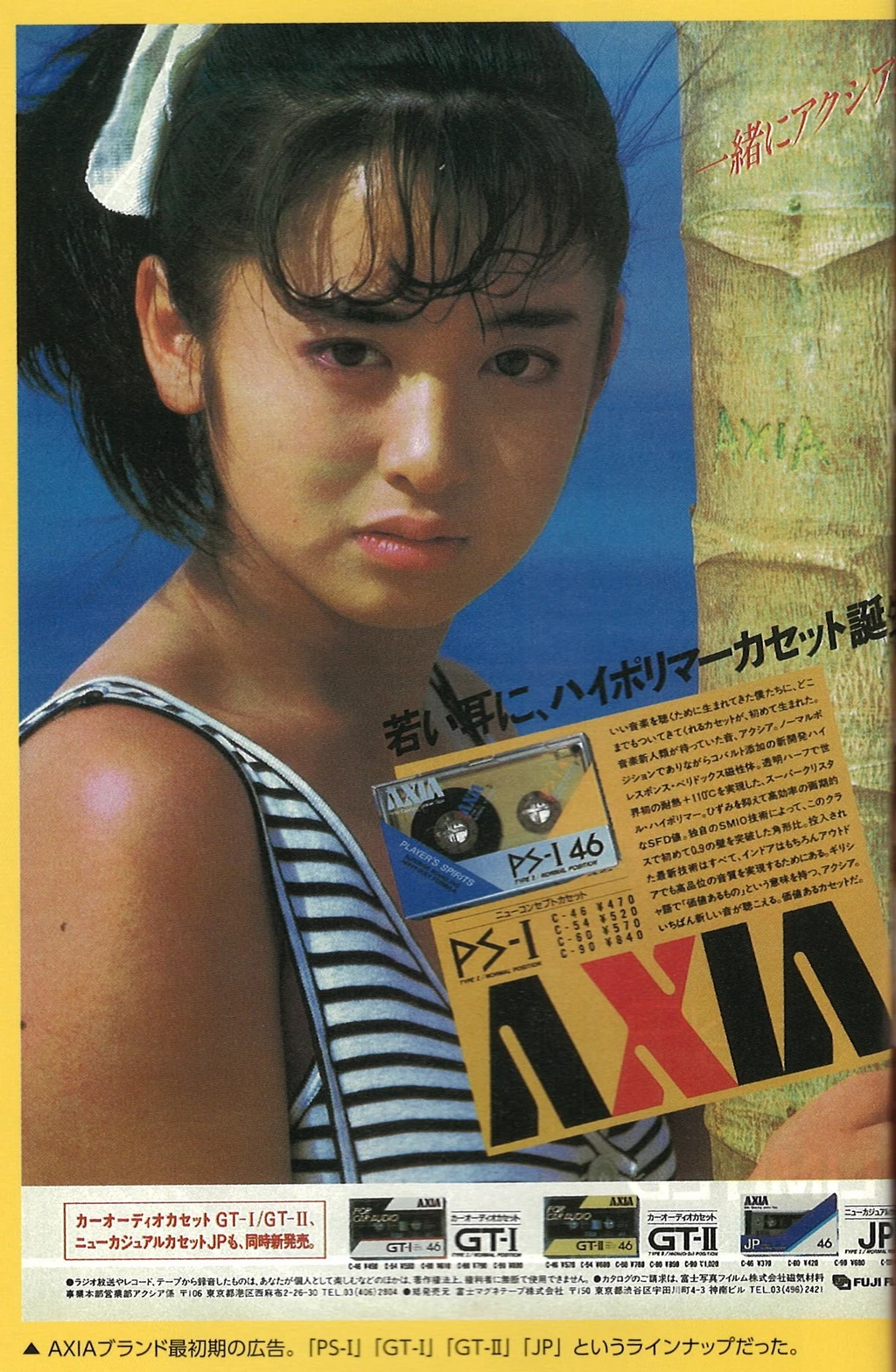
In 1985 FUJI Film launched a new cassette tape brand - AXIA. The name AXIA comes from the Greek word axia, meaning “valuable, having value,” and the brand logo used the slogan “Active eXciting Innovator All for you” - a double meaning. The name was chosen from roughly a thousand proposed candidates based on a survey of middle school students, underscoring the brand’s youth orientation. AXIA was positioned as a local Japanese market brand; outside Japan, the Fuji or Fujifilm names continued to be used.
At launch the lineup had four models: flagship PS-I (Player’s Spirits), car-audio GT-I and GT-II, and the affordable JP (Junior Player). The range expanded later, but from day one AXIA pushed contemporary, visually distinctive design. The key feature was a see-through cassette shell that let you watch the mechanism working - a solution that competitors later widely copied.
In 1989 the company developed an original Slim Case - about 20% thinner than standard cassette boxes. This proved especially popular with portable player users and quickly became an industry standard. In 1996 the problem of accidentally touching the tape when pulling out a cassette was solved with the Easy-In Slim Case, marketed under the slogan “Insert either way.”
Metal tapes didn’t appear in the AXIA lineup right away: FR-METAL under the Fuji brand continued selling, and in 1986 XD-Master was introduced as its effective successor. In 1989 a metal version was added to the popular PS-IVx series.
Youth culture and brand success
The core of AXIA’s strategy was targeting young audiences - primarily middle and high school students. Marketing combined music and fashion, and campaigns actively used images of young artists and performers. The face of the brand was a debuting idol singer Yuki Saito, whose popularity turned out to be exceptional. Her first album, titled AXIA, was released on the same day as the brand launch - a major marketing event.
AXIA campaigns also featured Judy and Mary, Bon Jovi, Yui Asaka and Eikichi Yazawa. The combination of original design, see-through shells, color variations, slim cases, competitive pricing and active work with music retail drove market share from around 5% up to around 20%, putting AXIA alongside the industry’s leading manufacturers.
The end of an era
In the 2000s, music media began moving from cassettes to CDs and digital audio formats. Fuji Film gradually shifted its strategic focus toward photographic materials, medical equipment and digital imaging, and in September 2006 the AXIA brand was withdrawn from the market.
Still, FUJI and AXIA cassettes represented the peak of the company’s magnetic tape technology. The thin-layer coating and magnetic material technologies developed in those years found application in digital data storage systems and medical imaging technologies, and they continue to influence modern devices.