
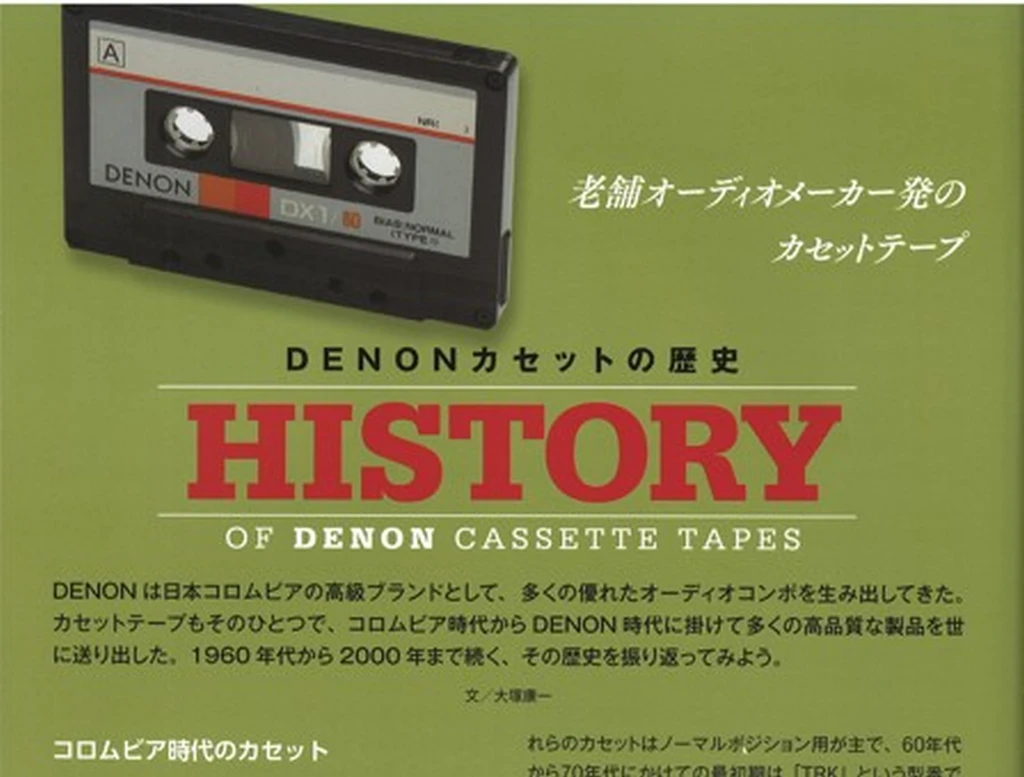
Text: Koichi Otsuka
DENON, as the premium brand of Nippon Columbia, produced a huge number of outstanding audio components. Cassette tapes were an important product category: from the Columbia era through the DENON brand’s peak, the company brought enormous quantities of high-quality products to market. Here’s an overview of that history, which ran from the 1960s to the early 2000s.
The Columbia-era cassettes
Nippon Columbia Co., Ltd. is a company and brand that made an enormous contribution to Japanese recording culture and the audio industry. Founded in 1910, it became a pioneer of the global business, and in 1939 it absorbed Nippon Denki Onkyo Co., Ltd. - after which DENON (originally pronounced “Den-On”) became the key brand for its electrical equipment division. Magnetic tape was developed by Nippon Denki Onkyo specialists and later manufactured at the Columbia factory in Kawasaki.
The company’s high technical level is confirmed by its collaboration with NHK: in 1962 its open-reel tapes, and in 1965 its MC stereo cartridge (the famous DL-103 series), were officially adopted by the broadcaster as the standard. In the 1970s the company became the world’s first to successfully implement PCM digital recording, making it a forerunner of the digital audio era.
Consumer cassette sales began in 1968. The earliest models carried the “TRK” designation (for example TRK-612, TRK-902) and came in cardboard boxes resembling candy packaging. A unique offering was the “cassette version of a sound album” - two cassettes in a single album sleeve. This format was rare among other manufacturers, but it reflected Columbia’s identity as a company professionally engaged in music.
Key models of the 70s
- MS (MASTER SONIC) (1972) - LH type with ultra-fine-grained magnetic material
- DH (DYNAMIC HI-OUTPUT) - LH type with dual mirror coating
- 1H (1976) - updated LN-type lineup (1H = basic LN, 3H = LH level)
- LX (1978) - successor to 1H, first to use a “Matrix Sheet” anti-friction pad with a matrix surface texture for improved running smoothness
- “Mister Glothree” (C-90-1H) - collector’s edition dedicated to legendary baseball player Shigeo Nagashima (number 3) of the Yomiuri Giants
The DENON brand appears
Originally, Columbia products were for the consumer market and the DENON brand for the professional sector. The name comes from Denki Onkyo (“electro-acoustics”). Abroad it started being pronounced “Denon” because the original “Den-On” was awkward for non-Japanese speakers (similar to how Nikon is pronounced “Nigh-kon” in the US). From 1978, all the company’s cassettes were unified under the DENON brand.
The famous “DX” series was launched:
- DX1 - basic LN cassette based on gamma iron oxide
- DX3 (1978) - dual-layer LH type in a precision shell; despite an accessible price, it had very good sound
- DX5 (1978) - for the rare FerriChrome (Type III) position
- DX7 (1979) - series flagship for Type II (High/Chrome) position with dual-layer cobalt coating
- DX8 (1983) - innovative high-position cassette using metal magnetic powder
- DXM (1979) - DENON’s first metal tape (Type IV), flagship with the highest sound quality
The era of quality and distinctive design (80s and 90s)
From the mid-80s, new series with improved specifications replaced the DX:
- RD series (1986) - normal position, “W-through” shell (fully transparent zone for labeling)
- HD series - high-position using metal compound for expanded dynamic range (HD-S, HD-8 models)
- MD series - metal position in shells with a characteristic angled window (Oblique window)
In the 90s, adapting to the CD digital era, DENON released distinctive individual models:
- MG-X (1993) - ultra-premium class in a heavy ceramic composite shell with a unique face-like window. Direct competitor to the Sony Metal Master.
- GR series (1992) - cassettes with a “P-ARK” mechanism and an arched window
- Lapisia (around 2000) - one of the final series released under the DENON brand
Marketing and cultural influence
DENON invested heavily in celebrity advertising campaigns: singer Remi (1985), comedian Shofukutei Tsurube (1986) and Yuri Kunimi (1988).
The most memorable was the 1989 campaign “HG - Go to Heaven with Denon”, whose face was the famous villain wrestler Abdullah the Butcher. The ad played on his aggressive image and trademark “blow to hell” move, effectively underscoring the toughness and drive of DENON cassettes under heavy use.
That very Abdullah commercial mentioned in the article:
Full verbatim text of everything said in Japanese in the video (why she hits him on the head with a cymbal - still unclear):
“Mr. Butcher, round three”
“Denon HG cassettes”
“Let’s go to heaven with Denon”
“Denon”
End of production
DENON cassette production ended in the early 2000s. Over 40 years the company made an enormous contribution to the audio industry. DENON cassettes were designed to bring out the full potential of their own high-end decks, which inherited technologies from professional open-reel recorders.
While the cassette design often looked more restrained and no-nonsense (bukotsu) compared to competitors, the actual specs, running reliability and magnetic layer quality were always at the highest level. The brand aimed to give the user not just a medium, but the pleasure of creativity: recording, editing and making your own musical mixes.