Text: Otsuka Koichi
A brand with its own identity, born in 1983
That’s cassette tapes are the product line that Japanese corporation Taiyo Yuden developed in the music media market from 1983 to the early 1990s. Despite a relatively short active presence, the products left a strong and distinctive impression through their combination of original design and high build quality. In a fiercely competitive landscape alongside Sony, TDK and maxell, the brand developed its own visual and technological identity. That’s didn’t just exist in the market - it became one of the pillars of mixtape culture, with real influence on how people personally consumed and shared music.
Distinctive design and high technical standards
That’s cassette tapes (ザッツ), developed and sold by Taiyo Yuden Co., Ltd., were in many ways products that stood sharply apart from the mass offerings of their era. Taiyo Yuden is an electronics component manufacturer with a strong engineering reputation, founded in 1950 by engineer Sato Hikohachi, who had been researching ceramic materials since the pre-war period. The company specialized in producing MLCC (multilayer ceramic capacitors), inductors and other electronic components, which built a solid scientific and technical foundation for its subsequent entry into the magnetic media market.
Taiyo Yuden had exceptionally high technological potential: it was the first in the world to commercialize a recordable optical disc in the CD-R format in 1988, and the name of the format itself was also proposed by the company’s specialists. From the late 1970s to the early 1980s, in response to the spread of portable audio players like the Walkman and the sharp growth in demand for home video recorders, the corporation made a strategic decision to begin manufacturing magnetic tape.
Cassette tape production and sales had begun in the late 1970s, but it was only after a specialized production system was deployed at the Yawatahara factory in Gunma Prefecture that the company in the early 1980s seriously entered the cassette tape market under the That’s brand. The exact origin of the name “That’s” is unknown, but its literal meaning - “that” or “that’s it” - suggests it was chosen as simple, intuitive and easy to remember for the mass consumer. In Japan and Europe the products were sold under the That’s brand from the start; in the United States an early alternative brand, TRIAD, was used, and only in the 1990s was the name unified across all markets.
Building and evolving the lineup
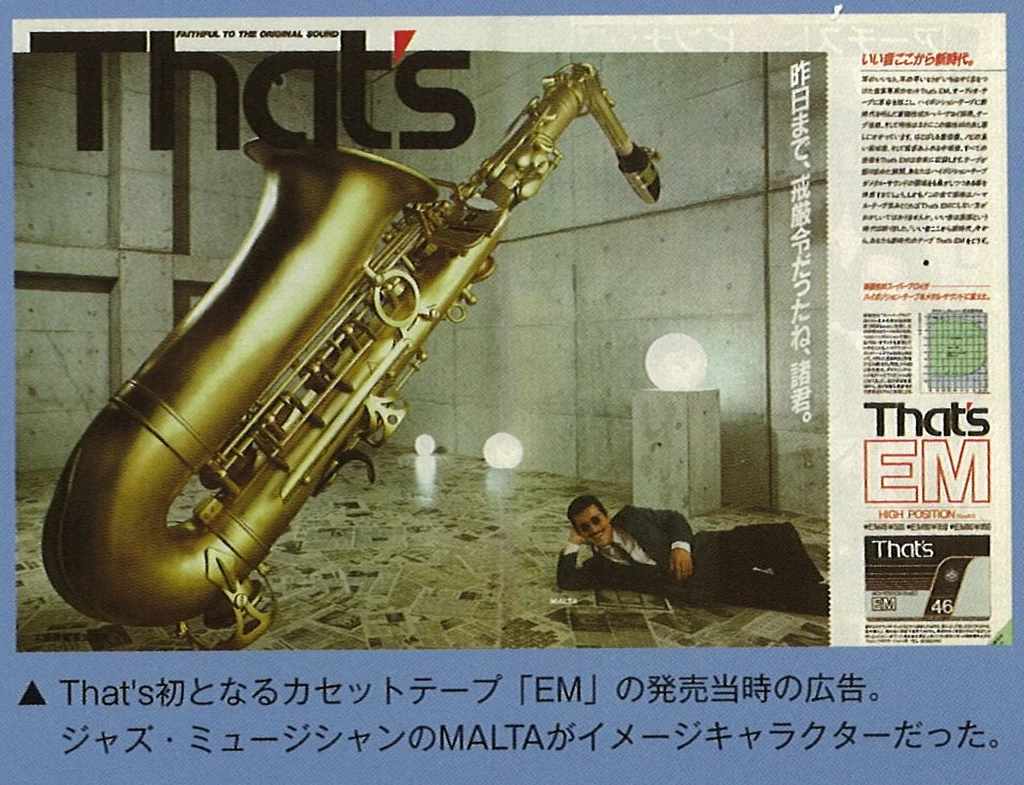
In 1983, the first That’s cassette tapes were released: the high-position EM and the metal MG and MR. The following year saw the high-end normal-position FX. Its triangular window - occupying half the cassette shell - became the That’s brand trademark and a symbol of its design and color approach, clearly setting the products apart from competitors and giving them instant visual recognition.
From 1984, alongside steady improvements in sound quality, the color expressiveness of the design developed rapidly. The RX model came with a white shell half, and logos and packaging elements were done in three color variants - blue, red and green - underlining the experimental character of the brand’s visual policy.
In 1986 the EVE series appeared, with similar color variations and white shells, along with the CD series, originally aimed at recording from compact discs. The lineup became quite full: normal EVE-I, CD-I and FX; high-position EVE-II, CD-II and EM-X; metal EVE-IV, CD-IV and MR-X - a complete and logically structured range.
In 1987, across all traditional positions - normal, high and metal - further improvements in audio characteristics and stronger visual expressiveness were achieved. Among the most notable models of this period were the high-position Q with cobalt magnetic material and the normal Pas-de-deux, released in white and pink. The latter was positioned as a fashionable cassette aimed primarily at female audiences, but the use of a monolithic mechanism gave it excellent running stability and a serious level of audio specs. The French expression “pas de deux” in ballet terminology describes a dance for two - a man and a woman - and literally translates as “steps of two.”
Unconventional That’s cassettes: design experiments
In 1988 a cassette arrived that was innovative - almost shocking - both for the company itself and for the whole cassette market. This was the SUONO model, designed by the studio of legendary Italian designer Giorgetto Giugiaro. The name comes from the Italian word for “sound” or “sonority,” and the key features were a shell form with a raised central section resembling an amphitheater, inspired by the image of the Roman Colosseum, along with contrasting red hubs.
Combined with high-quality materials that effectively damped unwanted vibrations, SUONO delivered an exceptionally high level of execution. However, the drive mechanism housing partially exceeded strict cassette standards, causing compatibility problems - primarily with slot-loading decks widely used in car audio systems. Despite these design limitations, SUONO won the prestigious Good Design Award that same year and has been consistently highly valued by enthusiasts ever since. In many ways this is unquestionably one of the landmark cassettes of the era, and today it remains a prized collector’s item.
That same year 1988 saw normal Si, PH-I, CD-IS and FX-XP, high-position PH-II, CD-IIS and EM-XP, and metal PH-IV, CD-IVS and MR-XP. PH was read as “pe-ha,” and Si was short for SOUND INDIVIDUAL. The lineup that year also included normal FM, OW-I, CD-IF and FX-XP, high-position OW-II, CD-IIF and EM-XP, and metal OW-IV, CD-IVF and MR-XP. Special cassettes AM (FOR AMENITY) and FM (FOR FAVORITE MUSIC) were also released in this period and were popular with listeners who liked to personalize their music selections.
Colorful and cost-effective series of the late 1980s
Starting from 1989, alongside the characteristic development of That’s original series, the company actively released cassettes that delivered another key brand advantage - the combination of low price and high performance. The LN-class PH series was aimed at an optimal price-to-performance ratio and sat in the same price range as competitors’ mass models, including TDK AE.
A more affordable CD-S series also appeared for SUONO, and in 1990 a CD-F series was introduced across all positions with a redesigned shell form brought into closer conformance with standard specs. This eliminated the compatibility problems noted earlier with certain deck types. CD-series packaging stated “SUONO format used” - which read as a confident and principled engineering statement by the company.
The end of That’s cassette era
In the period 1991-1992, the last significant models were released: normal OW-I, CD-IF and FX-XP; high-position OW-II, H2, CD-IIF and EM-XP; metal OW-IV, CD-IVF, MR-XP and SUONO in an original design version. The H2 model is particularly interesting - its packaging carried the designations HH and METAL HIGH POSITION. This reflected a characteristic early-1990s industry trend: using the metal magnetic layer traditionally used in Type IV tapes in high-position cassettes, achieving outstanding recording characteristics while maintaining compatibility with standard deck settings.
This list of models was the last in That’s cassette brand history. As compact discs spread and digital technologies developed rapidly, demand for analog cassettes began declining sharply. In 1993, Taiyo Yuden - following the general market logic - decided to exit the cassette business and concentrate resources on developing optical storage media, primarily CD-R.
The That’s brand was carried over into optical recording - first CD-R, then DVD-R - and for many years maintained its status as one of the most respected names in the recordable media segment. However, in 2015 Taiyo Yuden ceased all activity in optical media as well, after which the That’s brand officially came to an end.
Despite entering the market later than manufacturers like Sony, TDK and maxell, Taiyo Yuden managed through its own technologies and bold design decisions to carve out a unique niche. The technological legacy, visual daring and engineering approach of That’s cassettes continue to attract collectors and enthusiasts, confirming the brand’s lasting influence on the history and culture of analog audio recording.