
PART 1: Talk about UD - the UD series in focus.
Maxell, which created the first “C” cassette tape in 1966, pushed hard on music-oriented product development and ultimately built the “UD” brand. Praised for outstanding sound quality - including superb high-frequency extension - it earned recognition both in Japan and abroad. The people who lived through those events share how the development actually went down.
The birth of the first cassette tape and the shift toward music-focused research
▶︎ First of all, tell us how the “UD” brand - the symbol of Maxell - came to be.
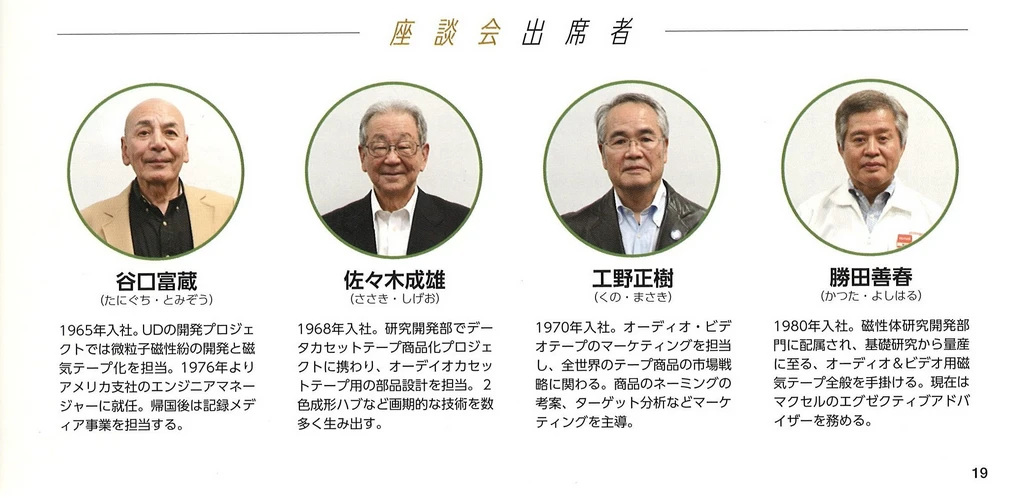
●︎ Taniguchi: In April 1966, the Dutch company Philips opened its cassette tape patents for free licensing, and Maxell immediately acquired the blueprints. We developed our own tooling and in July of that same year released Japan’s first “C60” cassette. Originally, like the Philips product, it was intended for stenographic and voice recording - but over time, voices within the company started calling for a cassette designed specifically for music. In March 1970 we released the “Low Noise Cassette (LNC),” but the consensus was that the name was not expressive enough. In June of the same year, simultaneously with a Maxell logo redesign, the cassette was relaunched under the new brand name “UD (Ultra Dynamic).”
▶︎ Where did the “Ultra Dynamic” name come from?
●︎ Kuno: It was inspired by the phrase “Ultra C”1, which became a buzzword during the Tokyo Olympics. We also wanted a name that conveyed musicality and high performance.
▶︎ What were the actual differences between the C60, the LNC and the UD?
●︎ Taniguchi: First and foremost, to push noise as low as possible, we reduced the magnetic powder particle size from roughly 1 micron down to about 0.3 micron. By packing in a large quantity of this finer powder we could maintain dynamic range and achieve confident high-frequency reproduction - which had always been the weak point of a cassette tape running at low speed. We also ran a calendering operation on the tape surface, applying antistatic agents and lubricants to prevent noise caused by head friction and static discharge during playback.
▶︎ There were plenty of obstacles along the way?
●︎ Taniguchi: When you pack a lot of magnetic powder into a tape, it becomes more prone to shedding, and the smoother you make the tape surface, the greater the friction with the head. You are constantly bumping into contradictory problems between chasing better performance and dealing with reality. In those conditions, painstaking manufacturing processes become critical. The kind of grinding work involved in mixing magnetic powder with plastic binder rarely gets any attention, but that is exactly where it all lives. By relentlessly building up those kinds of techniques, Maxell was able to win a real share of the cassette market. Before UD took its final shape, roughly a year went into research, and about 300 prototype samples were made.
▶︎ So UD was really the project that defined Maxell’s identity.
●︎ Taniguchi: Looking back, yes. Even the LNC release was fairly groundbreaking in itself, but the further push toward high-frequency extension allowed Maxell to go down its own evolutionary path.
▶︎ What was the reaction to the LNC and UD right after launch?
●︎ Kuno: Almost immediately after development was complete, a London label in the UK adopted them for their classical music cassettes. Japanese label King Records, which was the distributor in Japan, followed suit. That is what allowed the cassette tape business - which had been living in the shadow of the dry battery side - to finally get onto a solid growth track.
Deep-diving the magnetic powder and mastering the high-frequency range
▶︎ How did the magnetic powder research progress during UD development?
●︎ Katsuda: When I joined the company in 1980, UD was already on its second generation. During the first-generation period, the technologies for boosting coercivity and residual flux density in iron oxide - like cobalt deposition onto iron oxide - had not yet been commercialized. The work at that stage was mainly fundamental research. Coercivity and residual flux density are the critical parameters that determine magnetic properties, and the higher they are, the better the short-wavelength response. Needle-shaped magnetic particles were used for this, and a lot of attention went to how large a difference you could make between the short and long axes of those particles.
●︎ Taniguchi: The epitaxial technology for cobalt deposition onto acicular iron oxide came in starting with the UD-XL in 1974, but UD used pure iron oxide. I was mainly working on the iron powder side, and Maxell had always been a manufacturer that pursued quality through premium materials - we used Teflon and graphite even for the cassette separator sheets, without any compromise on cost. That kind of environment was what made it possible to create a high-quality cassette tape like UD.
▶︎ Was UD developed as an evolution of the C60, or was it a completely separate line?
●︎ Taniguchi: A separate line - because the powders and binders used were different.
●︎ Katsuda: In UD, as the magnetic properties improved, coercivity gradually climbed. It started at 340 oersteds, then moved up step by step, eventually reaching around 370 oersteds.
●︎ Taniguchi: Getting to that 370 level happened right at the very end. If you pick up a late-run UD and an LNC and compare the tape color, you can see the UD is clearly blacker and the surface has a sheen to it. Even after the LNC was rebranded as UD, various changes kept happening - better heat resistance, more aggressive calendering. That black color comes from high carbon black content, which gives the tape its anti-static character.
●︎ Katsuda: The material used for the calendering rolls also changed as the models evolved.
A model-change revolution: the second generation
▶︎ In the second-generation UD the shell halves went black. Why?
●︎ Taniguchi: The main goal was to create a sense of premium quality.
●︎ Sasaki: It became a topic of discussion because one look was enough to create that impression of high quality. Visually it was a very significant change, and it influenced every model that followed.
●︎ Kuno: We wanted to clearly differentiate ourselves from other companies’ products. Finding black screws that matched the shell turned out to be a genuinely tricky task. The other major change in the second generation was swapping the leader tape out for a cleaning tape.
●︎ Taniguchi: That used a matte-finish treatment where the polyester film surface was intentionally roughened.
●︎ Katsuda: On older cassette decks you had to clean the head with a cotton swab dipped in alcohol every now and then. When that cleaning tape appeared it seemed like you would never have to deal with that hassle again - I was genuinely impressed back when I was a student.
●︎ Taniguchi: When you pack a lot of magnetic powder into a tape, it sheds more easily and affects the head, and we spent a long time wrestling with how to reconcile those conflicting requirements.
▶︎ The second-generation UD came out roughly two years after the first. Was that gap intentional?
●︎ Kuno: When we launched the first UD, the development system was not yet fully in place. As conditions gradually improved we built up research and took time to think about how to create something new and achieve real differentiation - that is how the second UD was born. The results of that effort made it possible to include things like the black shell and the cleaning leader that had been technically out of reach with the first generation.
●︎ Katsuda: At that point I was still a middle school student, and open-reel machines still dominated music recording. There were not really high-quality decks yet either, so the shift toward using cassettes for music was in many ways driven by the success of UD.
▶︎ What did critics say after UD came out?
●︎ Taniguchi: The thing that got the most praise was the fact that the high-frequency range did not “drop off.”
●︎ Kuno: The output level was genuinely outstanding. Before this, there were no cassettes capable of handling classical music recording, so that quality is what led to adoption by the London label and major recording companies. At the same time, some people said the highs were overcooked - described as a piercing ring, “kinkin” in Japanese - and sometimes they were literally hard on the ears.
●︎ Taniguchi: In the US, UD became a massive hit because it was perfect for rock music. People were even saying that recording and playing back on UD sounded better than listening to the original record. That is how outstanding the high-frequency extension was. Thanks to UD, Maxell came to be seen as a premium brand in America.
Behind the scenes of the UD commercials
Speaking of “UD,” a lot of people will remember the commercials featuring Yamashita Tatsuro. In 1979 the tagline “Only the good sound remains” was created as the key phrase for Maxell cassettes, and from that point it became the brand’s image concept.
At the time, our company was lagging far behind the competition and was barely known. We could not follow the mass-market strategy of the big players - we needed to carve out an image position from a different angle. That is where “Only the good sound remains” came from. The music scene then was dominated by idol pop, but as a kind of counter-culture a different music scene was slowly forming - new music, artists who did not appear on television. Tatsuro-san was not widely famous with mainstream audiences, but in rock circles he had a unique sensibility and exceptional musicality. He had what you might call a “bedrock” - a devoted fan base - and the potential to break through. He was the pioneer of city pop, and that is why we trusted him with our image.
On the shoot: the ocean scenes were filmed in early February and ran for about 20 days on the island of Saipan. By the time we left Japan the track was nearly finished. Since Tatsuro-san was a Maxell fan himself, he was happy to add his own performance touches and tweak parts of the lyrics right there on set.
The mountain scenes were shot near the Nukkakushi crater on Hokkaido. Sulfurous fumes were rising everywhere, and though eyes and nose were in genuine agony, filming continued regardless. During breaks someone noticed that the back of everyone’s jeans had been eaten through by the sulfur. The whole crew ended up walking around with several layers of gaffer tape over their trousers. After dinner, Tatsuro-san kept working on a new composition right there in his hotel room.
The legacy of UD
▶︎ With UD moving to the second generation, the 46-minute tape format was released for the first time. How did that come about?
●︎ Kuno: The main reason was matching the running time of LP records. Writing “22 minutes 30 seconds per side” looked too awkward, so we decided to go with 23 minutes. The cassette started being called “the Maxell 46.” The extra minute gave users peace of mind when copying an album in full. After that, other companies picked up the 46-minute format too.
▶︎ What does the UD brand mean to Maxell?
●︎ Kuno: UD is the sub-brand that elevated the Maxell corporate brand. People often respond with “Maxell = UD” and “UD = Maxell.”
●︎ Taniguchi: For me it is a particularly memorable product, because it was my first real project. It was born out of an accumulation of grinding, unglamorous work, and it felt genuinely great when the sales team - usually sharp-tongued and cynical - offered their sincere praise for what we had made.
Примечания
-
“Ultra C” - a phrase popular in Japan that entered common use during the 1964 Tokyo Olympics. It meant a “super-complex move,” a “miraculous play,” an “unexpected super-achievement,” and was used extensively in sports and mass-media contexts as a symbol of the absolute limit of possibility and a dramatic display of superiority. ↩