
Behind the creation of the masterpieces that conquered the world
Text: Ito Matsugu
Maxell laid the foundation of the music cassette industry with the UD series. But it was the XL series - created to radically expand dynamic range - that made the real breakthrough. It not only became a massive hit in the US market, but definitively locked in Maxell’s status as a world technology leader.
Chasing perfection: why we walked away from chrome
▶︎ The XL series started with the UD-XL in 1974. Tell us exactly how that development began.
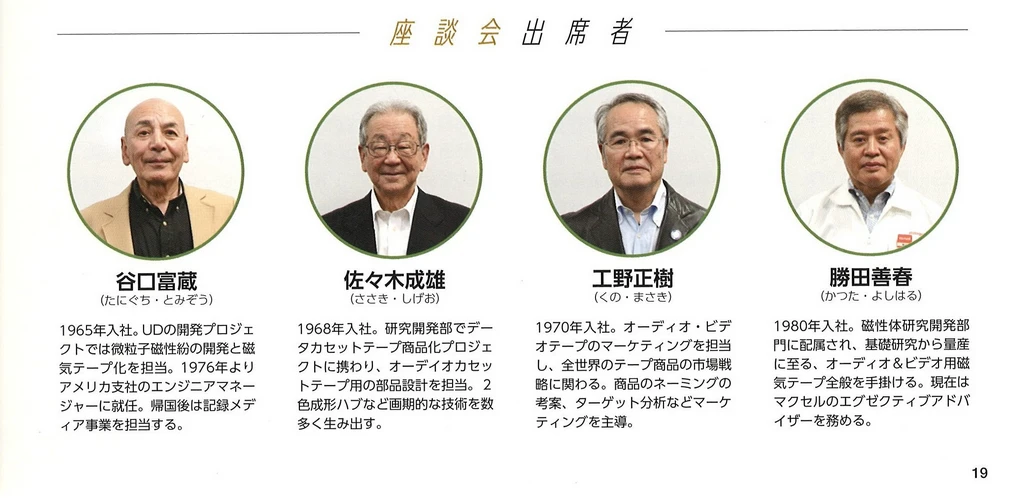
●︎ Taniguchi: The UD tape was quite specialized - we focused heavily on high frequencies to adapt the cassette for music. But if we were seriously claiming to be a “music tape,” we needed to expand dynamic range across the full spectrum. Before UD-XL, Maxell had been importing and selling chrome dioxide-based tapes for the High Position. But a serious problem emerged: chromium dioxide was extremely abrasive and was literally grinding down and wearing out tape deck heads. We had to pull those products quickly. We started our own research to find a replacement, and eventually developed the “epitaxial magnetic material.” It not only delivered excellent performance, but solved the head wear and clogging problem. That is how the UD-XL brand was born. Later, by varying the amount of cobalt, we built the XL I and XL II on that same foundation.
▶︎ What exactly does the name XL mean?
●︎ Kuno: It is short for “Excellent.”
●︎ Taniguchi: If you read the full name UD-XL, you get “Ultra Dynamic Excellent.” Sounds very powerful - maybe a bit overconfident (laughs).
●︎ Kuno: Honestly, we could have just called it XL right away, but continuity mattered to us. We wanted consumers to see the new tape as “an improved UD,” so at launch we used the double name.
The technological breakthrough: epitaxy and its secrets
▶︎ What difficulties did you face in implementing the new technology?
●︎ Taniguchi: The foundation for a music tape had already been established with UD, so in terms of the tape itself the main changes were to the magnetic layer. But an enormous amount of effort went into that.
●︎ Katsuda: The term “epitaxial” came from academia. The core idea is to “grow” a cobalt ferrite layer on crystals of gamma iron oxide. The new layer grows in strict accordance with the crystal structure of the substrate. This lets us control magnetic properties with great precision. The result was coercivity 10-20% higher than ordinary iron oxide in the “Normal” position, and for “High Position” (Type II) it nearly doubled compared to conventional formulations.
●︎ Taniguchi: We introduced this technology in 1974, well ahead of the competition. That is the true spirit of Maxell - being first in technology. Though I will admit, “epitaxial” was way too complicated for ordinary people. Looking back, I think something like “Hybrid” would have been a better choice.
Factory life: “working in swim trunks” and the American raw material problem
●︎ Katsuda: I heard that thousands of experiments were needed just to find the ideal reaction conditions.
●︎ Taniguchi: Those were crazy times. Right in the plant we set up synthesis tanks twice my height. I personally mixed experimental batches of material in there. The worst part was cleaning those tanks. After a production cycle finished I would strip down to my swim trunks and climb inside to scrub it out. By the end of a shift my whole body was coated in a sticky film and my clothes had turned bright yellow from iron hydroxide. We were completely immersed in that process.
●︎ Katsuda: Raw materials were another headache. The iron oxide for the first batches of XL I and XL II was imported from the US. It was a specific iron-chloride-based material that simply was not being produced in Japan at the time. But the quality of those American supplies was wildly inconsistent. The variation in characteristics from batch to batch was enormous. To maintain the XL standard we had to run total incoming inspection and literally “cherry-pick” specific good lots to purchase.
The “Thunderbird” design that turned the market upside down
▶︎ How did experts and critics receive the arrival of UD-XL?
●︎ Kuno: The reaction was enthusiastic even at the prototype stage. We had almost no negative reviews, and there was barely anything to fix in the product - it came out that balanced.
●︎ Taniguchi: I remember when UD-XL was still in development, we held a live recording session in the city of Takefu. I brought along a Nakamichi cassette deck and a huge professional open-reel machine running at 38 cm/s. We recorded a jazz performance by singer Mieko Hirota simultaneously on both machines. When our staff listened back later, they could not distinguish the cassette from the open reel in a blind test. The Nakamichi deck was magnificent, but it was the UD-XL tape that made that level possible.
▶︎ Beyond the tape itself, the XL series was known for its unique appearance. How was that design created?
●︎ Taniguchi: We were the first in the world to decide to create a cassette that was a class above the standard. But the real revolution in the XL series was the shell. The designer of the legendary Ford Thunderbird was a big Maxell fan. On his own initiative, he sketched the cassette he would want in his car and passed it to us for free through our consultant.
●︎ Sasaki: For designers at other companies this was a shock. The project got the internal codename “IB” (after Thunderbird), and I was responsible for the technical execution. We used a curved label for the first time, which made it much easier to write on. We also dramatically increased the tape-viewing window.
●︎ Taniguchi: I always believed that an aesthetically beautiful exterior makes people subconsciously trust the sound quality.
●︎ Sasaki: One signature detail was the concave hub holes. It looked stylish, but the mold makers cursed us - that construction was incredibly complex to manufacture.
The transparent-plastic dispute and the marketing “maniacs”
●︎ Kuno: Another important moment was introducing the fully transparent case. That was my idea - I wanted buyers in a shop to be able to see the cassette without opening the box. The factory director was completely against it at first. He was worried the transparent plastic would be too fragile and cassettes would break during shipping. But I stood my ground. In the end the design caused such a stir that it soon became the worldwide industry standard.
●︎ Sasaki: We even redesigned the paper insert and packaging so they would not block the view of the shell.
▶︎ How did you separate the UD and XL audiences?
●︎ Kuno: UD was the “people’s” tape - for everyone. XL we positioned as a product for adults, for “maniacs” - meaning serious audiophiles who appreciate nuance. We wanted to differentiate the brand by offering something exclusive.
●︎ Taniguchi: XL ended up so popular it even overshadowed UD. Over time the “UD” prefix was dropped and XL became a standalone brand. This was especially true of XL II. In the US it sold for the crazy price of 5 dollars (about 1,500 yen) at the time, but people queued up for it. It flew off shelves instantly.
The physical limit of the format
▶︎ Can we call the XL series the peak of cassette evolution?
●︎ Taniguchi: By the late 80s, when we released the third-generation XL II-S, engineers had a clear sense that we had hit the ceiling. Within the physical dimensions of the compact cassette, squeezing anything more out was practically impossible.
●︎ Katsuda: We used everything: noise reduction systems, new polishing methods. But further improvements were moving in hundredths of a decibel. In the final-generation XL I-S and XL II-S we focused on pushing recording density and residual flux density to the absolute limit. Those tapes became the final word - the ideal for semi-professionals and audiophiles. There was simply nowhere higher to jump.