
Text: Ito Takaaki
PART 2: Behind the scenes of the birth of a legend - the UDII.
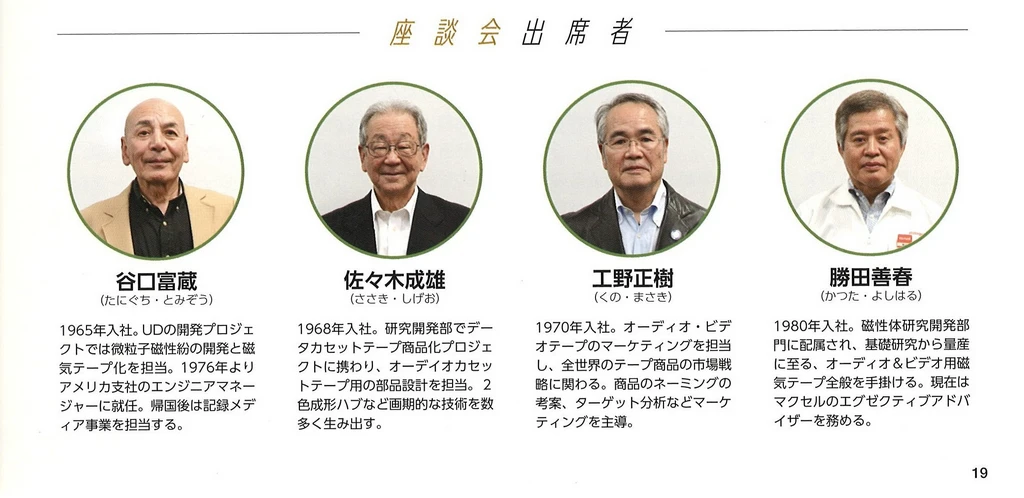
Roundtable participants: Kuno Masaki / Katsuda Yoshiharu / Taniguchi Tomizo / Sasaki Shigeo. Building on the success of UD, Maxell systematically strengthened its cassette tape lineup. The UD brand went through a major rethink, and in 1984 a High Bias (Type II) cassette in the mass-market price segment hit the shelves - the now-legendary “UDII.” But the road to getting there was one continuous obstacle course of technical challenges.
Overcoming internal resistance: bringing high quality to the mass market
▶︎ In 1983 the core brand name UD was changed to “UDI.” What was the goal of that rename?
●︎ Kuno: When the XLI appeared on the market, I already had a concept in my head for releasing an updated, more advanced version of UD. So we were running two tracks simultaneously: developing a new product and rebranding the existing UD cassette as “UDI.” That was necessary to build a clear hierarchy within the product lineup.
▶︎ Was there internal resistance to changing such an established name?
●︎ Katsuda: Absolutely, there were plenty of opinions. But personally, looking at the success of the XLI and XLII, I kept asking myself: “Are we really going to stop here and not develop UD any further?” UD was the best-selling brand in the country. Creating a full lineup around it - covering Normal (Type I), High Position (Type II) and Metal (Type IV) - seemed like the completely natural, logical step for strengthening our market position.
How the UDII was developed: High Position technology made accessible to younger buyers
▶︎ The “UDII” released in 1984 was a pioneer in the affordable High Position cassette segment. What was the vision behind the project?
●︎ Katsuda: Our main goal was to push the UD brand position - which was already firmly established in the domestic market - even further. In fact, the name “UDI” was chosen from the start with a future “UDII” already in mind. We poured all our drive and pioneering spirit into the development process under the banner of “Let us create a new era!” - trying to pack it with the most advanced technologies we had.
▶︎ Was the magnetic layer design of the UDII different from the more expensive XLII tape?
●︎ Katsuda: Yes, the UDII magnetic formulation is completely different from the XLII. To keep the final cost down and make it a mass-market product, we started development using materials from video cassettes, which were being produced in enormous volumes. Since we were moving sound from Normal Position to High Position, we had to run very careful cost calculations from the start. We were searching hard for efficient ways to use cobalt - how to deposit it, how to tune the magnetic characteristics - in order to get a quality Type II tape at mass-product pricing. All while tuning the sound so it inherited the distinctive sonic character that users had come to love from the UDI.
Expanding the lineup: the flagship product right through the 1990s
▶︎ The shell designs were really striking - silver label for the UDI and gold for the UDII. How innovative was that choice at the time?
●︎ Kuno: We decided to maintain the gold-and-silver continuity from the premium XLII and XLI, but for the UD lineup we added bright color accents - red and blue. The UDII got a red label. That was a fairly bold move, because warm tones were rarely used in audio product design at the time. The designer really had to sweat over it: the brief was to make the cassette in its case feel as premium as a luxury jewelry box or an expensive watch. We wanted even a mass-market product to give a sense of exclusivity.
▶︎ How did the market react, and what were the sales figures like?
●︎ Kuno: Although we were not only chasing sales volume, the UDII opened up a completely new market for consumers who wanted to enjoy High Position quality without spending a lot. In the end we captured more than 60% of the entire Type II cassette market. Competitors tried to launch their own budget alternatives, but they could not match our sound quality.
▶︎ Would you say UDII became the new face of Maxell?
●︎ Katsuda: Without question. We kept expanding the lineup, eventually releasing cassettes in lengths up to 150 minutes. Because the tape in those was extremely thin, it would sometimes break, and we would get jokey complaint calls from the factories about it (laughs).
●︎ Kuno: UDII remained our core product right through to the end of the 1990s, staying true to its original concept and sound quality. It became a cult item among high school students. There was a whole culture of exchanging recorded cassettes with friends, and the UDII was considered a seriously prized and prestigious gift because of its cool design and great sound.
▶︎ Later the “UDII-S” and “UDII-U” models appeared. What was the purpose?
●︎ Kuno: We were aiming to expand the market into a higher price segment above the standard UDII. But there was also a purely engineering ambition: we really wanted to try out the two-color injection molding technology for plastic shells. It was something of an experimental product, which is why its market cycle was not as long as the main model.
▶︎ What does UDII ultimately represent in Maxell history?
●︎ Kuno: It was a huge success. From 1984 to the final model in 2000, nine generations of UDII were released. We never stood still - constantly introducing new technology and refreshing the packaging design, making it “cute” one season and “edgy” the next to stay relevant with new generations of buyers. The strategy worked: we created a mass-market product that never looked cheap. UDII and UDI, like brothers, formed the powerful UD sub-brand - the true face of Maxell.
Behind the WHAM! commercial shoot: making High Position accessible
In 1984, British duo WHAM! - fronted by George Michael and at the peak of their global fame - was brought in for the UDII advertising campaign. Why them? High Position cassettes had an image of being “elite” and expensive. To flip that perception to “affordable quality,” we looked at the British pop and rock scene, which was incredibly popular with Japanese youth. WHAM! were already huge worldwide, and in Japan their popularity was just starting to explode. We chose them for their bright, energetic and stylish sound - a perfect match for the character of the UDII.
All filming took place in Japan. Andrew Ridgeley was remembered by everyone as an incredibly energetic, restless and chatty guy. George Michael, by contrast, was very quiet - preferring to sit in a corner of the studio during breaks. But the moment filming started, he transformed completely and performed with a dazzling smile. His vocal skill was simply astonishing. The commercials used the tracks “Freedom” and “Bad Boys,” but with modified lyrics. During the recording of the short versions at CBS Sony studio, you could watch through the glass as George argued animatedly and shouted out comments. The manager would hand him a piece of paper, and George would rewrite the words on the spot to suit the commercial.
That campaign gave a massive boost to the popularization of High Position tapes. Following WHAM!, we continued working with British artists - Tom Bailey from Thompson Twins and Paul Weller from Style Council - to keep UD image as the most stylish brand going. Looking at how long those artists have stayed in music, you could say: “Only good sound can last.”