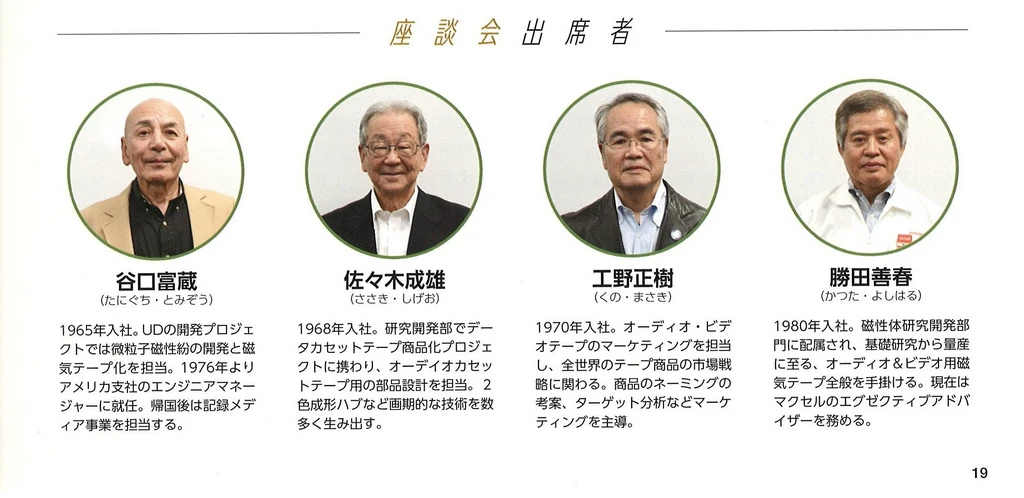
Roundtable: behind the creation of the Maxell Metal Vertex masterpiece
Text: Ito Matsugu
In 1989 Maxell unveiled the Metal Vertex - an ultimate cassette that brought together the best achievements of the technology of its time. The use of manual labor in production, including the engraving of individual serial numbers, and an uncompromising approach to both sound quality and shell aesthetics, turned this model into a legend among audiophiles and brand devotees.
A flawless metal tape born from a dream of the ideal
▶︎ In 1989, when competitors had already released their premium models, Maxell launched the Metal Vertex. How did that development begin?
●︎ Kuno: By the late 1980s, the evolution of cassette technology seemed to have reached its limit. We felt the moment had come for Maxell to set a new, ultra-high standard - to demonstrate every technological capability we had.
●︎ Katsuda: About two years before the official release, voices started appearing in the engineering department saying that Maxell needed to create a truly elite product. Honestly, at the time I was asking myself: “What can we possibly do beyond what already exists?” We had excellent tapes in all three positions, right up to XL-S. Jumping higher seemed impossible. But the process of searching for the idea of an “ideal analog cassette” was genuinely exciting. We started experimenting with materials basically for ourselves.
▶︎ So this was working on a near-impossible task?
●︎ Katsuda: Competition in the Metal position was at its peak - everyone was racing for the top. We decided not just to participate in that race, but to redefine the quality standard itself. We started “playing” with shell and tape concepts, knowing we needed materials at an extreme level. Every component was eventually made to custom specification. On top of that, production required next-generation prototype coating machines - standard equipment simply could not handle the required characteristics. Because of the small scale and uniqueness of the project we were short-handed, so engineers from the development department stood at the machines themselves and handled production. From a business perspective it was a complete disregard for profitability. I caught myself more than once thinking: “Maybe we should stop before it is too late?” (laughs).
●︎ Kuno: If you look at this project as a marketing tool or a long-term brand image investment, there were no budget problems. We understood that Metal Vertex technology would eventually pull the quality of the whole rest of our product lineup upward.
●︎ Katsuda: We put everything the Maxell Kyoto factory had into this project. For example, we used a back-coated film similar to what is used in professional open-reel machines. It was a total “everything included” approach. As for the retail price, we had to align with the market and competitors, but if we had calculated the cost based on actual research and development expenditure, it would have been astronomical.
●︎ Sasaki: Even producing the shell halves alone required colossal effort. And on top of that, it was effectively hand assembly with individual number engraving. Taniguchi-san, was it not your passion for detail that really shone through here?
●︎ Taniguchi: Projects like this always need creative passion and a dash of recklessness.
●︎ Katsuda: Because of us, prototype production was at full capacity and other departments were constantly grumbling that we were consuming all their spare time and resources (laughs).
Uniqueness that anyone could feel
▶︎ Tell us more about the “Super Energy Pure Metal” magnetic layer. What makes it special?
●︎ Katsuda: We used extremely fine particles, carefully tuned to achieve record-breaking magnetic characteristics. The high magnetization density delivered incredible signal purity and power. At the development stage, the characteristics of this material were so high that it ended up on COCOM restriction lists as a technology of strategic significance.
▶︎ How did you differentiate it from the existing MX tape?
●︎ Katsuda: The main goal was total noise reduction. We optimized the shape and size of every particle. Using an ultra-smooth base film minimized modulation noise. Our measurements showed we were outperforming everything the market had to offer across every parameter.
▶︎ The metal insert in the center of the shell looks very impressive. What is it there for?
●︎ Kuno: We wanted the cassette to feel substantial in the hand. That “weight” effect is subconsciously associated with premium quality and reliability.
●︎ Katsuda: The idea of engraving the serial number on a heavy metal plate came when we were thinking about how to underline the uniqueness of each individual unit. It was meant to be proof of uncompromising quality control - for us and for the buyer.
▶︎ This is already the level of genuine industrial art.
●︎ Kuno: The shell manufacturing technology was incredibly complex. We had to solve the problem of a perfect polymer-to-metal join during precision cutting of the plate.
●︎ Sasaki: Because the guide blocks are made as separate parts, the cassette has a complex three-component structure. This allowed the guides to be set perfectly vertical with ideal precision - which is critical for stable tape travel.
▶︎ How many cassettes were produced in total?
●︎ Kuno: Given the complexity of the process, there could not have been many. Metal Vertex serial numbers go up to 90,000, but the exact number of units produced remains our secret.
●︎ Katsuda: These cassettes now go for serious money at auction. I had a unit with a prototype plate, but I gave it to someone. I really regret that now (laughs). For me, Metal Vertex was the “graduation exam” in the world of cassettes. We were given complete freedom, and we realized a dream. After that I felt that creating something better was simply impossible.
The peak of Maxell: technical specifications
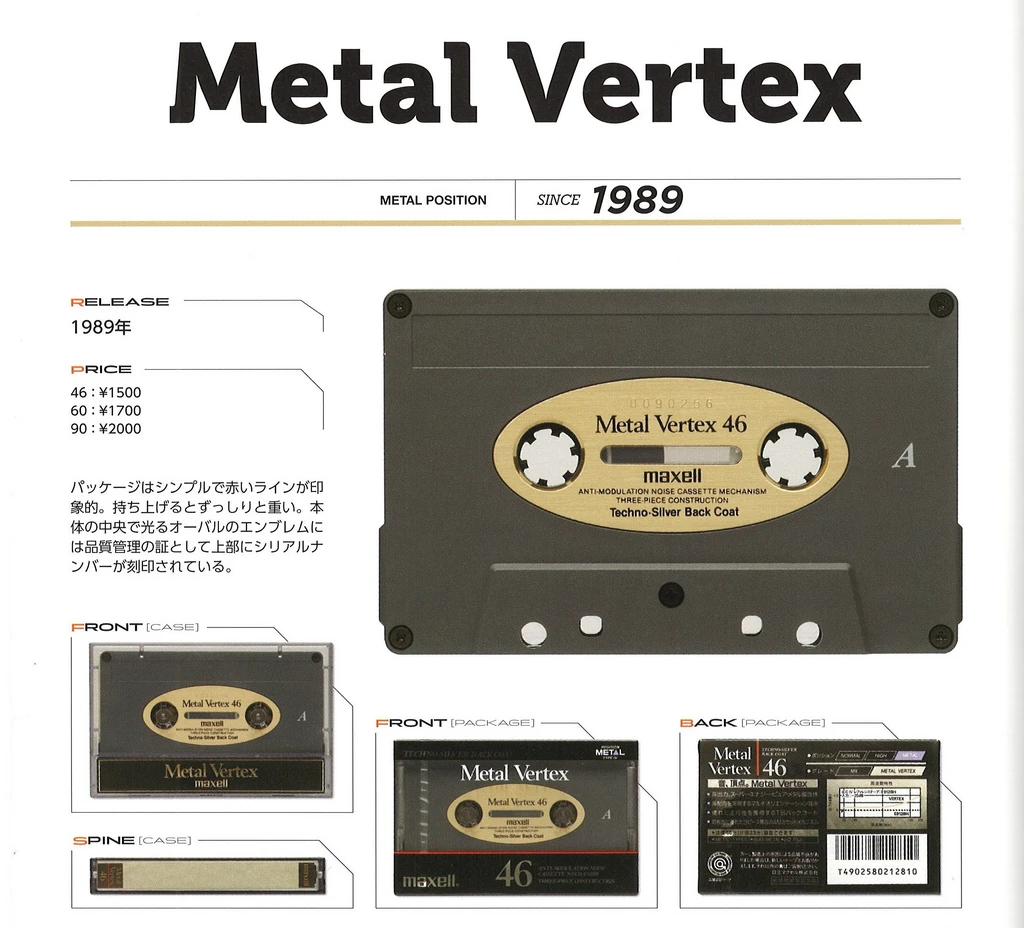
METAL VERTEX | METAL POSITION | FROM 1989
Prices at launch: 46 min - 1,500 yen, 60 min - 1,700 yen, 90 min - 2,000 yen.
The packaging follows a minimalist style with a distinctive red line. From the very first contact you feel the solid weight of the product. The shining gold oval in the center of the shell is not just a design element - it is also a mark of the highest quality control. The central emblem also serves as a vibration damper. The unique serial number is engraved in the lower part of the plate.
Metal Vertex was introduced in 1989 as a “Natural Mutation” - the pinnacle of Maxell cassette evolution. The concept was built around “ultra-low modulation noise” and “ultra-wide dynamic range” technologies. Thanks to its outstanding characteristics, the product was classified by the COCOM committee as a strategic material.
Technical specifications:
| Parameter | Value |
|---|---|
| Magnetic layer | Super Energy Pure Metal |
| Coating | Techno-Silver back-coat |
| Base | Ultra-smooth SSS film |
| Coercivity | 95 kA/m (1200 Oe) |
| Squareness ratio | 0.90 |
| Sensitivity (315 Hz) | +1.0 dB |
| Sensitivity (10 kHz) | +3.0 dB |
| MOL (315 Hz) | +7.5 dB |
| Pause noise | -57.0 dB* |
Compared to IEC Type IV reference tape
The tape uses the Super Energy Metal magnetic formulation with particle size 0.3 micron. Parallel Bundling (PB) technology ensures ideal particle orientation and maximum packing density. Compared to the MX model, output level increased by 1.0% and distortion decreased by 40%.
The cassette shell has a unique three-component structure. The primary material is a specially developed “Techno-Silver Metal” with a specific gravity twice that of ordinary plastic. The central gold emblem is mounted through a dedicated damping layer, acting as a counterweight to suppress any residual resonances. Despite the high price, Metal Vertex production ran at a loss due to the incredible complexity and the use of engineers doing manual assembly work.