



Part 1. Cassette tapes
The history of Japanese cassette tapes began in 1966. We trace that history from its beginnings to its heyday.
For most cassette release years in this book, the editors made their own estimates using the publication dates of magazine articles and advertisements, catalogues and other materials from the time. They may therefore differ from the actual release year by approximately one year in either direction. Prices in the Cassette Chronicle were also established through similar research. Please note that some cassette prices may have changed later.
Cassette chronicle 1971-1993
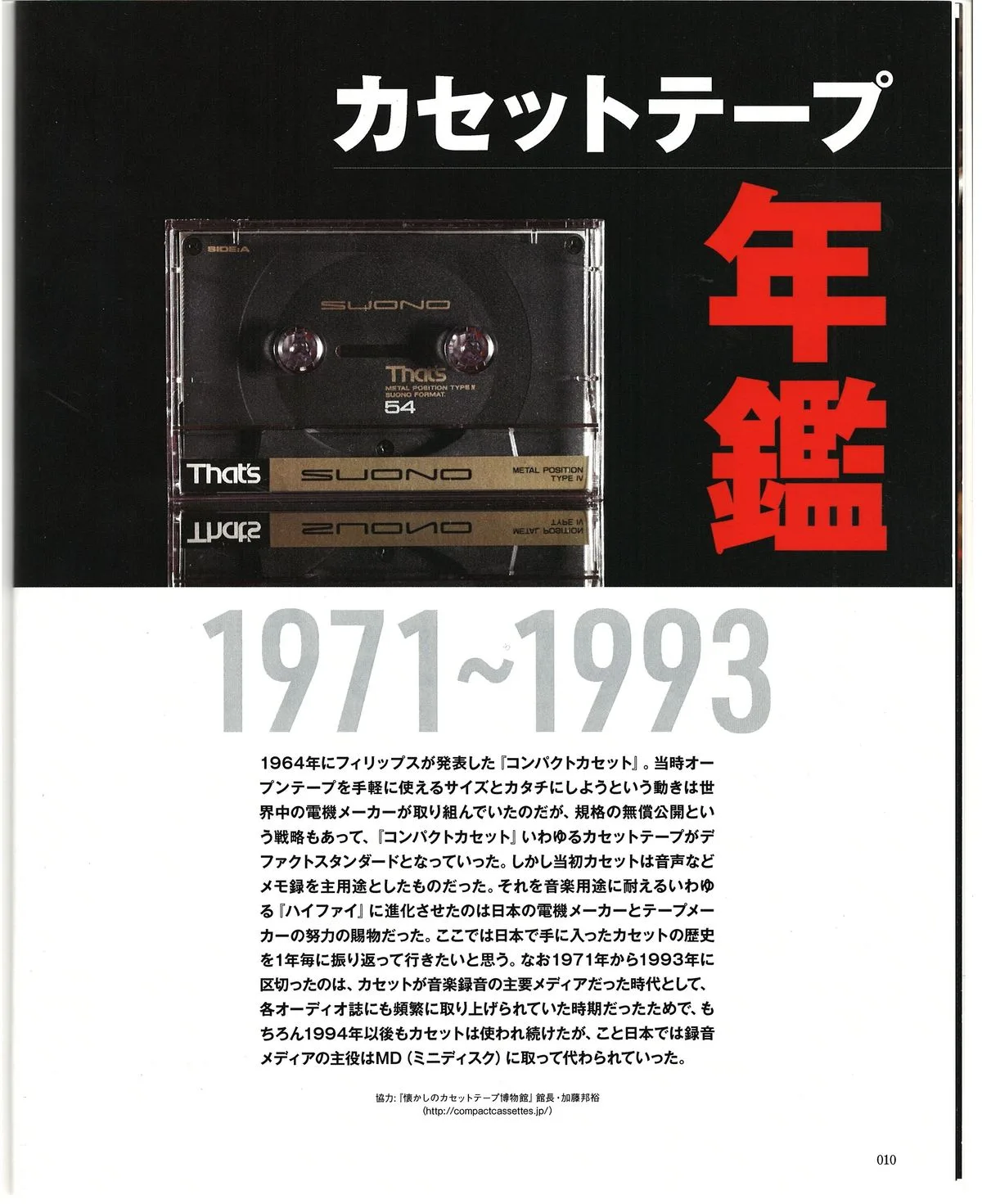
Philips introduced the Compact Cassette in 1964. At the time, electrical equipment manufacturers around the world were working to make reel-to-reel tape more convenient in size and form. Thanks in part to the strategy of making the standard freely available, the Compact Cassette became the de facto standard. At first, however, it was intended primarily for speech and other voice recordings. It owes its transformation into a hi-fi medium suitable for music to the efforts of Japanese manufacturers of electrical equipment and magnetic tape. Here we look back year by year at the history of cassettes available in Japan. The period from 1971 to 1993 was chosen because cassettes were then the main medium for recording music and were frequently covered by audio magazines. Cassettes continued to be used after 1994, of course, but in Japan the MD (MiniDisc) gradually took over as the main recording medium.
With the assistance of Kato (加藤邦裕), director of the Nostalgic Cassette Tape Museum (懐かしのカセットテープ博物館): http://compactcassettes.jp/
1971
In the days of reel-to-reel tape recorders, music lovers reportedly found it particularly inconvenient to interrupt listening partway through a recording. If they wanted to stop, they could not put the tape away until it had been wound completely onto one reel. A cassette, by contrast, could easily be removed from the recorder in the middle of a recording. When cassettes first appeared, it was this convenience that attracted attention, and recording was mainly monophonic. The arrival of stereo recorders and the 1968 release of TDK SD, a tape made specifically for music, contributed greatly to the cassette’s acceptance as a music medium. Audio magazines began covering cassettes in the 1970s, and by 1971, when various companies had released chrome ハイポジション (high-position) tapes, the cassette had established itself as a music medium. At the time, the basic grade was called “standard”, the better grade “low noise”, and the next grade up “hi-fi” or “LH”.
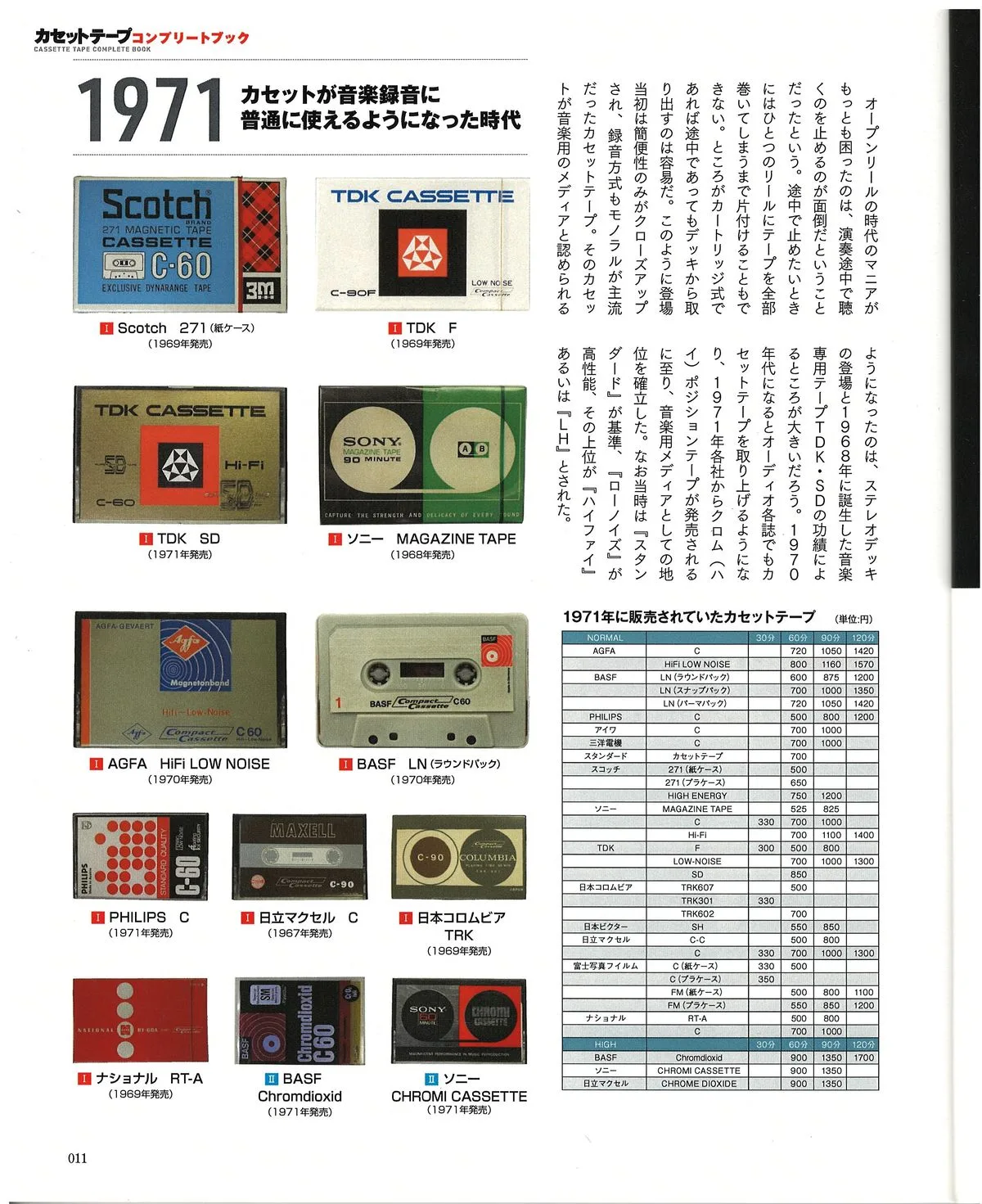
Notes from photo captions: Scotch 271, paper case (released 1969); TDK F (1969); TDK SD (1971); Sony MAGAZINE TAPE (1968); AGFA HiFi LOW NOISE (1970); BASF LN, round case (1970); PHILIPS C (1971); Hitachi Maxell C (1967); Nippon Columbia TRK (1969); National RT-A (1969); BASF Chromdioxid (1971); Sony CHROMI CASSETTE (1971).
Cassettes released in 1971 (prices in yen)
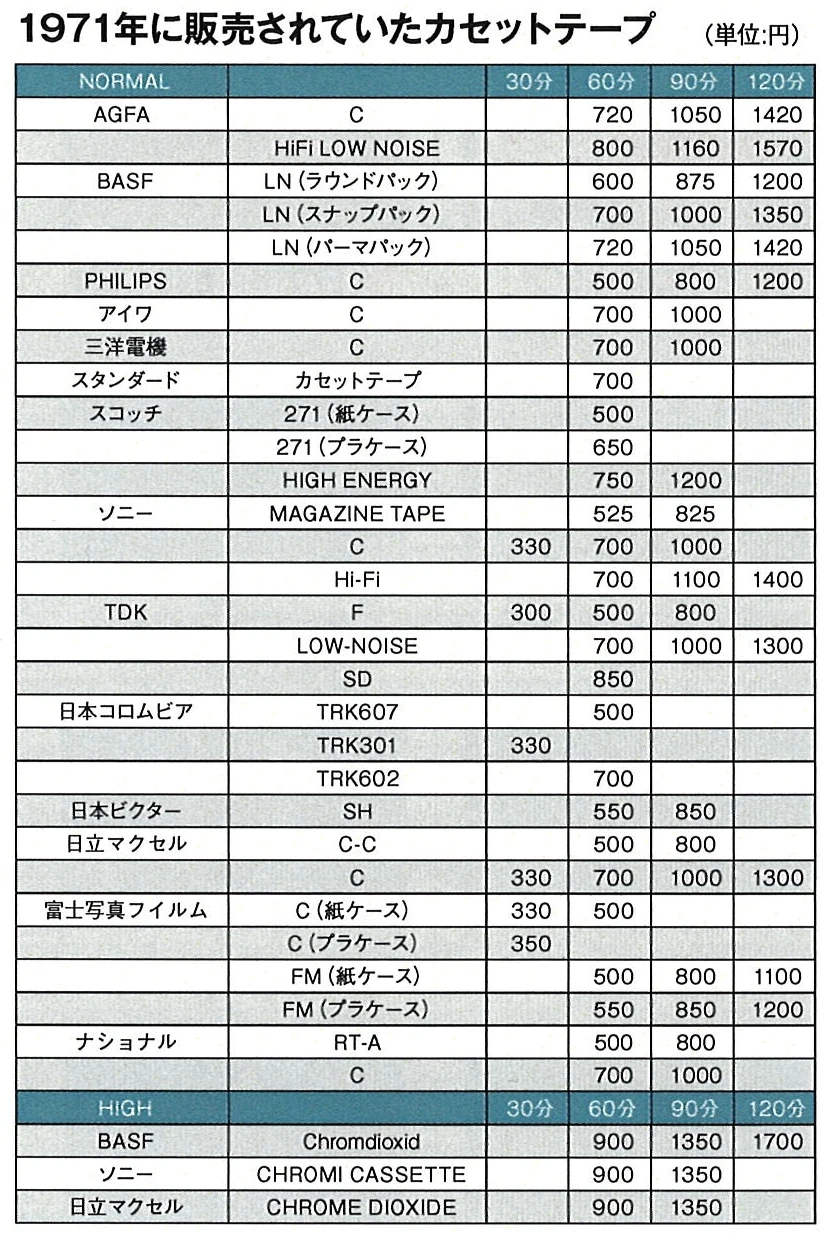
NORMAL
| Brand | Model | 30 | 60 | 90 | 120 |
|---|---|---|---|---|---|
| AGFA | C | 720 | 1050 | 1420 | |
| HiFi LOW NOISE | 800 | 1160 | 1570 | ||
| BASF | LN (round case) | 600 | 875 | 1200 | |
| LN (スナップパック, snap case) | 700 | 1000 | 1350 | ||
| LN (パーマパック, case type) | 720 | 1050 | 1420 | ||
| PHILIPS | C | 500 | 800 | 1200 | |
| AIWA | C | 700 | 1000 | ||
| Sanyo | C | 700 | 1000 | ||
| Standard | cassette tape | 700 | |||
| Scotch | 271 (paper case) | 500 | |||
| 271 (plastic case) | 650 | ||||
| HIGH ENERGY | 750 | 1200 | |||
| Sony | MAGAZINE TAPE | 525 | 825 | ||
| C | 330 | 700 | 1000 | ||
| HI-FI | 700 | 1100 | 1400 | ||
| TDK | F | 300 | 500 | 800 | |
| LOW-NOISE | 700 | 1000 | 1300 | ||
| SD | 850 | ||||
| Nippon Columbia | TRK607 | 500 | |||
| TRK301 | 330 | ||||
| TRK602 | 700 | ||||
| Victor | SH | 550 | 850 | ||
| Hitachi Maxell | C-C | 500 | 800 | ||
| C | 330 | 700 | 1000 | 1300 | |
| Fuji Photo Film | C (paper case) | 330 | 500 | ||
| C (plastic case) | 350 | ||||
| FM (paper case) | 500 | 800 | 1100 | ||
| FM (plastic case) | 550 | 850 | 1200 | ||
| National | RT-A | 500 | 800 | ||
| C | 700 | 1000 |
HIGH
| Brand | Model | 30 | 60 | 90 | 120 |
|---|---|---|---|---|---|
| BASF | Chromdioxid | 900 | 1350 | 1700 | |
| Sony | CHROMI CASSETTE | 900 | 1350 | ||
| Hitachi Maxell | CHROME DIOXIDE | 900 | 1350 |