



Chrome tape uses chromium dioxide (CrO2), developed by the American company DuPont, as its magnetic material. Another material was also considered for ハイポジション (high-position) tapes: the iron oxide used in normal tapes, with cobalt added to increase coercivity. Most manufacturers chose chromium dioxide, however, because it suffered less demagnetisation from pressure and friction and had better high-frequency characteristics. Technologies were then developed to control demagnetisation through the degree of oxidation of iron oxide and to change coercivity through the distribution of cobalt. Finally, TDK succeeded in releasing the first cobalt high-position tape, SA. Another advantage of cobalt magnetic material was that no patent royalties had to be paid to DuPont, allowing a lower price. Cobalt tapes subsequently became predominant among high-position tapes in Japan.
Fuji Film released FX Duo, an improved version of the previous year’s FX. Like FX, it used ピュアフェリックス (Pure-Ferrix) magnetic material, but デュアルコーティング (dual coating) was said to give it a denser sound. The following year, 1976, the company released FX Jr, one grade below FX. This made the Pure-Ferrix tape range a three-tier lineup.
Among overseas brands, Scotch and BASF completely redesigned their packaging. Both brands frequently changed designs, probably in connection with the presentation used in their home markets, but this year both moved to simpler packaging.
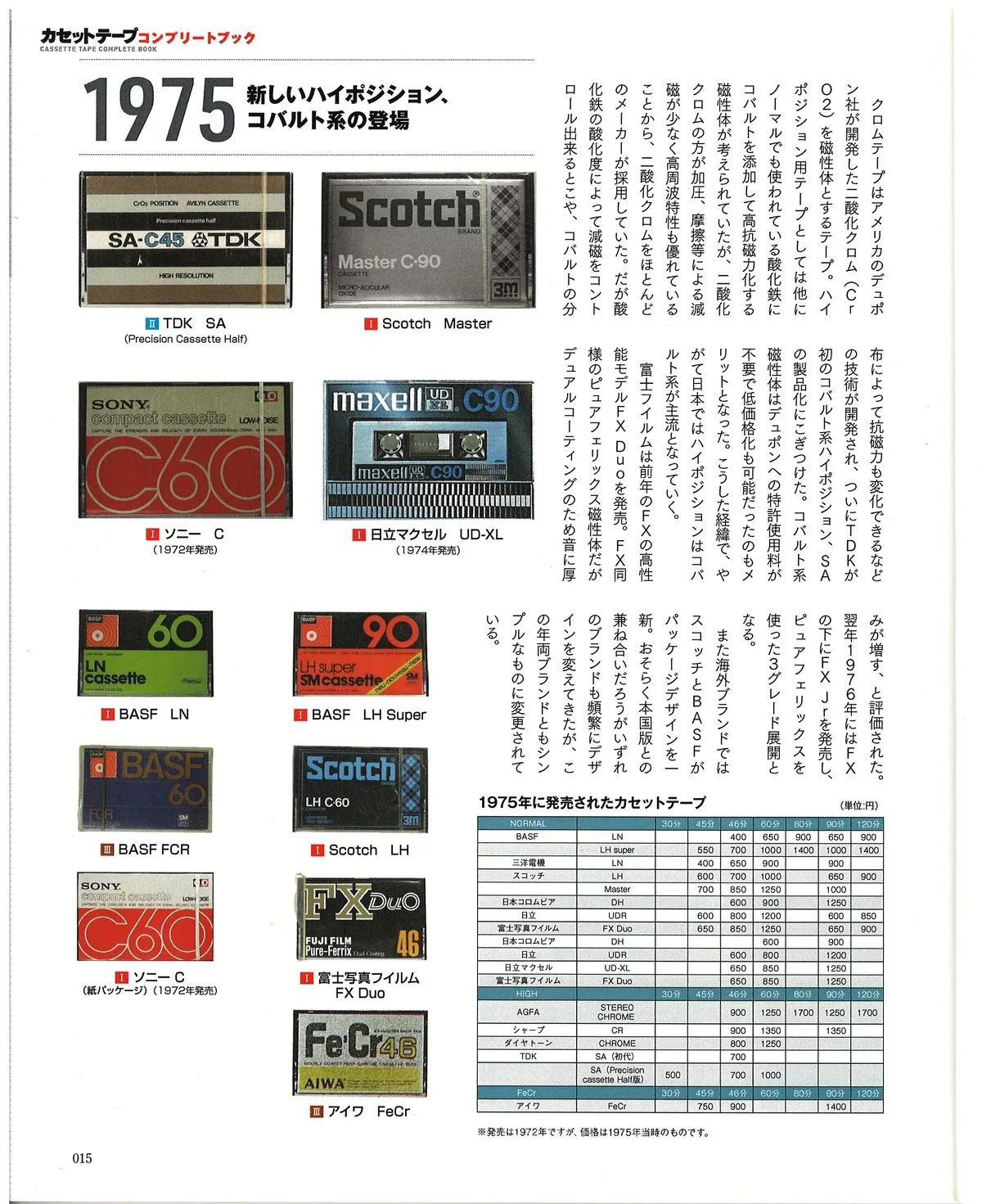
Notes from photo captions: TDK SA (Precision Cassette Half); Sony C (released 1972); Hitachi Maxell UD-XL (released 1974); Sony C, paper packaging (released 1972).
Cassettes released in 1975 (prices in yen)
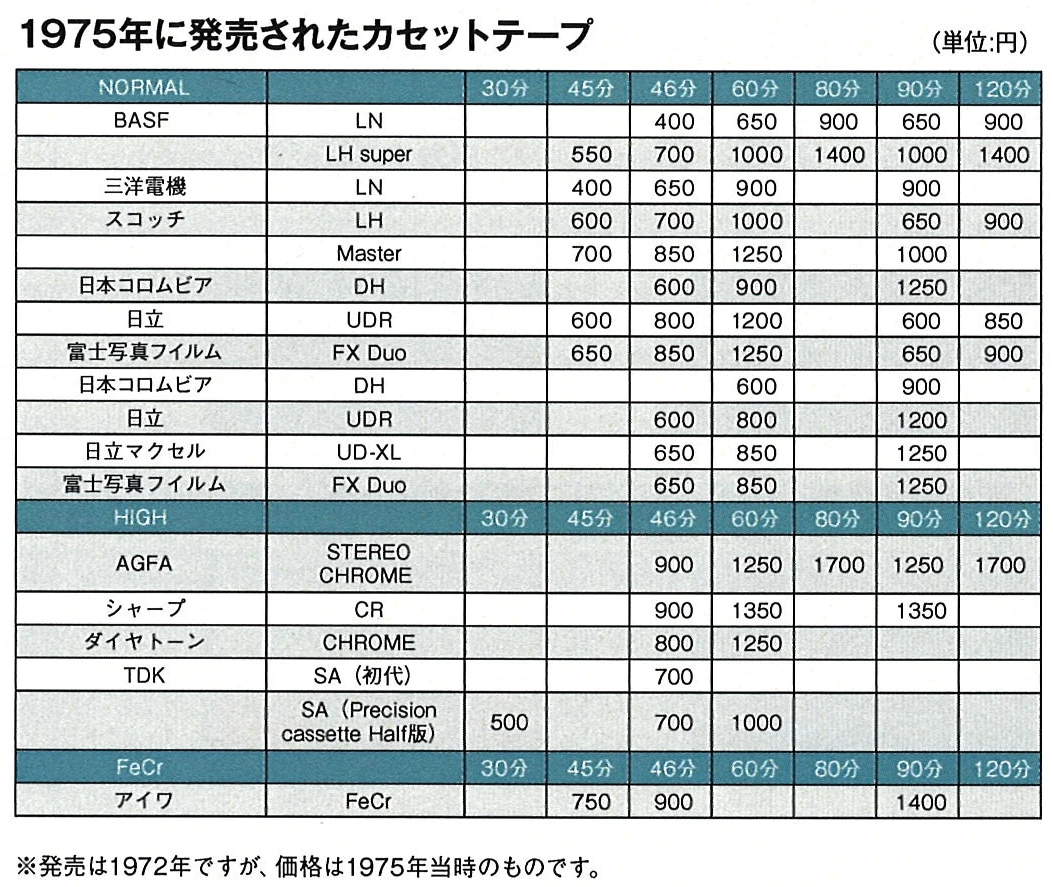
NORMAL
| Brand | Model | 30 | 45 | 46 | 60 | 80 | 90 | 120 |
|---|---|---|---|---|---|---|---|---|
| BASF | LN | 400 | 650 | 900 | 650 | 900 | ||
| LH super | 550 | 700 | 1000 | 1400 | 1000 | 1400 | ||
| Sanyo | LN | 400 | 650 | 900 | 900 | |||
| Scotch | LH | 600 | 700 | 1000 | 650 | 900 | ||
| Master | 700 | 850 | 1250 | 1000 | ||||
| Nippon Columbia | DH | 600 | 900 | 1250 | ||||
| Hitachi | UDR | 600 | 800 | 1200 | 600 | 850 | ||
| Fuji Photo Film | FX Duo | 650 | 850 | 1250 | 650 | 900 | ||
| Nippon Columbia | DH | 600 | 900 | |||||
| Hitachi | UDR | 600 | 800 | 1200 | ||||
| Hitachi Maxell | UD-XL | 650 | 850 | 1250 | ||||
| Fuji Photo Film | FX Duo | 650 | 850 | 1250 |
HIGH
| Brand | Model | 30 | 45 | 46 | 60 | 80 | 90 | 120 |
|---|---|---|---|---|---|---|---|---|
| AGFA | STEREO CHROME | 900 | 1250 | 1700 | 1250 | 1700 | ||
| Sharp | CR | 900 | 1350 | 1350 | ||||
| Diatone | CHROME | 800 | 1250 | |||||
| TDK | SA (first generation) | 700 | ||||||
| SA (Precision Cassette Half version) | 500 | 700 | 1000 |
FeCr
| Brand | Model | 30 | 45 | 46 | 60 | 80 | 90 | 120 |
|---|---|---|---|---|---|---|---|---|
| AIWA | FeCr | 750 | 900 | 1400 |
※ The cassette was released in 1972, but prices are as of 1975.