

GO Way Jump: National portable headphone stereos
National and Panasonic fought Walkman for market share, especially in North America. Rather than one permanent name, the company used One More, Way, GO and Jump; after the S series appeared in 1989 these names disappeared. The range remained inventive and broad until the end.
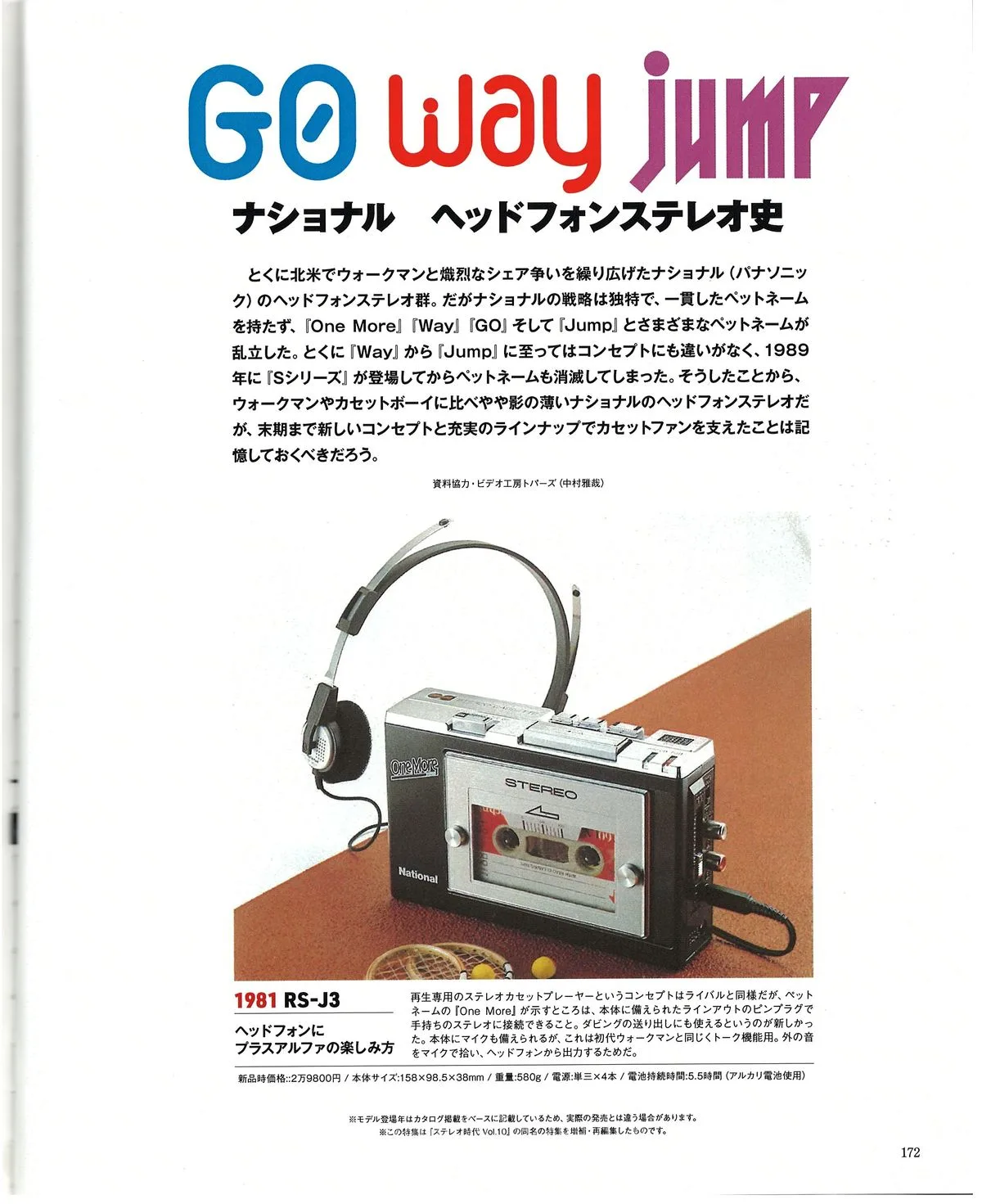
The 1981 RS-J3 One More connected to an existing stereo through a line output and could act as a dubbing source. RQ-J9 (1982) brought Metal playback to the first Way, while RQ-J6 added a stereo microphone. RX-1960 combined Metal recording and playback with FM/AM radio and small speakers.


World Way models RQ-SJ1, RQ-WJ1 and RQ-KJ1 shared a mechanism but used different designs. RQ-J36 offered stereo recording at a lower price, and RQ-J2 brought five colours. RQ-R2 and RQ-R1 introduced fashionable auto-reverse, while RX-S40 used Direct Drive and reached cassette-case size.
Miniaturisation, batteries and new functions
National developed proprietary rechargeable packs, multi-band tuners, recording reverse, bass boost, Dolby B, remotes and search functions. The S series pursued thin bodies and long playback, while Chot Wave models targeted women with accessory-like styling. Panasonic later added shock-resistant designs and international synthesiser tuners.


By 2003 RQ-SX93F was effectively the last multifunction recording model, with three-band tuner, reverse recording, search, Dolby B and charging stand. RQ-SX59 in 2005 was the final headphone cassette player, by then competing with MD and iPod.