
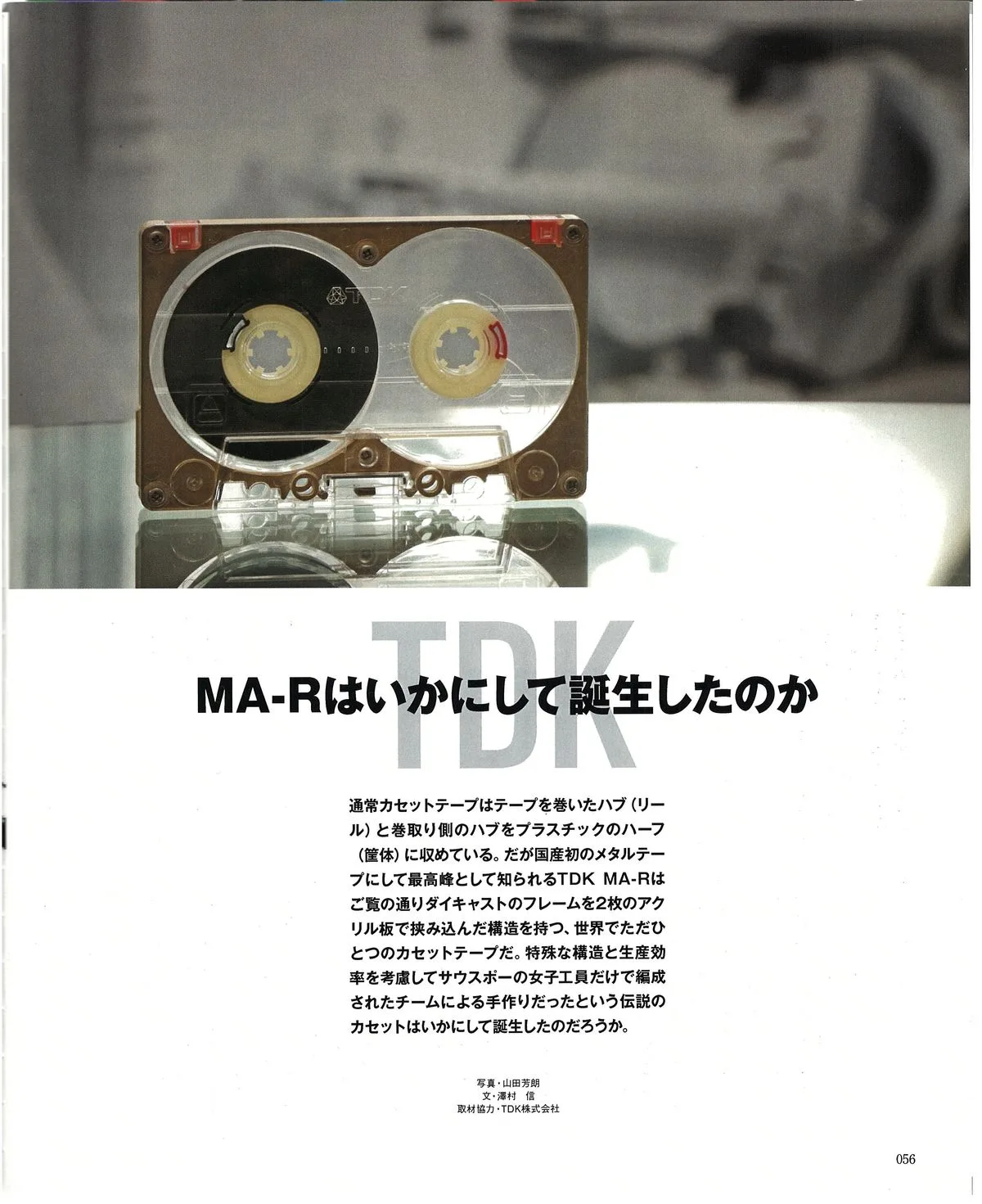
Usually the supply and take-up reels, with their tape, are enclosed in a plastic cassette shell. TDK MA-R, known as Japan’s first metal-powder cassette and the peak of the class, was different: a die-cast frame was clamped between two acrylic plates. It was the only cassette in the world with this construction. This is the story of how the legendary cassette was born.
Photo: Yoshiro Yamada (山田芳朗). Text: Makoto Sawamura (澤村信). With the cooperation of TDK Corporation.
A metal shell as a mass-produced product
“The construction was devised by a designer at TDK Design, a wholly owned TDK subsidiary,” recalls Takateru Sato (佐藤孝輝), then a developer in the technical department of TDK’s magnetic-tape division. The technical department had already used a custom aluminium “divine cassette” for analysing tape performance. Its guide-pin angle could be adjusted precisely, allowing the tape’s performance to be measured close to 100 percent.
The idea was to make a practical metal shell rather than produce that million-yen laboratory tool. Designer Uemura brought a mock-up, and development took about two and a half years, beginning in late 1977 or early 1978. Metal promised less friction than plastic and better long-term stability, especially at the tape guides. But metal brought its own difficulties.
The Philips Compact Cassette dimensions left almost no room for a frame sandwiched between acrylic plates. The standard shell is 100.4 mm long, 63.8 mm wide and 8.7 mm thick. The acrylic and die-cast part had to become extremely thin around the guide rollers and head window. Sato feared that a 0.9 mm zinc part could not be cast accurately.
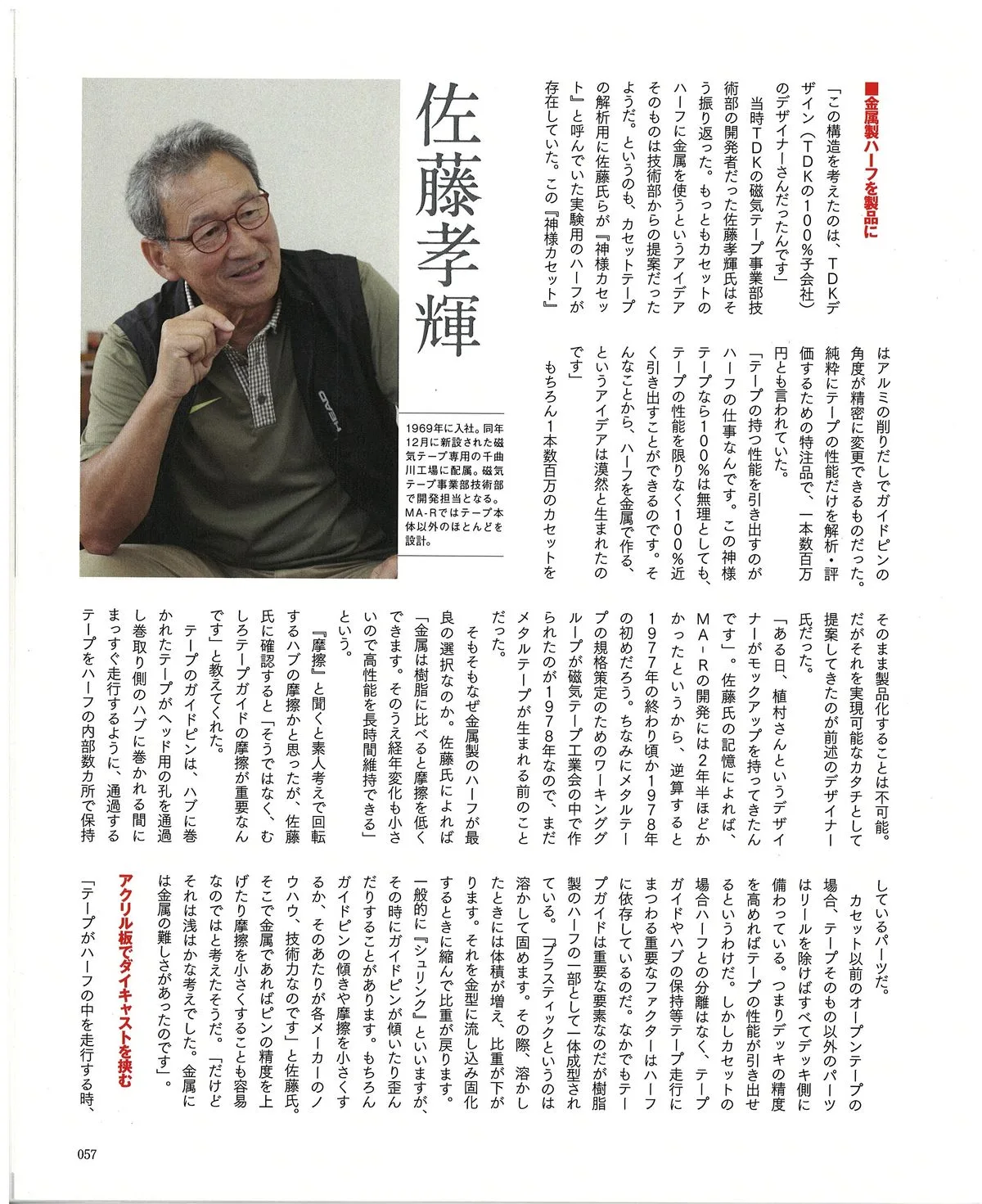
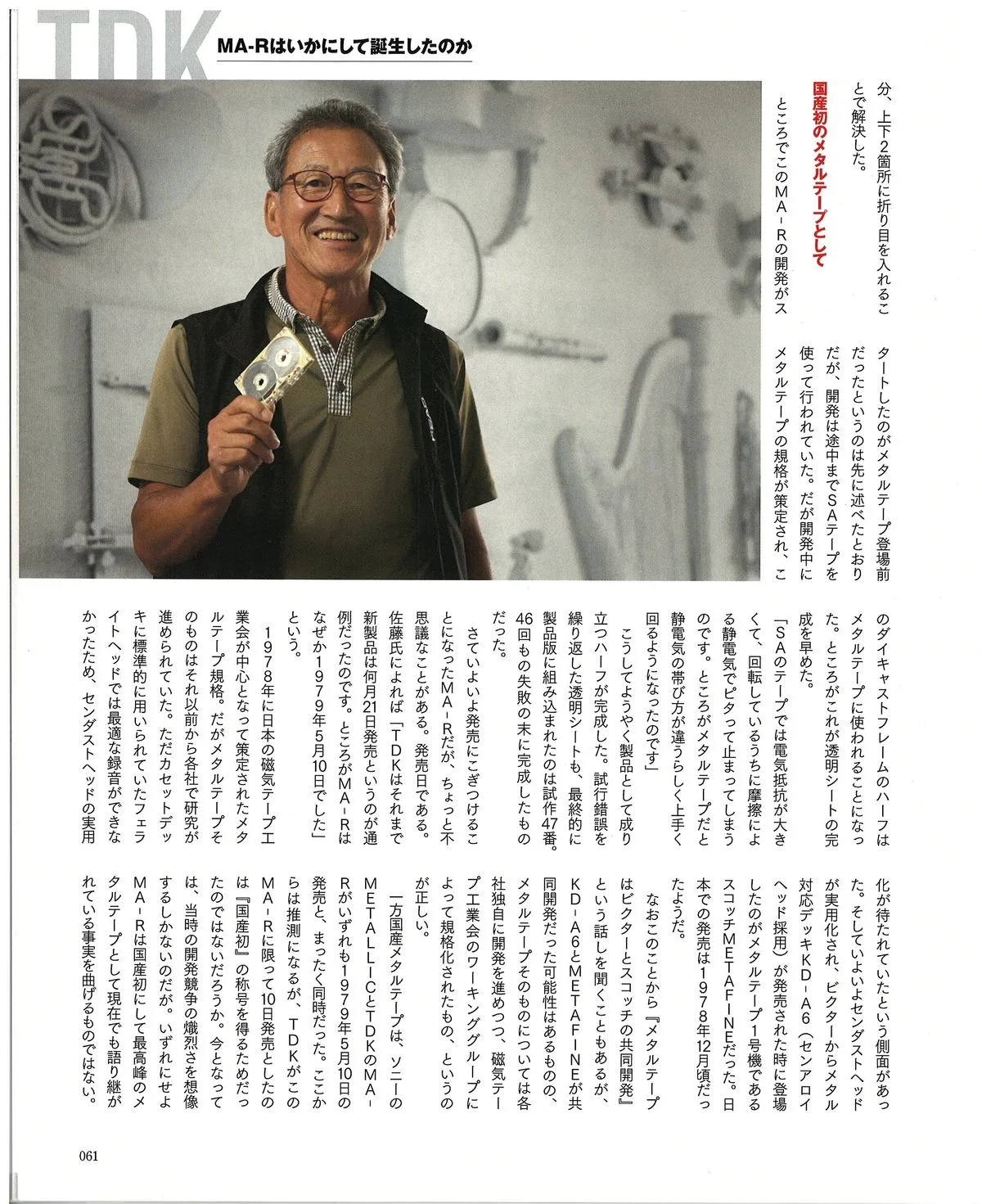
Sato joined TDK in 1969 and designed almost everything in MA-R except the tape itself.
The die-cast frame between acrylic plates
Six guides keep the tape straight through the shell. If a guide tilts, the tape shifts relative to the head, disturbing phase and, in severe cases, left-right balance. Die-casting offered a path to greater guide accuracy, but the complicated thin frame was hard to produce.
The frame was die-cast from zinc, not aluminium. Runners, gates, cold slug and overflow had to be removed, and the remaining burrs were polished away in a vibrating barrel with ceramic media. Too much processing bent the guide pins. The casting supplier repeatedly considered stopping, but TDK’s purchasing team persuaded it to continue.
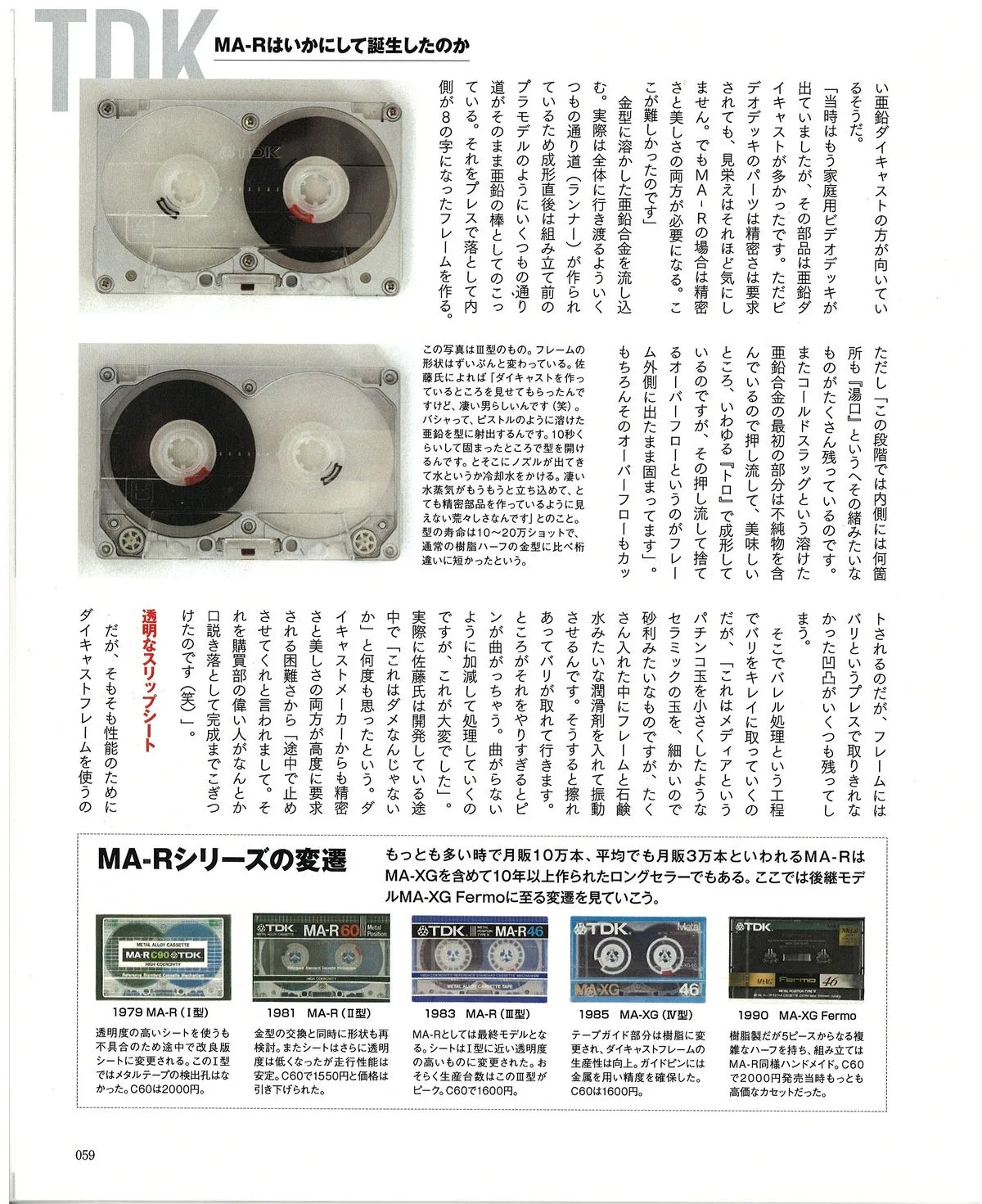
Evolution of the MA-R series
MA-R sometimes sold 100,000 units in a month and averaged about 30,000. Counting MA-XG, the family remained in production for more than ten years:
- 1979 MA-R type I: an extremely transparent slip sheet; C60 cost 2,000 yen.
- 1981 MA-R type II: a revised mould and construction stabilised tape movement; C60 fell to 1,550 yen.
- 1983 MA-R type III: the final model named MA-R, with a clearer sheet; C60 cost 1,600 yen.
- 1985 MA-XG type IV: plastic guides improved casting productivity and metal pins preserved accuracy; C60 cost 1,600 yen.
- 1990 MA-XG Fermo: a complex five-part plastic shell assembled by hand; C60 cost 2,000 yen.
The transparent sliding slip sheet
The thin slip sheet prevents the wound tape from touching the shell and keeps the reel centred. Early premium cassettes used graphite and Teflon, while TDK also used silicone-coated paper and carbon-filled ultra-high-molecular-weight polyethylene. These were opaque, so MA-R required a transparent material.
After testing polyester, polypropylene, cellophane, surfactants and silicone coatings, TDK settled on polyester with a silicone film. A very clear sheet could be scratched by the reels, and worn particles could cause signal loss. A slightly textured surface slid better, though it was less transparent. Two folds at the reel-contact areas solved the final problem.
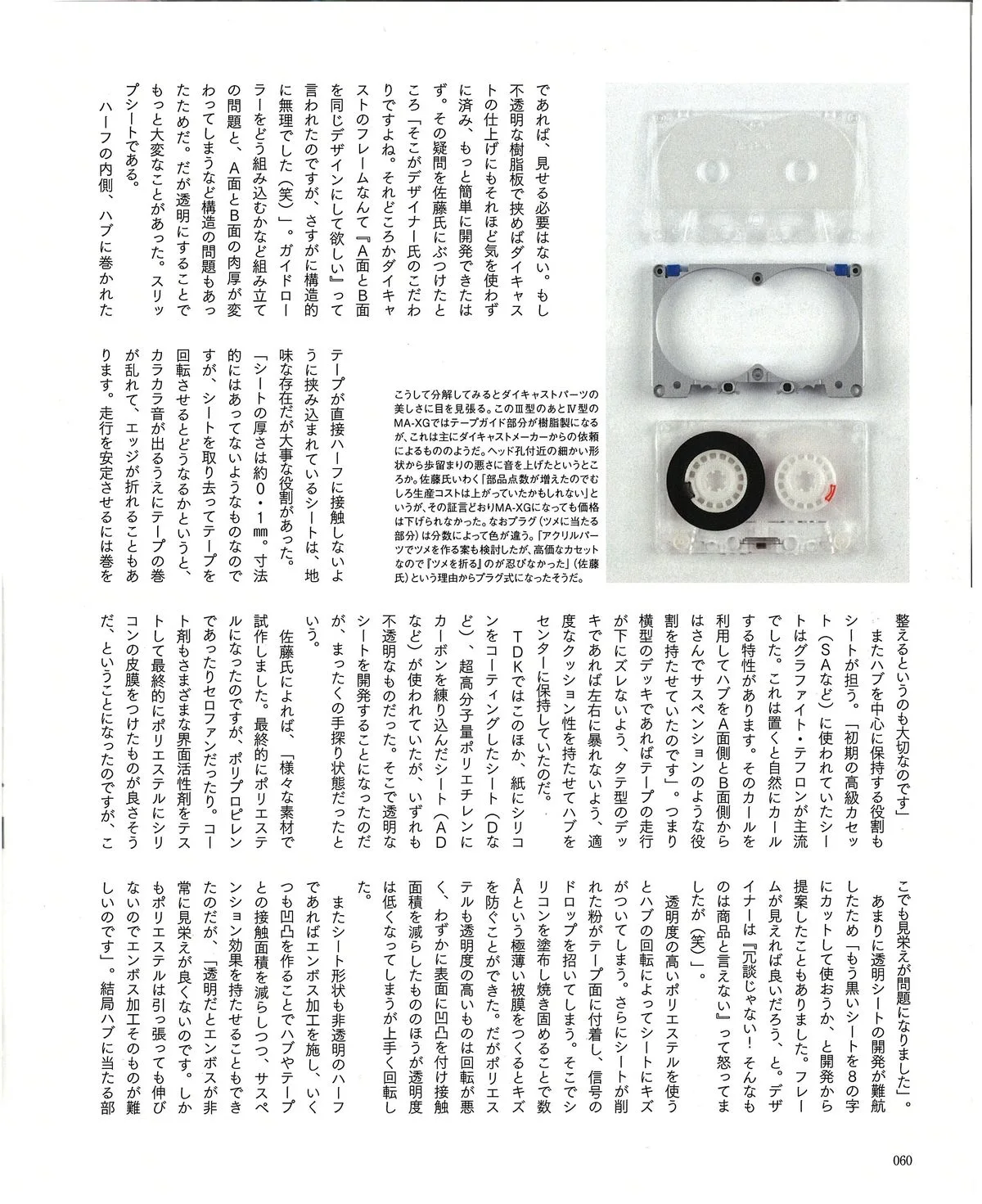
The beauty of the cast parts is striking when the cassette is disassembled. The change to plastic guides in MA-XG was probably requested by the casting supplier, since the intricate shape around the head opening produced too few usable parts. The coloured plugs replacing the write-protect tabs depended on cassette length.
Japan’s first metal-powder tape
MA-R development began before the metal-powder standard existed, so the team initially used SA tape. When the standard was adopted, TDK decided to use the die-cast frame for metal tape. The transparent sheet was the forty-seventh prototype, after 46 unsuccessful attempts.
The metal-powder standard was adopted in 1978 under the leadership of the Japanese Association of Magnetic Tape Manufacturers. Victor’s KD-A6 deck with a Sen-Alloy head and Scotch METAFINE were among the first practical products; METAFINE appears to have reached Japan around December 1978. Sony METALLIC and TDK MA-R then went on sale simultaneously on 10 May 1979. It is possible that TDK chose that date so MA-R could claim the title of Japan’s first metal-powder cassette. Whatever the rivalry, MA-R is still remembered as the first Japanese metal-powder cassette and the peak of its class.