
The text is laid out as a “footer” running under photos of the SONY Walkman themselves, so the translation is presented here with the source pages embedded - otherwise it’s too uncomfortable to read, you’d have to keep jumping back to the original book. The photo captions with model descriptions are also inserted in page order.
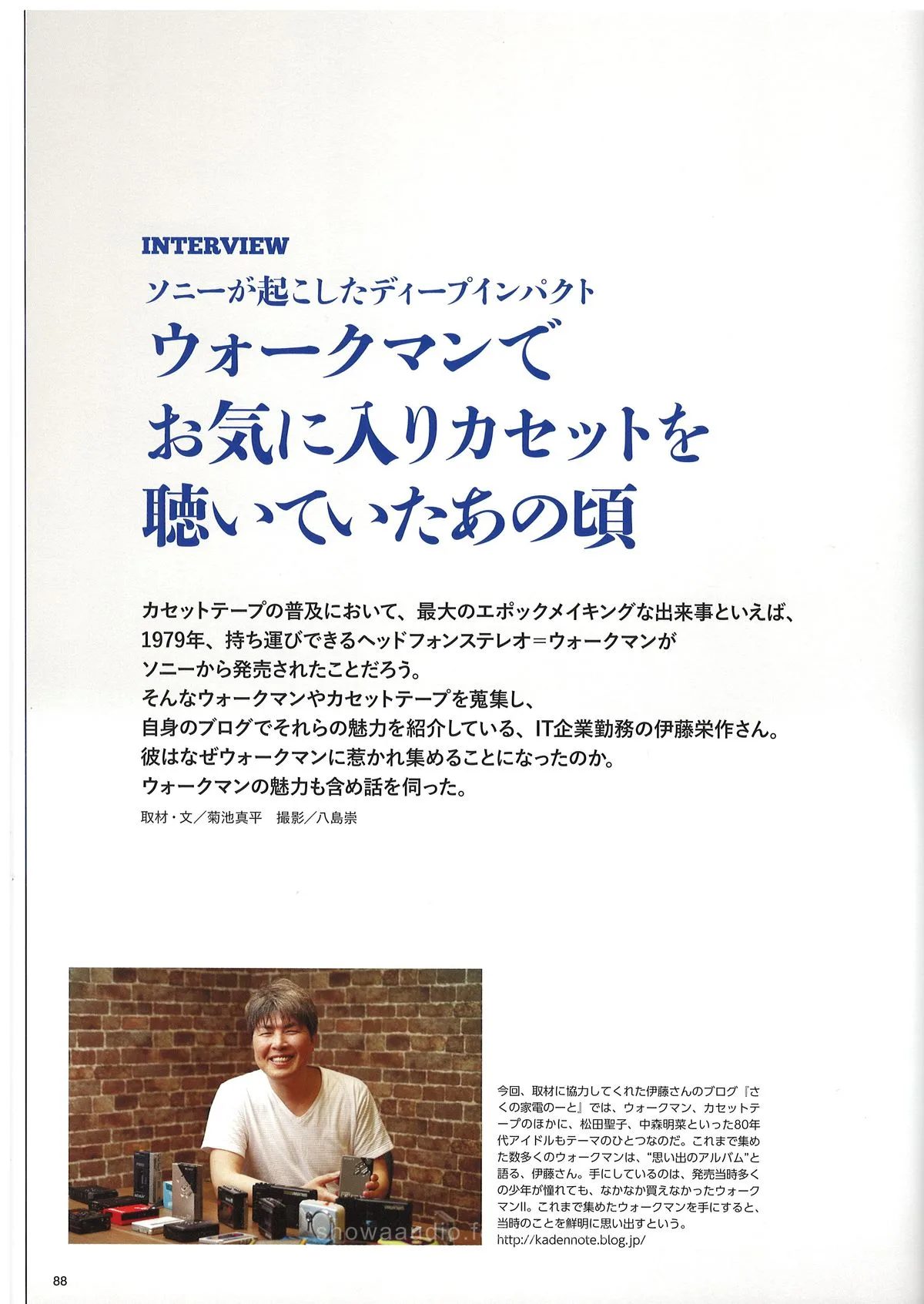
When people talk about the single most important moment in the spread of cassette tapes, it’s probably the release of the portable stereo Walkman by Sony in 1979. Eisaku Ito works in an IT company, collects these players and cassettes, and writes about what makes them special on his blog. What exactly hooked him on Walkman and pushed him to build a whole collection? We asked him to talk about what draws him to these devices and the memories behind them.
Our contributor Ito-san runs the blog “Electronics at Eisaku’s Place,” where alongside Walkman and cassette tapes he writes a lot about 1980s J-pop stars - Matsuda Seiko and Nakamori Akina. He calls his collection of players an “album of memories” - each one once sparked dreams in countless boys who couldn’t afford them. When Ito-san picks up another piece from his collection, the images of the past come back vividly.
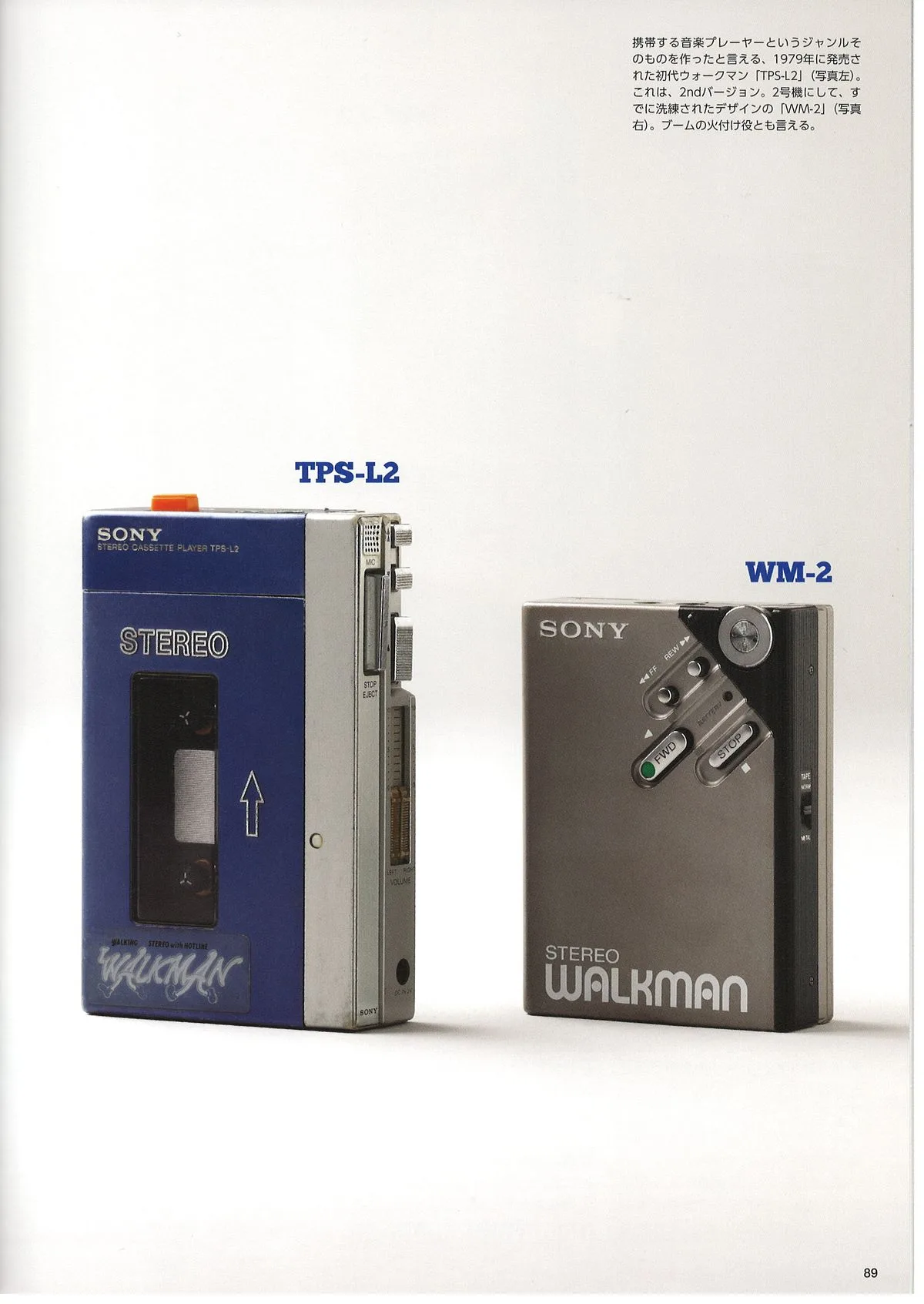
The portable music player that started it all - the first Walkman TPS-L2, released in 1979. This is the second generation, the WM-2, with its refined design, also known as the “player with ears.” It set the visual language that became a symbol of the era.
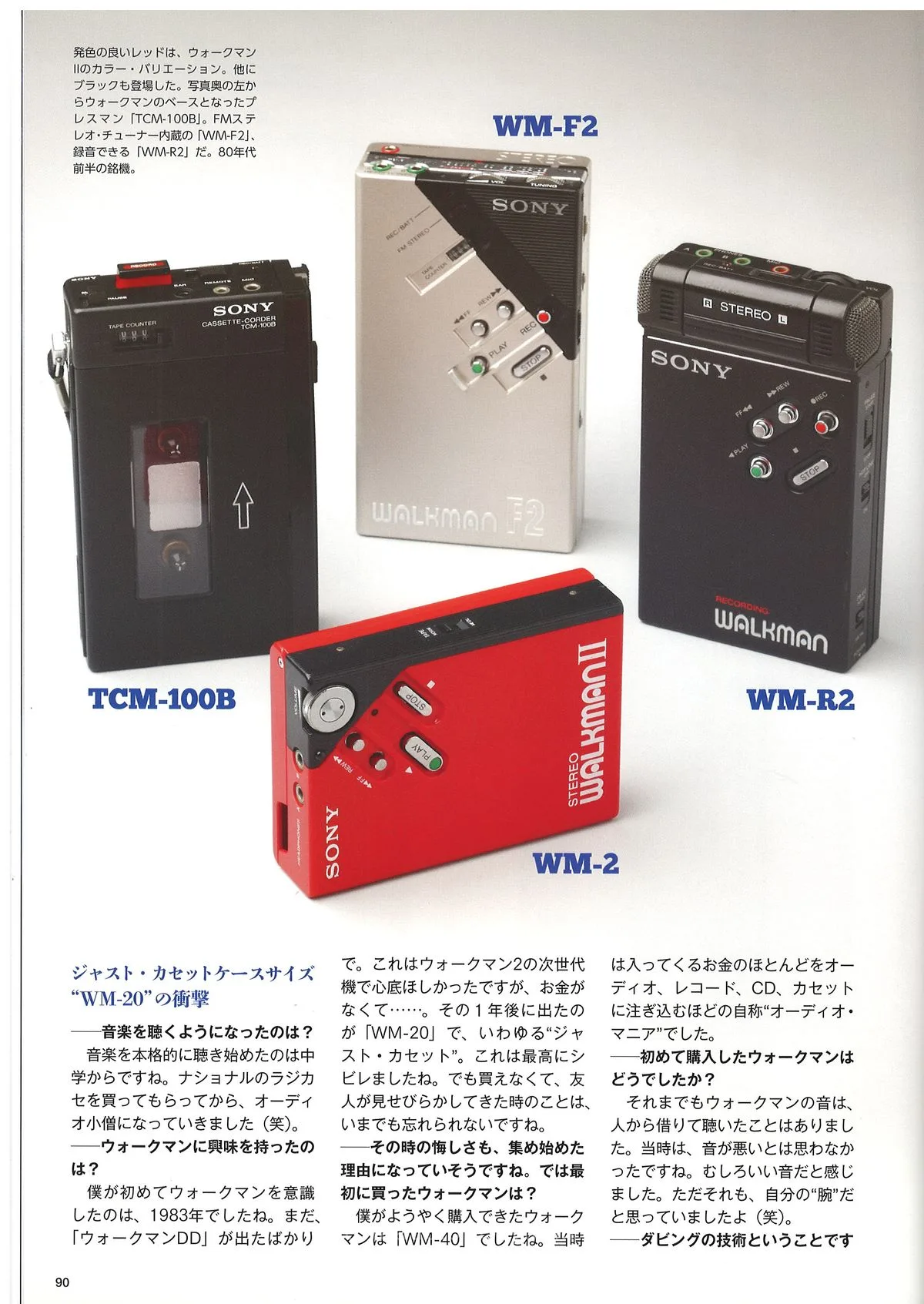
Red models - one of the color options for Walkman II. The black version was produced in parallel. TCM-100B was a compact cassette player that later became the foundation for the Walkman line. WM-F2 came with a built-in FM tuner, and WM-R2 supported recording. All three are defining devices from the first half of the 1980s.
Exactly the size of a cassette case: the shock of the WM-20
When did you first get into music seriously?
I started really listening in middle school. After my parents got me a National1 radio-cassette player, I quickly turned into a teenage audio fanatic (laughs).
When did you first notice Walkman?
I first paid attention to Walkman in 1983. The “Walkman DD” had just come out - the next generation after Walkman 2. I desperately wanted one but had no money at all… Then a year later the “WM-20” appeared, literally the size of a cassette. That was incredible. I couldn’t buy it either, and I still remember my friend showing it off in front of me.
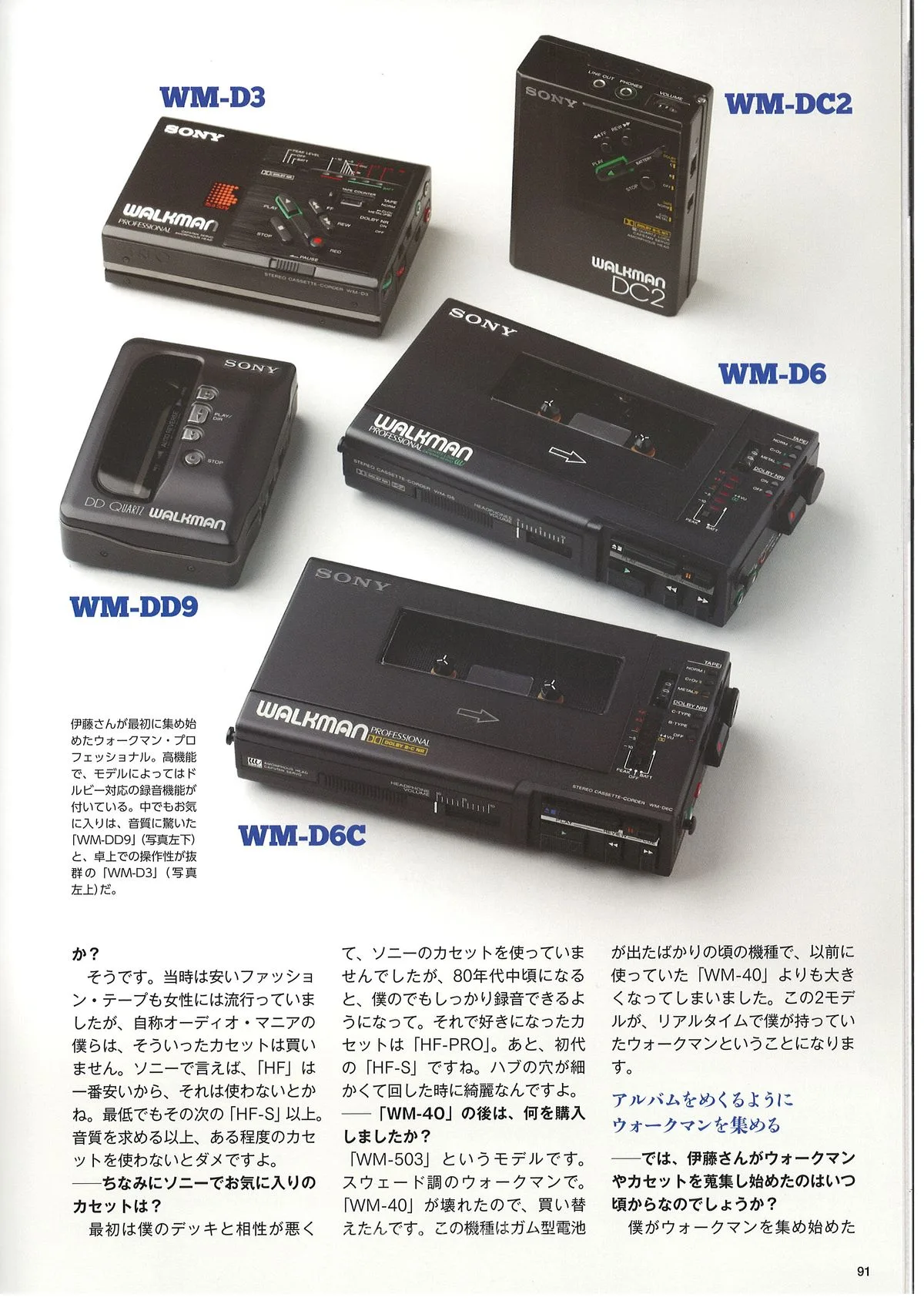
The first professional-grade Walkman that started Ito-san’s collection was a fully-featured model. Depending on the version, some units came with Dolby recording. Among his favorites are the WM-DD9 - with its reputation as a discerning listener - and the WM-D3, a legendary portable deck with flawless recording mechanics.
It sounds like that childhood frustration was part of what drove the collecting. So which Walkman was your first actual purchase?
The first player I finally managed to afford was the “WM-40.” At the time I was a total audio maniac - I spent almost everything on gear, records, CDs and cassettes.
And how was your first Walkman in practice?
Before that I’d borrowed players from friends, and the sound had never seemed bad to me. On the contrary, it was great. But I always thought it was thanks to my own “skill” (laughs).
You mean recording skill?
Exactly. At the time, girls were into cheap “fashion” cassettes in colorful shells, but we audiophiles never touched those. With Sony, the basic “HF” was considered too entry-level - we ignored it. Minimum was “HF-S” or above2. Getting good sound meant using tape at a certain level.
Speaking of which, what are your favorite Sony cassettes?
At first Sony cassettes didn’t match my deck well, so I wasn’t using them. But by the mid-80s that had sorted itself out. My favorite became “HF-PRO.” I also really loved the first version of “HF-S” - it had elegant openings in the hubs that looked beautiful spinning.
What did you buy after the WM-40?
The “WM-503” in a suede-style shell. I bought it to replace a broken WM-40. The 500-series was where Sony started using flat rechargeable batteries (the so-called “gum” packs3), which made it slightly larger than my previous player. Those two were the ones I owned in real time during those years.
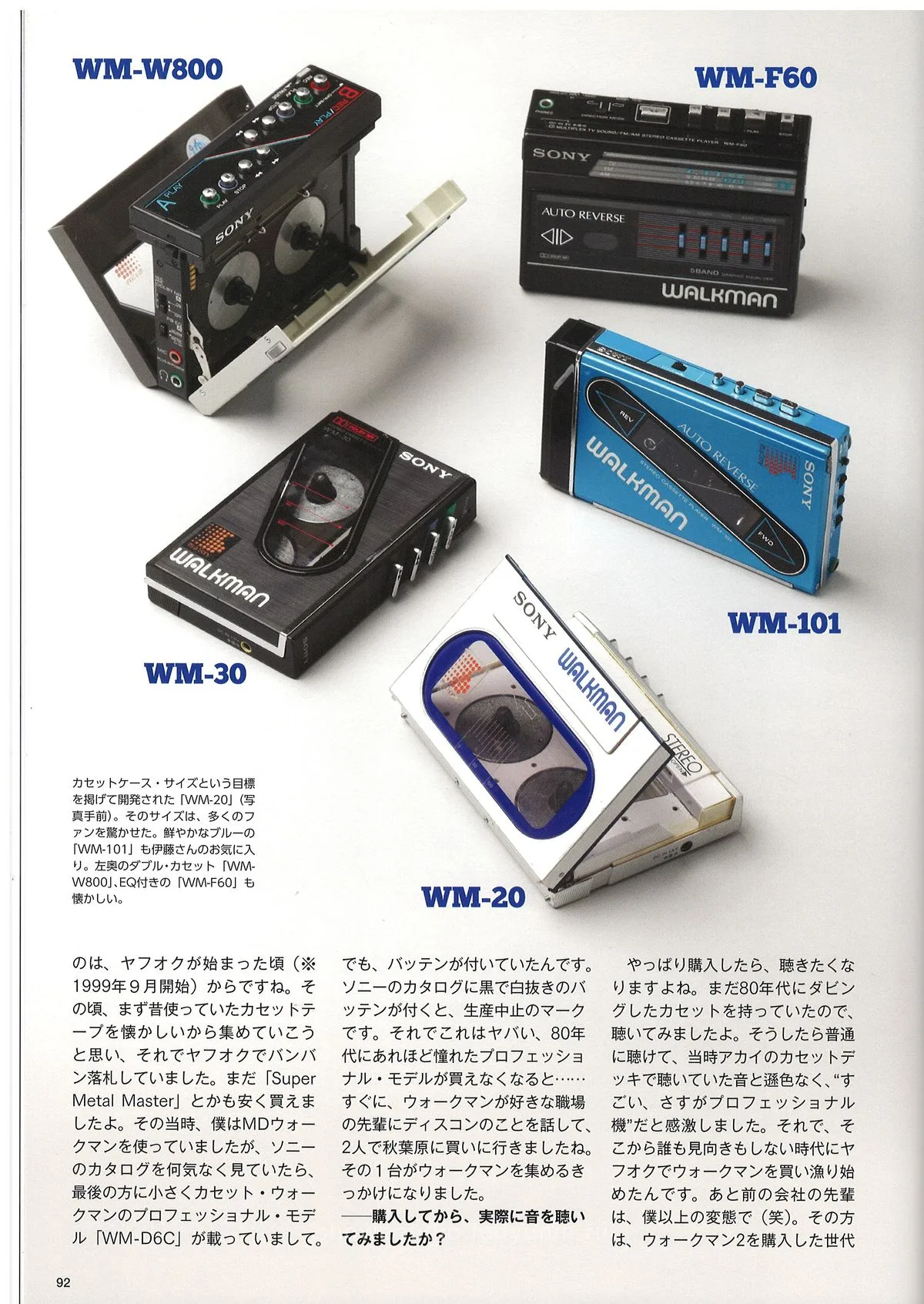
WM-20 - a player designed around the goal of maximum compactness. Its tiny size caused a sensation among Walkman fans. The fresh blue of the WM-101 is another favorite in Ito-san’s collection. WM-W800, a dual-cassette deck, and WM-F60 with a built-in equalizer are equally treasured.
Every player carries its own memories: how the collection grew
When did you start deliberately collecting Walkman and cassettes?
It all started with Yahoo! Auctions4 launching in September 1999. At first I just wanted to track down old cassettes from my youth for nostalgia - I was actively buying them at auction. Back then you could even pick up legendary Super Metal Master5 cassettes for almost nothing. I was using an MD player at the time, but one day while browsing a Sony catalog I spotted a small note at the very end about the professional cassette Walkman “WM-D6C.” Next to it was an icon - a white cross on a black background. In Sony catalogs that meant only one thing: the model was discontinued (discon6). I realized this was serious - a professional machine I’d been dreaming about since the 80s was about to disappear forever. I immediately talked my colleague - an equally obsessed player fanatic - into going with me, and we rushed to Akihabara7. That purchase was the starting point of my collection.
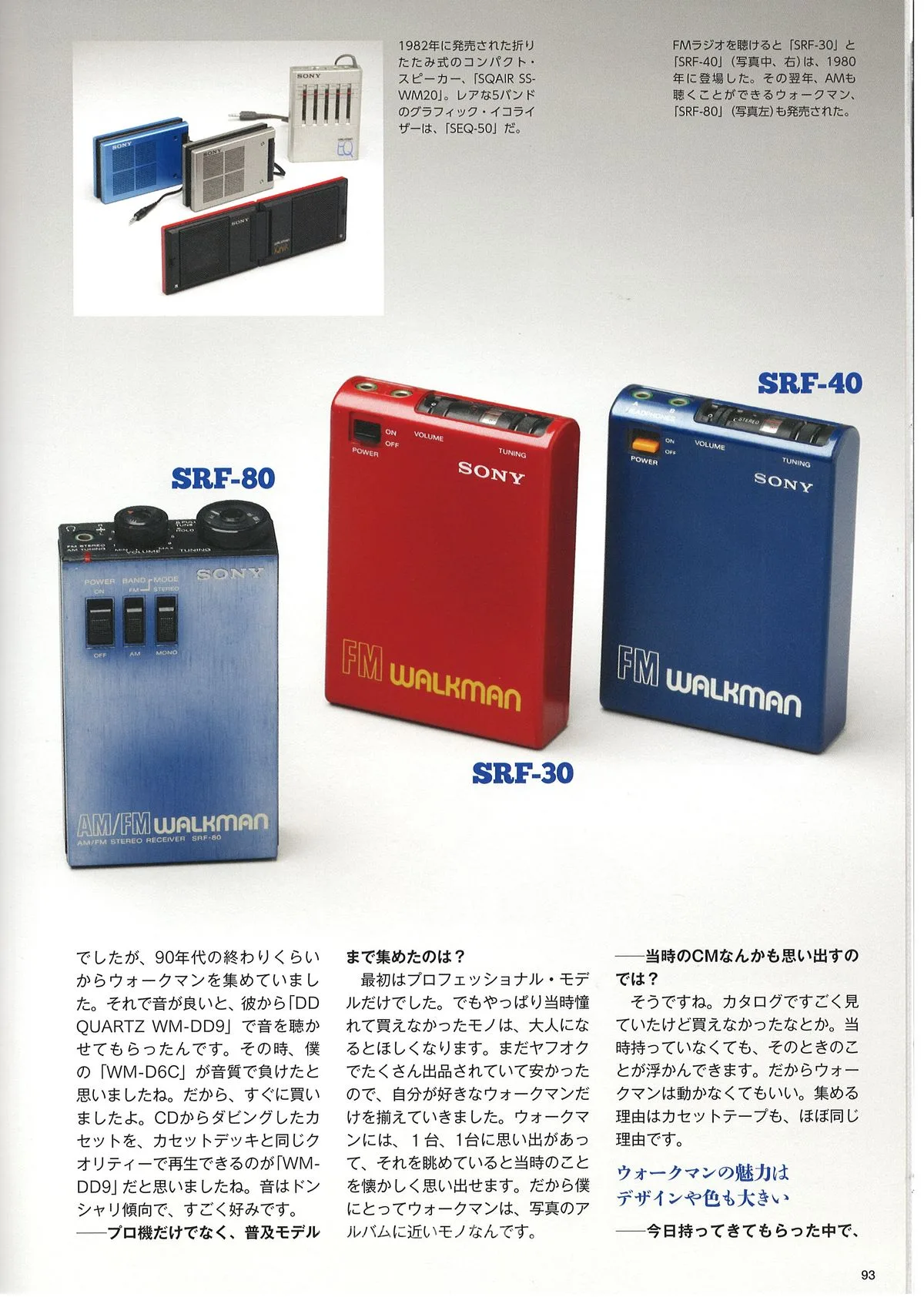
The compact folding speaker SQAIR SS-WM20, released in 1982. A rare five-band graphic equalizer SEQ-50 is another gem in his collection. Portable radios SRF-30 and SRF-40 went on sale in 1980. That same year the SRF-80 arrived - a Walkman with AM reception, letting people listen to radio on the go.
Did you listen to it after buying it?
Of course! I wanted to check the sound right away. I had tapes I’d recorded back in the 80s on an Akai deck. I played them and was stunned - the sound was every bit as good as stationary equipment. I was thrilled: “This thing is a real professional machine!” From that point I started buying players on Yahoo! Auctions during an era when nobody else cared about them. My colleague from that previous job turned out to be an even more obsessive enthusiast than me (laughs). He was from the generation that had bought Walkman 2, and had started building his collection in the late 90s. One day he let me listen to his “DD QUARTZ WM-DD9.” Right then I realized my WM-D6C was losing to it on playback quality. I immediately bought one myself. With the WM-DD9, tapes recorded from CD sounded as clean as on a home deck. It has that “don-shari”8 character - emphasized bass and highs - which I love.
Why did you start collecting mainstream models as well as professional ones?
At first I was only interested in the pros. But as you get older, you develop this desire to own things you desperately wanted but couldn’t afford when you were young. There were a lot of options at accessible prices at auction, and I started buying whatever I liked. For me every Walkman holds a piece of memory. Looking at them, I feel a pleasant wave of nostalgia for those years. The players are like pages in a photo album.
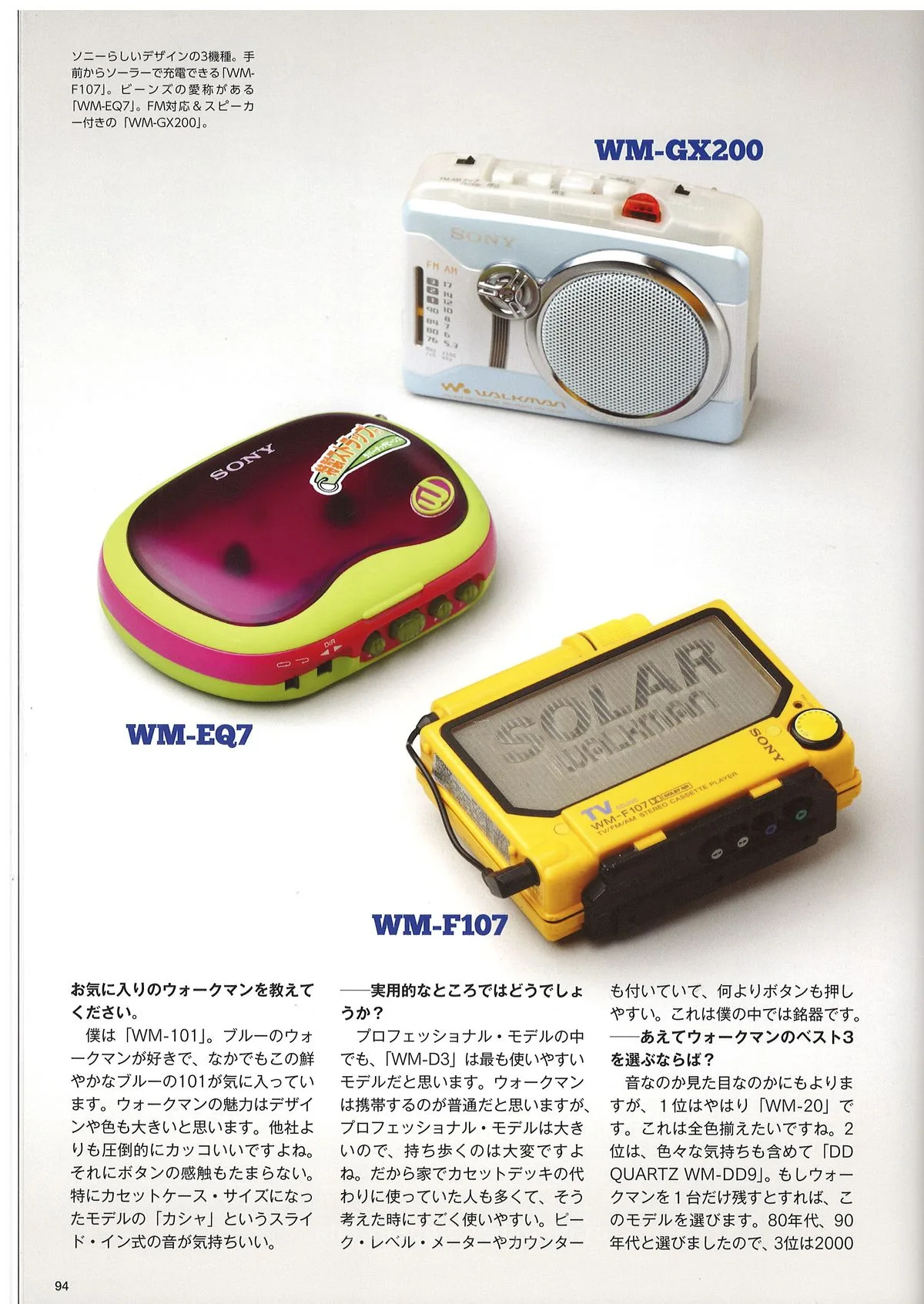
Three fine examples of the Sony style. WM-F107 pioneered solar charging for portable players. WM-EQ7 is a favorite among bass fans thanks to its built-in equalizer. WM-GX200 is a compact model with an FM tuner and built-in speakers.
Does the advertising from that era come back to you too?
Yes, absolutely. I remember poring over catalogs knowing I couldn’t buy any of it. Even if I didn’t own a specific model back then, it still brings up associations with that whole time. So I don’t even need the player to be working. Same goes for the cassettes.
Design and color - the real magic of Walkman
Of the models you brought in today, which is your favorite?
My favorite is the “WM-101.” I love blue players, and the bright blue of the 101 is just gorgeous. Design and color are a huge part of what makes Walkman appealing. They look miles ahead of anything competitors produced. And the tactile feel of the buttons? Pure joy. What I especially love is that characteristic click (kasha9) of the loading mechanism on the cassette-case-sized models.
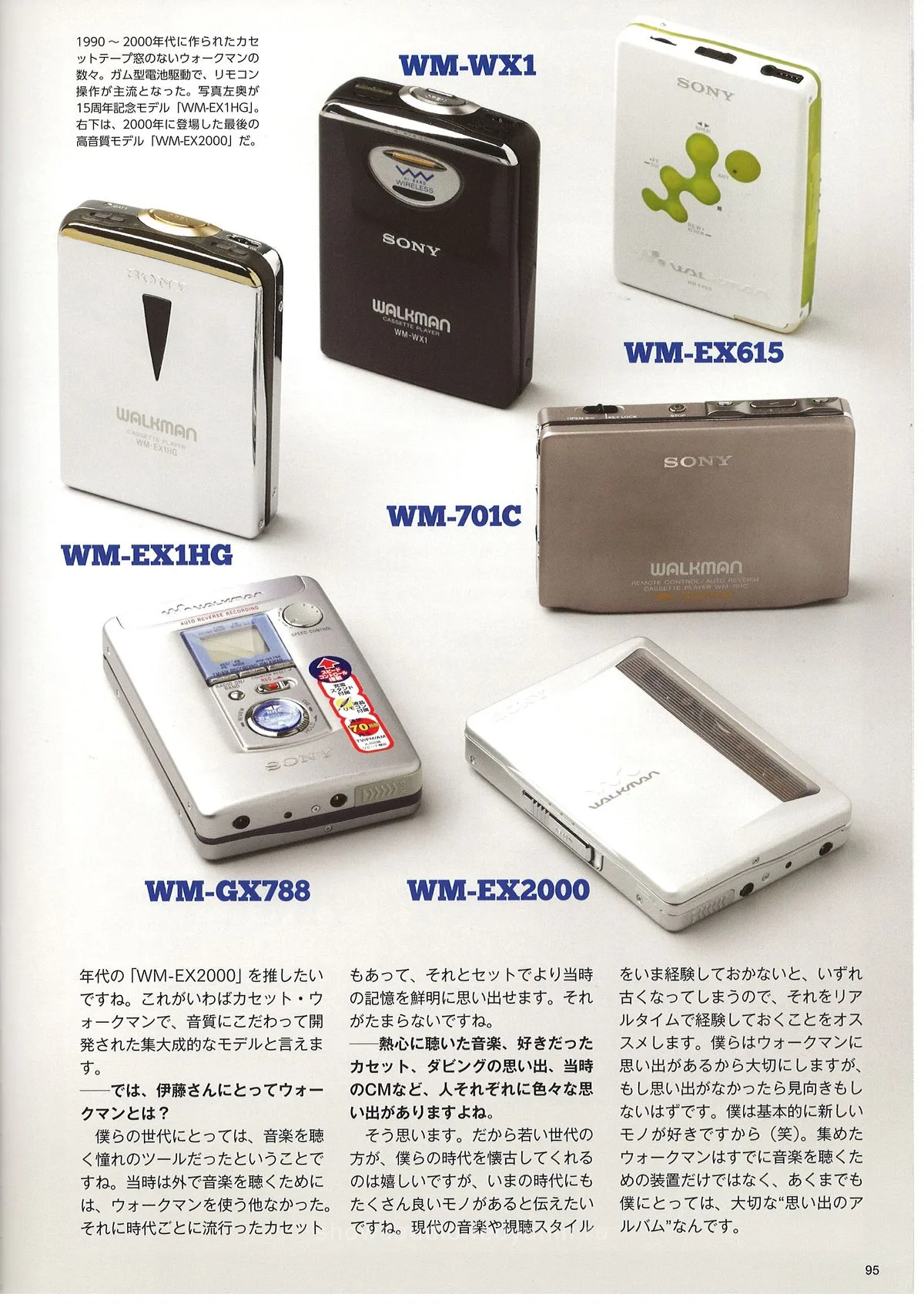
Players from the 1990s-2000s without a transparent cassette window - a large section of the collection. Once compact “gum” batteries arrived, the construction simplified and remote controls moved to the foreground. WM-EX1HG is the anniversary model for the series’ 15th birthday. WM-EX2000 was the last high-spec Walkman, released in 2000.
What about practicality?
From a usability standpoint, among the professional models the best is the “WM-D3.” Walkman is normally about portability, but the professional models are bulky and heavy to carry around. Many people used them at home as a replacement for a stationary deck, and for that purpose the “D3” is ideal. It has a precise peak level meter, a tape counter, and most importantly very comfortable buttons. For me it’s a truly special machine.
If you had to pick a top 3?
It depends whether you’re judging by sound or looks. But my number one is the “WM-20” without question - I want to collect every color version. In second place, for a combination of specs and personal feeling, I’d put the “DD QUARTZ WM-DD9.” If I were allowed to keep only one player, that would be it. Since I’ve already picked models from the 80s and 90s, third place goes to the “WM-EX2000” from the 2000s. It’s something like the culmination of the cassette Walkman’s evolution - a model where engineers put everything they’d learned into achieving ideal sound.
What does Walkman ultimately mean to you, Ito-san?
For our generation it was the key that unlocked the world of music. There was simply no other way to listen to music anywhere except at home. The cassettes that were popular in different periods, paired with the player, make memories of the past incredibly vivid. It’s a feeling you can’t really explain.
Everyone has their own trigger - music, favorite cassettes, the art of recording, old ads…
Exactly right. I’m glad younger people are interested in our era, but I want to say: there are plenty of wonderful things in the present too. If you don’t experience the music and the listening style of today while it’s happening, someday that will become history as well. So I’d encourage living that experience in real time. We treasure our Walkmans because our lives are wrapped up in them. Without those memories we wouldn’t give these gadgets a second glance. Honestly, I love everything new (laughs). My players are no longer just playback devices - they’re my precious “album of memories.”
Примечания
-
National - the brand used by Matsushita (now Panasonic) for consumer electronics and audio equipment sold in Japan at the time. ↩
-
HF, HF-S, HF-PRO - the hierarchy of Sony Type I (Normal Position) cassettes. HF was the entry-level tape, while HF-PRO was the premium model with improved shell construction and magnetic layer. ↩
-
“Gum battery” (Gum-type battery) - flat nickel-cadmium rechargeable batteries that Sony started using to reduce player thickness. Their shape resembled a stick of chewing gum. ↩
-
Yahoo! Auctions - Japan’s largest online auction platform (similar to eBay), which remains the primary destination for finding vintage electronics in the country. ↩
-
Super Metal Master - Sony’s legendary Type IV (Metal) cassette. Considered one of the finest and most expensive cassettes ever made, thanks to its ceramic shell and exceptional tape quality. ↩
-
Discon - short for discontinued. Japanese shorthand for products officially pulled from production and removed from catalogs. ↩
-
Akihabara - a district in Tokyo known as “Electric Town.” Since the postwar era it has been Japan’s main center for electronics, components and consumer appliances. For collectors, Akihabara was (and remains) the place to find anything - from the latest models to the rarest discontinued vintage gear. ↩
-
Don-shari - a Japanese audiophile term. “Don” mimics the sound of powerful bass, “shari” mimics the ring of high frequencies. It describes a sound signature with boosted lows and highs and a recessed midrange - what’s often called a “V-shaped” frequency response. ↩
-
Kasha - a Japanese onomatopoeia for the characteristic sound of the slide-in loading mechanism on ultra-compact cassette-case-sized models. In Japanese, the word is commonly used for sharp, dry mechanical sounds - like a camera shutter click or a latch snapping into place. ↩