

The actress chosen as the face of a new brand, the one who won teenagers’ hearts - a direct interview.
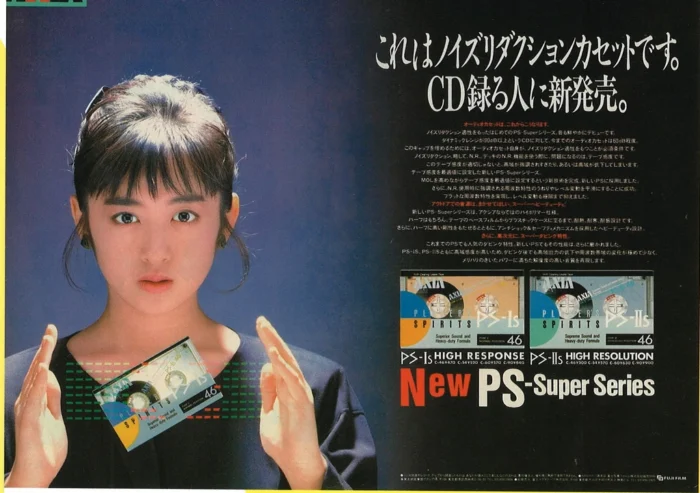
Interview with Yuki Saito
Leaving behind the Fuji Cassette era that never quite took off1, Fujifilm decided to start fresh and launched a new brand - AXIA - as a bid for revival. The face they chose was a then-unknown young actress and singer, Yuki Saito. We talked with her about those days - the woman Fujifilm had staked the company’s future on.
The AXIA image and the first shoot
In June 1985, a TV commercial for the PS-I cassette tape appeared with the slogan “Issho ni AXIA”2 - and the AXIA brand story began. What does the star of that campaign remember?
“I don’t remember exactly when the offer came - I was too busy (laughs). If only my old manager were here… The first shoot, I think, was somewhere in Guam… Everything was different back then - no retouching and post-processing like today. Photos taken on set went straight to posters and ads. We were walking along the sea, and from far away they were pointing this enormous blinding reflector right at me.”
“They keep saying ‘Open your eyes!’ and I just can’t - it’s too bright. Got a tan, shoulders and back aching, exhausted, boiling hot… That’s all I could think about.”
Did she know at the time that she had been chosen as AXIA’s image character because of overwhelming support from high school students in surveys?
“I didn’t hear about that then. But it’s nice to know. Finding out the choice was based on data and research - it’s a little reassuring, actually.”
She smiles, looking both surprised and pleased, and shares something unexpected:
The song “Kanashii Kotori” (Sad Little Bird), written by poet Gin’iro Natsuo, ended up tied to the AXIA campaign too.
“It was originally a standalone song, but as part of the tie-up3 they asked to make ‘AXIA’ the main title instead. I’d only just debuted, but I remember it felt wrong. Like it wasn’t right. And I still remember that feeling.”
Even so, “AXIA - Kanashii Kotori” became the campaign theme and has since been covered by artists from Noriko Matsumoto in the 1990s to Otoha and, more recently, Mone Kamishiraishi. The song outlived both the brand and its generation.
AXIA as a personal story
As the conversation goes on, memories come back.
“I think it was in Akasaka - at the FUJI Film headquarters. They invited me after I was confirmed as the image character, and I remember standing in front of all the staff saying ‘yoroshiku onegaishimasu.’”
When preparing this issue, we spoke with former AXIA staff. Hearing that she had been entrusted as the final link - the face of a campaign meant to carry the sincere determination of every employee to make the brand succeed at any cost - Yuki Saito responds with a smile: “That makes me genuinely happy. I’m truly grateful.”
A mother’s suggestion and a path into show business
In 2025, Yuki Saito celebrates 40 years since her debut. From the beginning she has won awards both as a singer and as an actress. And today she continues working in film and television, drawing attention with her expressive performances.
“When I was 16, my mother saw an audition notice in the newspaper and suggested I try. We took a photo and sent it in - and somehow I made it to the very end. That’s how I got into show business. I never really chased it myself - I wasn’t dreaming of fame, didn’t want to meet anyone in particular. But in the very beginning, when I was just starting out, it was genuinely brutally hard and busy. And still, I could keep going because people praised me and acknowledged my existence. That was the most important thing.”
“In April 1985, after Yuki had appeared in four TV dramas, the series Sukeban Deka began airing and brought her wide recognition. Two months before the broadcast started, she debuted as a singer with the single ‘Sotsugyou’ (Graduation). The song became a massive hit and is still considered a classic graduation anthem in Japan.”
What cassettes she actually used
Of course, back then Yuki Saito was actively using cassette tapes - swapping them with friends at school.
“I have an older sister and an older brother, and they had completely different taste in music. Under their influence I listened to all kinds of things. My sister loved Yuming and Off Course, my brother was into British music - prog rock especially, ELP, ELO, King Crimson. And I liked JAPAN and Duran Duran, and later Sheena Easton and Suzanne Vega.”
The ad shoot and the physical cost of a frame
She particularly remembers the commercial shot alongside her first feature film - “Yuki no Dansho - Jonetsu” (Fragment of Snow - Passion), directed by Shinji Somai.
“The film shoot was so grueling I ended up with gastroenteritis. And then suddenly - a light, pretty ad in a retro train, holding a cassette and looking out the window. It was a bit disorienting, which is exactly why I remember it so clearly. I think my manager at the time was working hard to connect my first film and the ad together.”
Even the commercial required stamina.
“The position of the cassette, the angle, the placement of my fingers - everything was controlled to the millimeter. Shoots went on for a long time, your arms start shaking, muscle pain sets in. I remember holding that cassette thinking, this is genuinely hard.”
Looking back
Today Saito sees that experience differently.
“People like us only appear at the very end - on screen. But behind it all there’s enormous work: the concept, the brand name, the image, the product development. As you get older you really start to feel the weight of that time and effort. If someone sees AXIA and remembers - ‘Oh, Yuki Saito was the first face of that brand’ - and then remembers their own youth… then it was all worth it.”
For me, the 1980s were a frantic, dizzying rush.
Примечания
-
In the late 1970s and early 1980s, FUJI Cassette tapes sold under the main Fuji Film corporate brand gradually lost ground in the market. Competition in the audio cassette segment intensified from specialist manufacturers - primarily Maxell, TDK and Sony - who responded faster to audiophile demand and aggressively pushed premium lines. With declining brand recognition and unclear positioning, Fuji Film decided to drop the old cassette brand and in 1985 launched AXIA - a separate label targeting young audiences, contemporary design and more aggressive marketing. ↩
-
AXIA’s advertising slogan for this campaign, meaning “AXIA - together.” ↩
-
Tie-up is a standard format for promotional collaboration in Japan. It’s a contract where a performer’s song becomes the official soundtrack for an advertising campaign (in this case, for AXIA cassettes). In return, the brand heavily rotates the song in their commercials, giving it airplay and exposure. For the Japanese industry this was a crucial promotional tool: the song helped sell cassettes, and the cassette ads helped the song become a hit. ↩