


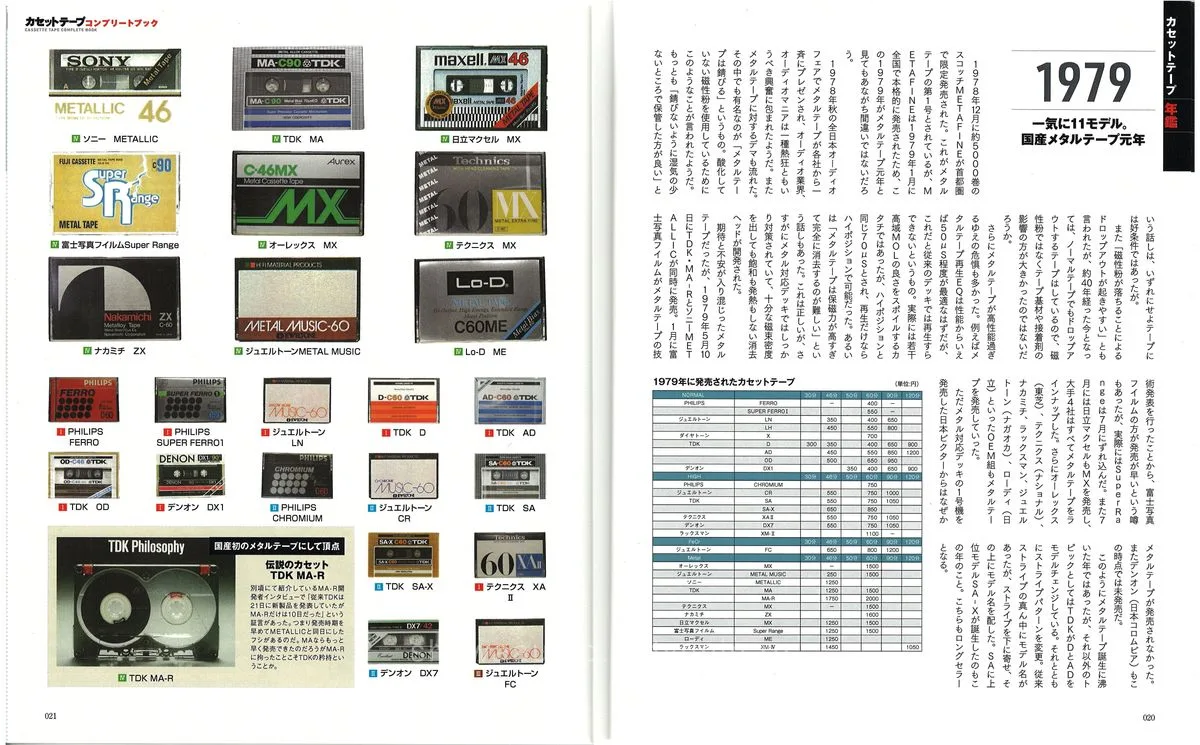
In December 1978, about 5,000 Scotch METAFINE cassettes went on limited sale in the Tokyo metropolitan area. This is considered the first metal-particle tape, but full nationwide sales of METAFINE began in January 1979. It would therefore not be much of an error to regard 1979 as the first year of metal-particle tape.
At the All-Japan Audio Fair in autumn 1978, various companies presented metal-particle tapes at the same time. Excitement that might be called a kind of fever seems to have gripped the audio industry and enthusiasts. Rumours circulated about the new tape too. One of the best known was: “Metal-particle tape rusts.” This was probably said because it used unoxidised magnetic particles. In any case, keeping tape in a dry place to avoid rust was a favourable storage condition.
People also said that the magnetic particles shed easily, causing signal dropouts. But now, about 40 years later, dropouts can be found on normal tapes too. Perhaps the problem had more to do with the tape base or binder than the magnetic particles.
There were also many concerns about the exceptionally high performance of metal-particle tape. For example, the playback equalisation time constant best suited to its characteristics would have been about 50 μs, but older decks would then have been unable even to play the recording. In practice, 70 μs was chosen, as for ハイポジション (high-position) tape: although this slightly reduced the advantage in maximum output level (MOL) at high frequencies, playback was possible in the high-position setting. It was also said that the high coercivity of metal-particle tape made complete erasure difficult. This was true, but decks supporting metal-particle tape solved the problem with an erase head that would neither saturate nor overheat at a sufficient magnetic flux density.
Metal-particle tape was greeted with a mixture of hopes and concerns, but on 10 May 1979 TDK MA-R and Sony METALLIC were released at the same time. Fuji Photo Film had presented its metal-particle tape technology in January, so there were rumours that its tape would come out earlier. In fact, Super Range was delayed until July. Hitachi Maxell also released MX in July, giving all four of the largest companies a metal-particle tape. OEM brands such as Aurex (Toshiba), Technics (National), Nakamichi, Luxman, Jeweltone (Nagaoka) and Lo-D (Hitachi) subsequently released metal-particle tapes as well.
For some reason, however, Victor, which had released the first deck supporting metal-particle tape, did not release a metal-particle tape of its own. Denon (Nippon Columbia) had not yet introduced one either.
Although the year was dominated by the arrival of metal-particle tape, there were other developments: TDK updated D and AD, changing their striped design. Previously the model name had been in the middle of the stripes; now the stripes were moved down and the name placed above them. This year also saw the introduction of SA-X, a model one grade above SA. It too became long-lived.
The first Japanese metal-particle tape and the top of the range: the legendary TDK MA-R
In an interview elsewhere in the book, a developer of MA-R recalls: “TDK used to introduce new products on the 21st, but MA-R alone came out on the 10th.” It appears that the release was brought forward to coincide with METALLIC. Perhaps MA could have been released earlier, but TDK’s determination to work on MA-R is a sign of its pride.
Cassettes released in 1979 (prices in yen)
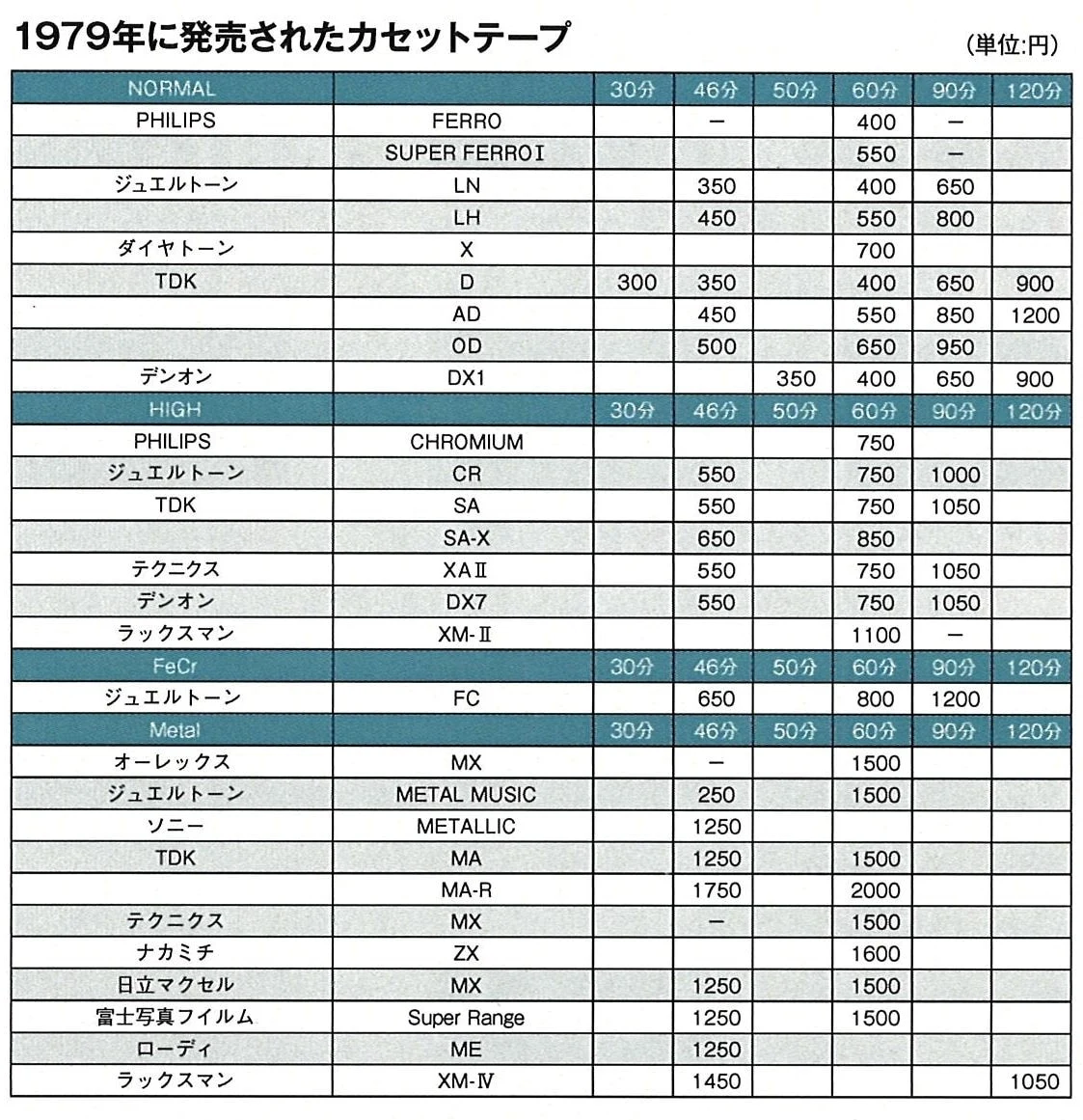
NORMAL
| Brand | Model | 30 | 46 | 50 | 60 | 90 | 120 |
|---|---|---|---|---|---|---|---|
| PHILIPS | FERRO | - | 400 | - | |||
| SUPER FERRO I | 550 | - | |||||
| Jeweltone | LN | 350 | 400 | 650 | |||
| LH | 450 | 550 | 800 | ||||
| Diatone | X | 700 | |||||
| TDK | D | 300 | 350 | 400 | 650 | 900 | |
| AD | 450 | 550 | 850 | 1200 | |||
| OD | 500 | 650 | 950 | ||||
| Denon | DX1 | 350 | 400 | 650 | 900 |
HIGH
| Brand | Model | 30 | 46 | 50 | 60 | 90 | 120 |
|---|---|---|---|---|---|---|---|
| PHILIPS | CHROMIUM | 750 | |||||
| Jeweltone | CR | 550 | 750 | 1000 | |||
| TDK | SA | 550 | 750 | 1050 | |||
| SA-X | 650 | 850 | |||||
| Technics | XA II | 550 | 750 | 1050 | |||
| Denon | DX7 | 550 | 750 | 1050 | |||
| Luxman | XM-II | 1100 | - |
FeCr
| Brand | Model | 30 | 46 | 50 | 60 | 90 | 120 |
|---|---|---|---|---|---|---|---|
| Jeweltone | FC | 650 | 800 | 1200 |
Metal
| Brand | Model | 30 | 46 | 50 | 60 | 90 | 120 |
|---|---|---|---|---|---|---|---|
| Aurex | MX | - | 1500 | ||||
| Jeweltone | METAL MUSIC | 250 | 1500 | ||||
| Sony | METALLIC | 1250 | |||||
| TDK | MA | 1250 | 1500 | ||||
| MA-R | 1750 | 2000 | |||||
| Technics | MX | - | 1500 | ||||
| Nakamichi | ZX | 1600 | |||||
| Hitachi Maxell | MX | 1250 | 1500 | ||||
| Fuji Photo Film | Super Range | 1250 | 1500 | ||||
| Lo-D | ME | 1250 | |||||
| Luxman | XM-IV | 1450 | 1050 |