



The WM-2, which can be called Walkman’s greatest success, appeared the previous year. Its front panel was almost the same size as a cassette case, and it was about twice as thick. Compared with earlier headphone stereos, it was incomparably more stylish and compact. This Walkman II and its wire-like headphones with orange pads became a status symbol among young people. There were still more manufacturers: National finally introduced its Way headphone stereo. Hitachi, Victor and Sharp also brought out new products.
Changes were brewing in the cassette world too. As already noted, development had previously been driven mainly by improved performance. Now design and a stylish appearance also came to be considered important.
Packaging dominated by black, associated with high performance, or resembling that of professional materials had previously been in fashion. White was now used more often, giving a sporty image that appealed more to young people.
Fuji Photo Film, which compared with Sony and TDK was more strongly associated with products for connoisseurs, completed a range in predominantly white packaging. Scotch also updated its packaging: model names in pastel colours appeared on a black-and-white checked background. Pioneer updated all its models at once but kept white packaging.
Many new products, on the other hand, retained the old image. Denon, Hitachi Maxell, Kenwood (Trio) and AIWA used, perhaps rather bluntly put, old-fashioned packaging and shell designs, although performance was of course improving.
Sony and Yamaha differed from this direction. Sony extended the metallised packaging introduced for UCX-S the previous year to UCX and even the normal-position BHF. The packaging emphasised high grade and performance while remaining stylish and avoiding a cheap appearance. Yamaha had an entirely different vision: gold packaging with one small window. Its atmosphere of a musical-instrument accessory may have taken account of Nippon Gakki’s particular sales channels. This packaging, like Yamaha’s audio equipment as a whole, was probably designed by GK Design.
TDK was hardly active this year, but from the following year it gradually began changing its image.
Thus 1982 was a transitional period: old and new mingled as manufacturers looked towards the next generation and sought solutions.
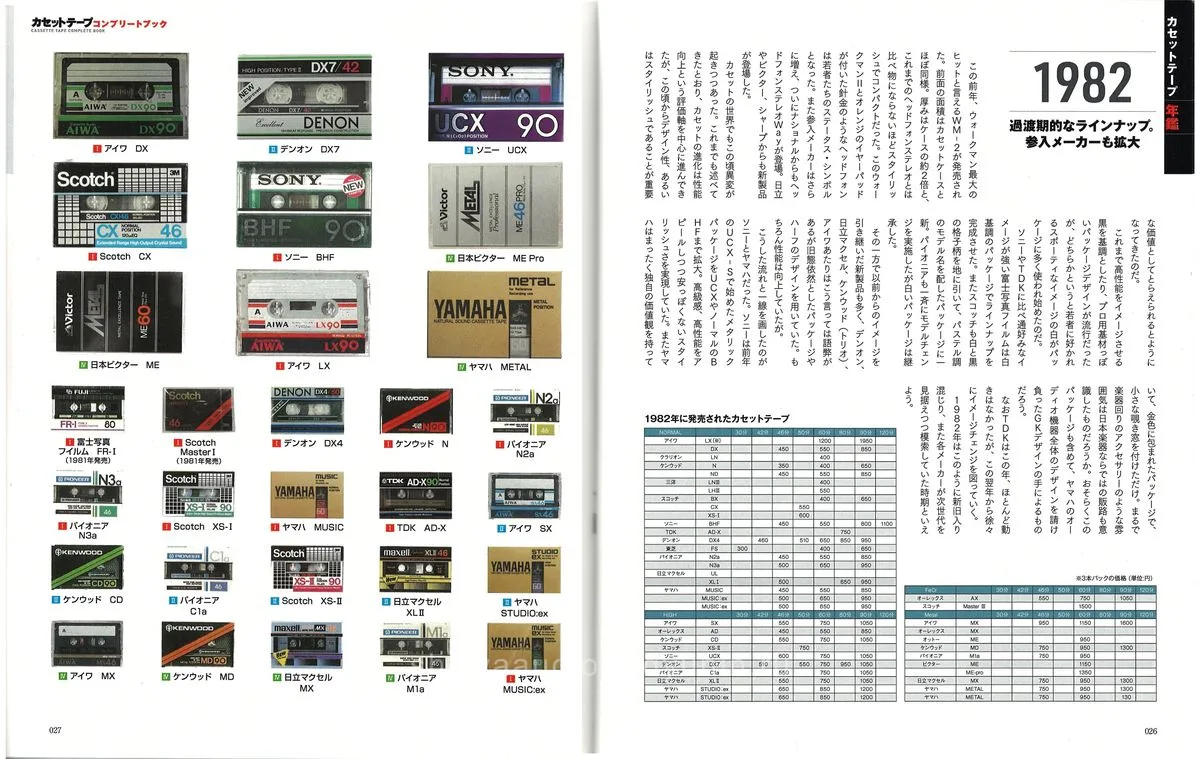
Notes from photo captions: Fuji Photo Film FR-I (released 1981); Scotch Master I (released 1981).
Cassettes released in 1982 (prices in yen)
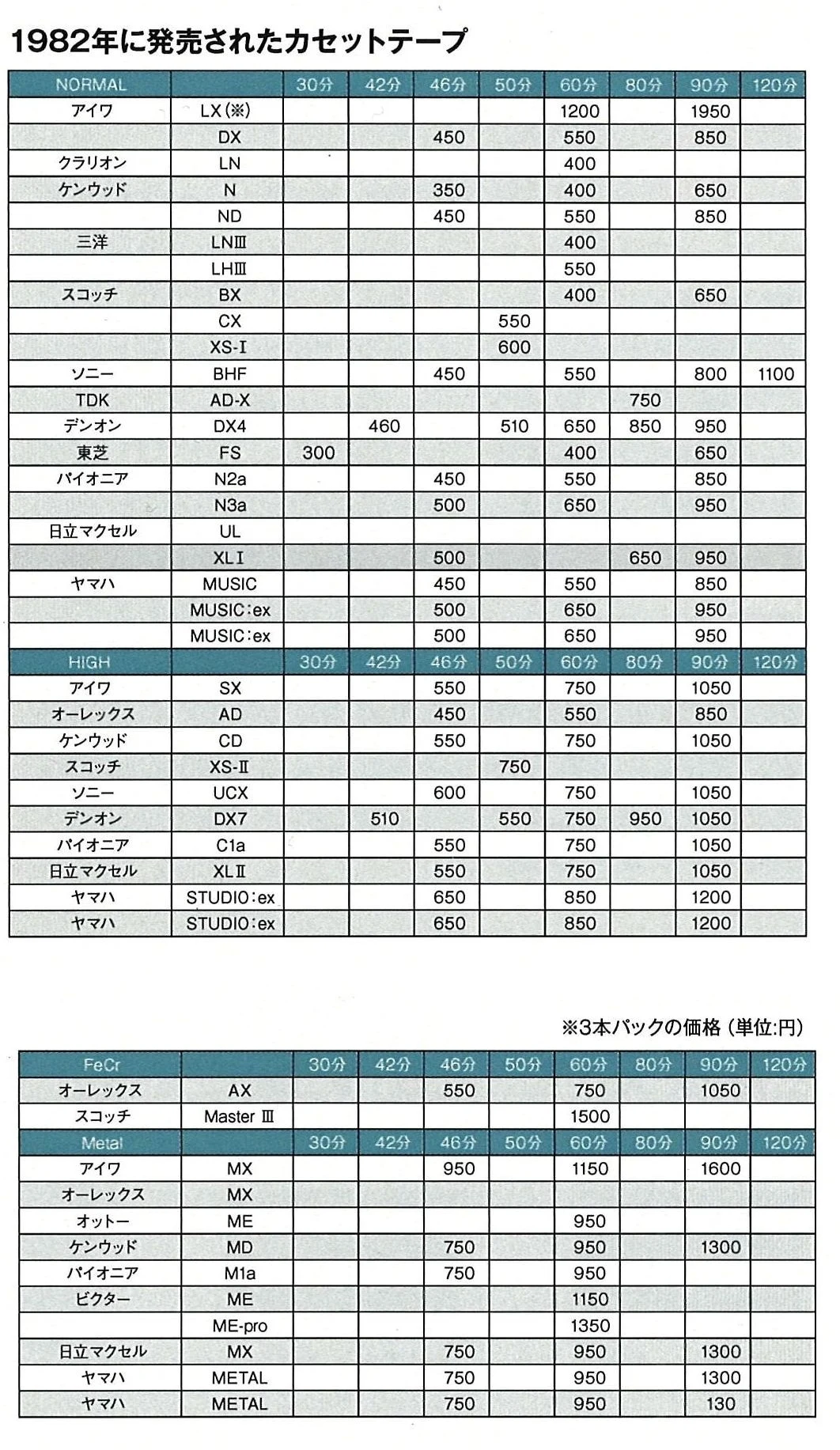
NORMAL
| Brand | Model | 30 | 42 | 46 | 50 | 60 | 80 | 90 | 120 |
|---|---|---|---|---|---|---|---|---|---|
| AIWA | LX (※) | 1200 | 1950 | ||||||
| DX | 450 | 550 | 850 | ||||||
| Clarion | LN | 400 | |||||||
| Kenwood | N | 350 | 400 | 650 | |||||
| ND | 450 | 550 | 850 | ||||||
| Sanyo | LN III | 400 | |||||||
| LH III | 550 | ||||||||
| Scotch | BX | 400 | 650 | ||||||
| CX | 550 | ||||||||
| XS-I | 600 | ||||||||
| Sony | BHF | 450 | 550 | 800 | 1100 | ||||
| TDK | AD-X | 750 | |||||||
| Denon | DX4 | 460 | 510 | 650 | 850 | 950 | |||
| Toshiba | FS | 300 | 400 | 650 | |||||
| Pioneer | N2a | 450 | 550 | 850 | |||||
| N3a | 500 | 650 | 950 | ||||||
| Hitachi Maxell | UL | ||||||||
| XL I | 500 | 650 | 950 | ||||||
| Yamaha | MUSIC | 450 | 550 | 850 | |||||
| MUSIC:ex | 500 | 650 | 950 | ||||||
| MUSIC:ex | 500 | 650 | 950 |
HIGH
| Brand | Model | 30 | 42 | 46 | 50 | 60 | 80 | 90 | 120 |
|---|---|---|---|---|---|---|---|---|---|
| AIWA | SX | 550 | 750 | 1050 | |||||
| Aurex | AD | 450 | 550 | 850 | |||||
| Kenwood | CD | 550 | 750 | 1050 | |||||
| Scotch | XS-II | 750 | |||||||
| Sony | UCX | 600 | 750 | 1050 | |||||
| Denon | DX7 | 510 | 550 | 750 | 950 | 1050 | |||
| Pioneer | C1a | 550 | 750 | 1050 | |||||
| Hitachi Maxell | XL II | 550 | 750 | 1050 | |||||
| Yamaha | STUDIO:ex | 650 | 850 | 1200 | |||||
| STUDIO:ex | 650 | 850 | 1200 |
FeCr
| Brand | Model | 30 | 42 | 46 | 50 | 60 | 80 | 90 | 120 |
|---|---|---|---|---|---|---|---|---|---|
| Aurex | AX | 550 | 750 | 1050 | |||||
| Scotch | Master III | 1500 |
Metal
| Brand | Model | 30 | 42 | 46 | 50 | 60 | 80 | 90 | 120 |
|---|---|---|---|---|---|---|---|---|---|
| AIWA | MX | 950 | 1150 | 1600 | |||||
| Aurex | MX | ||||||||
| OTTO | ME | 950 | |||||||
| Kenwood | MD | 750 | 950 | 1300 | |||||
| Pioneer | M1a | 750 | 950 | ||||||
| Victor | ME | 1150 | |||||||
| ME-pro | 1350 | ||||||||
| Hitachi Maxell | MX | 750 | 950 | 1300 | |||||
| Yamaha | METAL | 750 | 950 | 1300 | |||||
| METAL | 750 | 950 | 130 |
In the original, the 90 column for the second Yamaha METAL row reads 130.
※ Price for a pack of three cassettes (in yen).