




According to the machinery statistics from Japan’s Ministry of International Trade and Industry mentioned earlier, magnetic tape production exceeded one billion square metres for the first time this year. Tape recorder production also approached 70 million units.
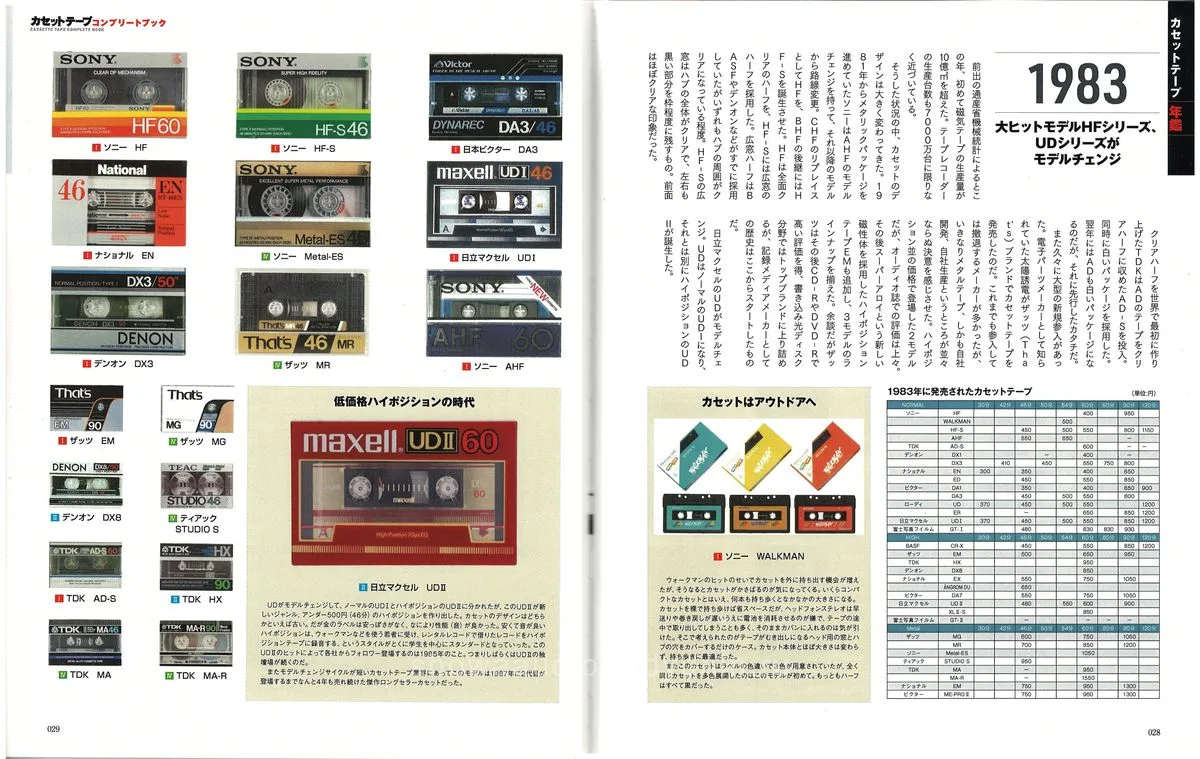
Against this background, cassette design changed considerably. Sony, which had been developing metallised packaging since 1981, changed direction for subsequent models after renewing AHF. HF replaced CHF, while HF-S succeeded BHF. HF received a completely transparent shell; HF-S had a shell with a wide window. BASF, Denon and others had already used wide windows, but their transparent areas were mainly around the reels. In the wide window of HF-S the reels were visible in their entirety, while the black parts at the edges remained only as a frame. The front appeared almost completely transparent.
TDK, the first company in the world to create a transparent shell, released AD-S: AD tape in a transparent cassette. At the same time it adopted white packaging. AD itself received white packaging the following year, but AD-S came first.
After a long interval, a major new manufacturer entered the market. Taiyo Yuden, known for electronic components, released cassettes under the That’s brand. Many companies had previously entered and left the market, but here the seriousness of its intentions was evident in its immediate introduction of metal-particle tapes developed and made in-house. Two models were priced comparably to high-position tapes and received favourable reviews in audio magazines. The company then added the high-position EM, with a new magnetic material called スーパーアロイ (Super Alloy), bringing the range to three models. That’s was later highly regarded for CD-R and DVD-R and became a leading brand in recordable optical discs. Its history as a maker of recording media began here.
Hitachi Maxell renewed UD: the normal tape became UDI, and a separate high-position UDII appeared.
The cassette goes outdoors
The success of Walkman meant that cassettes were more often taken along. But people also began to notice how much space they occupied. However compact one cassette might be, several together took up a noticeable amount of room. Carrying cassettes without cases would save space, but rewinding on portable stereos was slow and used battery power, so tapes were often removed partway through. Putting one straight into a bag like that was a little worrying. The solution was a case covering only the head window, where the tape is exposed, and the reel openings. It was scarcely larger than the cassette itself and convenient to carry.
This cassette was sold with labels in three colours. For the first time, exactly the same cassette was offered in several colours, although the shells themselves were black in every version.
The age of affordable high-position cassettes
After its renewal, UD split into normal UDI and high-position UDII. UDII created a new category: a 46-minute high-position tape for less than 500 yen. Its design looked rather old-fashioned, but the gold label did not look cheap, and above all its performance and sound were good. An inexpensive, good-sounding high-position tape appealed to young users of Walkman and other players. Renting a record and copying it onto high-position tape became commonplace, particularly among students. The success of UDII produced followers from other companies in 1985. Until then UDII remained alone in its category for a while.
In a cassette industry with short model cycles, this successful tape sold for a full four years, until the second generation appeared in 1987.
Cassettes released in 1983 (prices in yen)
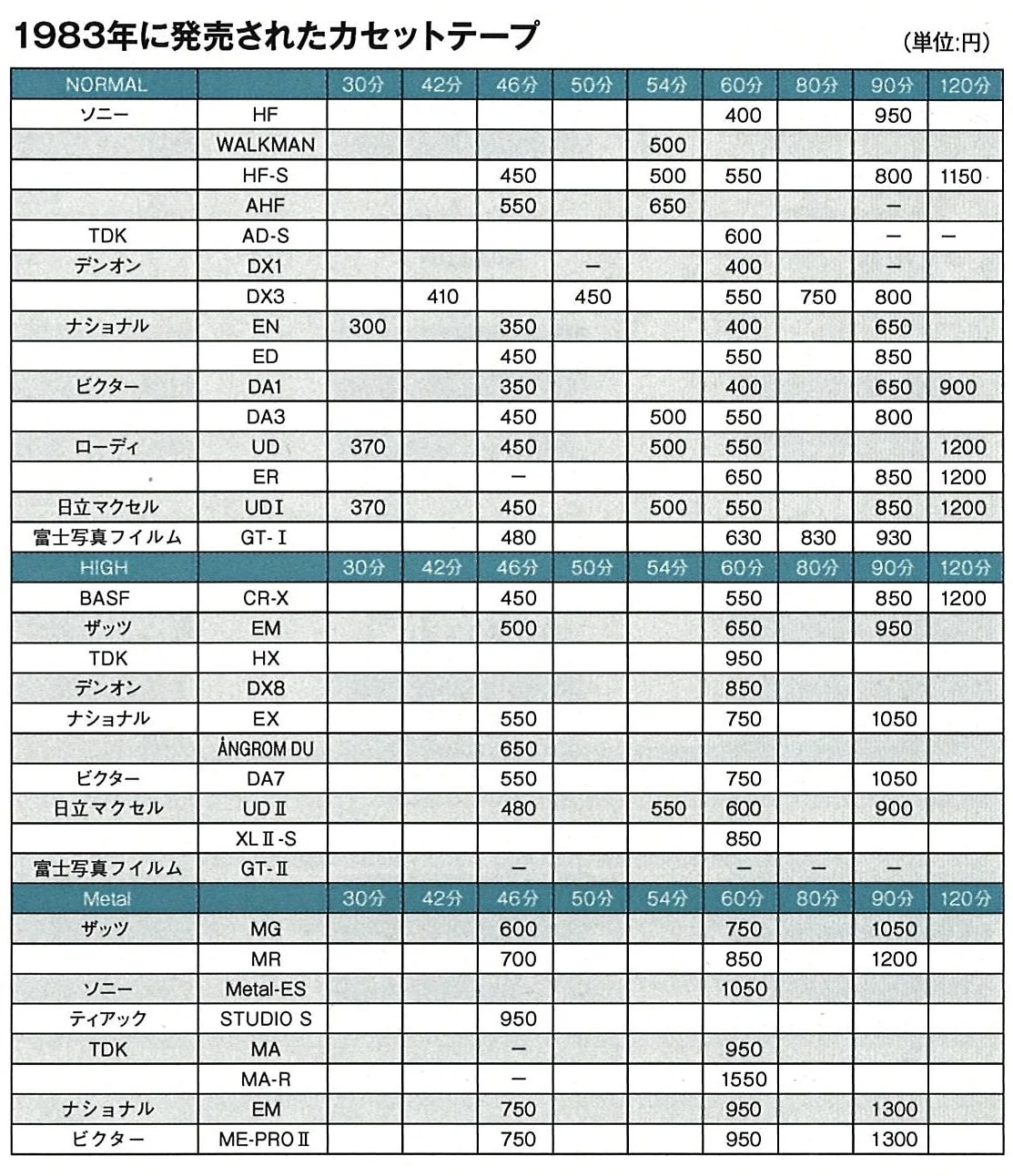
NORMAL
| Brand | Model | 30 | 42 | 46 | 50 | 54 | 60 | 80 | 90 | 120 |
|---|---|---|---|---|---|---|---|---|---|---|
| Sony | HF | 400 | 950 | |||||||
| WALKMAN | 500 | |||||||||
| HF-S | 450 | 500 | 550 | 800 | 1150 | |||||
| AHF | 550 | 650 | - | |||||||
| TDK | AD-S | 600 | - | - | ||||||
| Denon | DX1 | - | 400 | - | ||||||
| DX3 | 410 | 450 | 550 | 750 | 800 | |||||
| National | EN | 300 | 350 | 400 | 650 | |||||
| ED | 450 | 550 | 850 | |||||||
| Victor | DA1 | 350 | 400 | 650 | 900 | |||||
| DA3 | 450 | 500 | 550 | 800 | ||||||
| Lo-D | UD | 370 | 450 | 500 | 550 | 1200 | ||||
| ER | - | 650 | 850 | 1200 | ||||||
| Hitachi Maxell | UD I | 370 | 450 | 500 | 550 | 850 | 1200 | |||
| Fuji Photo Film | GT-I | 480 | 630 | 830 | 930 |
HIGH
| Brand | Model | 30 | 42 | 46 | 50 | 54 | 60 | 80 | 90 | 120 |
|---|---|---|---|---|---|---|---|---|---|---|
| BASF | CR-X | 450 | 550 | 850 | 1200 | |||||
| That’s | EM | 500 | 650 | 950 | ||||||
| TDK | HX | 950 | ||||||||
| Denon | DX8 | 850 | ||||||||
| National | EX | 550 | 750 | 1050 | ||||||
| ÅNGROM DU | 650 | |||||||||
| Victor | DA7 | 550 | 750 | 1050 | ||||||
| Hitachi Maxell | UD II | 480 | 550 | 600 | 900 | |||||
| XL II-S | 850 | |||||||||
| Fuji Photo Film | GT-II | - | - | - | - |
Metal
| Brand | Model | 30 | 42 | 46 | 50 | 54 | 60 | 80 | 90 | 120 |
|---|---|---|---|---|---|---|---|---|---|---|
| That’s | MG | 600 | 750 | 1050 | ||||||
| MR | 700 | 850 | 1200 | |||||||
| Sony | Metal-ES | 1050 | ||||||||
| TEAC | STUDIO S | 950 | ||||||||
| TDK | MA | - | 950 | |||||||
| MA-R | - | 1550 | ||||||||
| National | EM | 750 | 950 | 1300 | ||||||
| Victor | ME-PRO II | 750 | 950 | 1300 |