




The year’s biggest event was probably the arrival of the new AXIA brand. Although Fuji Photo Film’s cassette history was almost as long as that of TDK, Sony and Hitachi Maxell, in the difficult year of 1984 its market share was only 2.5%. The company therefore abandoned the FUJI name under which it had sold cassettes since its first model in 1969 and was reborn under a new name. The target audience was 15-year-old boys, younger than the main body of buyers among high-school and university students. Yuki Saito (斉藤由貴), then popular with junior high school pupils, was chosen as the face of the brand.
The strategy worked, and Fuji Photo Film’s cassette division revived. The PS series, one of the first AXIA models, became long-lived and remained in production into the twenty-first century.
By this time tape technology was approaching its peak, and the idea that a good recording required high-position or metal-particle tape was gradually being disproved. For example, AXIA PS-I, although a normal-position tape, used ハイレスポンスベリドックス (High Response Beridox) magnetic material with added cobalt. That’s RX used the ultrafine magnetic material ファイン・クリスタル・コバルト (Fine Crystal Cobalt). Denon DX4 also received high-sensitivity iron oxide with a pore-free cobalt coating. Cobalt materials had previously been used in high-position tapes but were now applied to normal tape. TDK, a pioneer of cobalt tapes, also made AR-X more effective by making the particles of its アビリン (Avilyn) cobalt material finer and increasing their packing density.
Work was not limited to the tape: Sony used a ceramic composite block in the cassette’s guide section and was able to bring out the tape’s full potential. Hitachi Maxell XL I-S received a shell made from the same heavy resin as MX and XL II-S, and an SS・PA mechanism that provided unprecedented smoothness of movement and eliminated factors impairing tape operation. Thanks to developments in both the tape, including its magnetic layer, and the cassette shell, normal cassettes comparable in performance to earlier high-position and metal tapes were no longer rare.
Bright shells and serious performance
Previously, colourful cassettes were more often made by consumer electronics manufacturers. They were probably aimed at ordinary buyers in branded appliance stores and supermarkets rather than necessarily at audiophiles. By this time, however, leading cassette brands such as Sony and Hitachi Maxell had also included many coloured-shell models in their ranges.
Hitachi Maxell UR-F used ニュー・ピュアクリスタル・ガンマ酸化鉄 (New Pure Crystal Gamma iron oxide). Its performance did not stand out in one particular respect, but its sound was even from low to high frequencies. Sony Gokkigen46!! and what’s up? were effectively coloured-shell versions of HF and HF-S respectively, so their quality was well known. Denon PASTEL LIVE was offered in five pastel shell colours, including pink and yellow, and contained the same reliably sounding tape as DX1.
In That’s RX, the use of ファイン・クリスタル・コバルト (Fine Crystal Cobalt) magnetic material reduced noise. Residual magnetic induction was 1,600 gauss and coercivity 380 oersteds: these figures surpassed the previous normal-position level. What was new was the combination of this performance with a white shell. The lower photograph shows a limited release for the launch of RX: a set of three cassettes in blue, pink and green cases. All the cassettes were white; the cases provided the variety of colours.
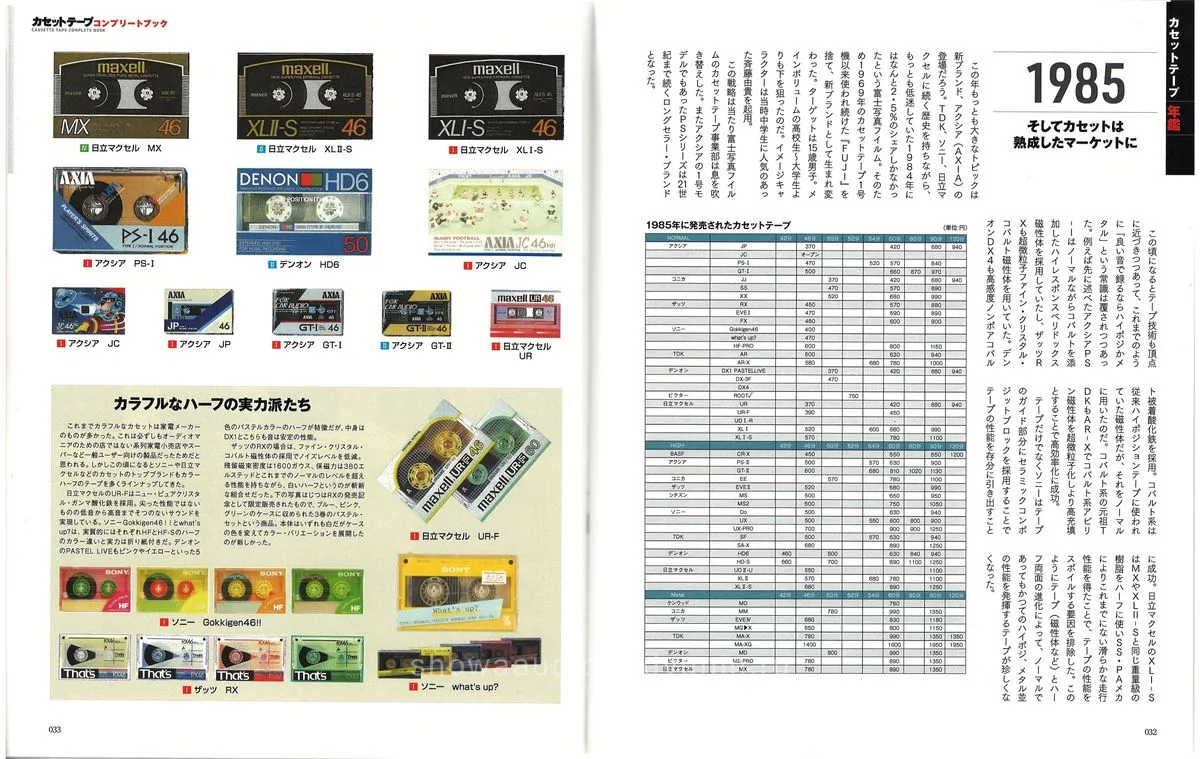
Notes from photo captions: Denon PASTEL LIVE (label side); Denon PASTEL LIVE (cassette side).
Cassettes released in 1985 (prices in yen)
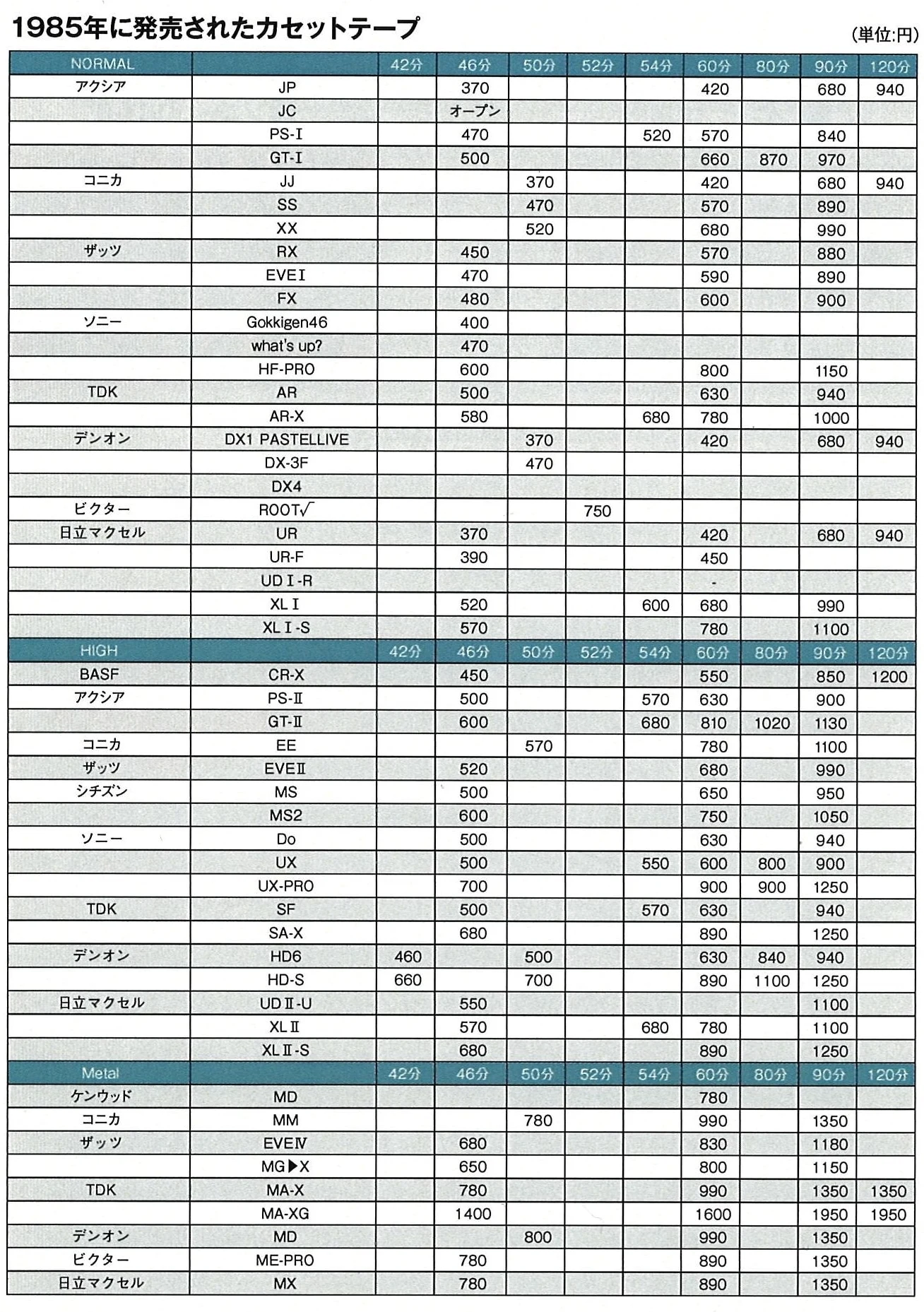
NORMAL
| Brand | Model | 46 | 50 | 52 | 54 | 60 | 80 | 90 | 120 |
|---|---|---|---|---|---|---|---|---|---|
| AXIA | JP | 370 | 420 | 680 | 940 | ||||
| JC | open price | ||||||||
| PS-I | 470 | 520 | 570 | 840 | |||||
| GT-I | 500 | 660 | 870 | 970 | |||||
| Konica | JJ | 370 | 420 | 680 | 940 | ||||
| SS | 470 | 570 | 890 | ||||||
| XX | 520 | 680 | 990 | ||||||
| That’s | RX | 450 | 570 | 880 | |||||
| EVE I | 470 | 590 | 890 | ||||||
| FX | 480 | 600 | 900 | ||||||
| Sony | Gokkigen46 | 400 | |||||||
| what’s up? | 470 | ||||||||
| HF-PRO | 600 | 800 | 1150 | ||||||
| TDK | AR | 500 | 630 | 940 | |||||
| AR-X | 580 | 680 | 780 | 1000 | |||||
| Denon | DX1 PASTELLIVE | 370 | 420 | 680 | 940 | ||||
| DX-3F | 470 | ||||||||
| DX4 | |||||||||
| Victor | ROOT√ | 750 | |||||||
| Hitachi Maxell | UR | 370 | 420 | 680 | 940 | ||||
| UR-F | 390 | 450 | |||||||
| UDI-R | - | ||||||||
| XLI | 520 | 600 | 680 | 990 | |||||
| XLI-S | 570 | 780 | 1100 |
HIGH
| Brand | Model | 42 | 46 | 50 | 54 | 60 | 80 | 90 | 120 |
|---|---|---|---|---|---|---|---|---|---|
| BASF | CR-X | 450 | 550 | 850 | 1200 | ||||
| AXIA | PS-II | 500 | 570 | 630 | 900 | ||||
| GT-II | 600 | 680 | 810 | 1020 | 1130 | ||||
| Konica | EE | 570 | 780 | 1100 | |||||
| That’s | EVE II | 520 | 680 | 990 | |||||
| Citizen | MS | 500 | 650 | 950 | |||||
| MS2 | 600 | 750 | 1050 | ||||||
| Sony | Do | 500 | 630 | 940 | |||||
| UX | 500 | 550 | 600 | 800 | 900 | ||||
| UX-PRO | 700 | 900 | 900 | 1250 | |||||
| TDK | SF | 500 | 570 | 630 | 940 | ||||
| SA-X | 680 | 890 | 1250 | ||||||
| Denon | HD6 | 460 | 500 | 630 | 840 | 940 | |||
| HD-S | 660 | 700 | 890 | 1100 | 1250 | ||||
| Hitachi Maxell | UDII-U | 550 | 1100 | ||||||
| XLII | 570 | 680 | 780 | 1100 | |||||
| XLII-S | 680 | 890 | 1250 |
Metal
| Brand | Model | 46 | 50 | 60 | 90 | 120 |
|---|---|---|---|---|---|---|
| Kenwood | MD | 780 | ||||
| Konica | MM | 780 | 990 | 1350 | ||
| That’s | EVE IV | 680 | 830 | 1180 | ||
| MG▶X | 650 | 800 | 1150 | |||
| TDK | MA-X | 780 | 990 | 1350 | 1350 | |
| MA-XG | 1400 | 1600 | 1950 | 1950 | ||
| Denon | MD | 800 | 990 | 1350 | ||
| Victor | ME-PRO | 780 | 890 | 1350 | ||
| Hitachi Maxell | MX | 780 | 890 | 1350 |
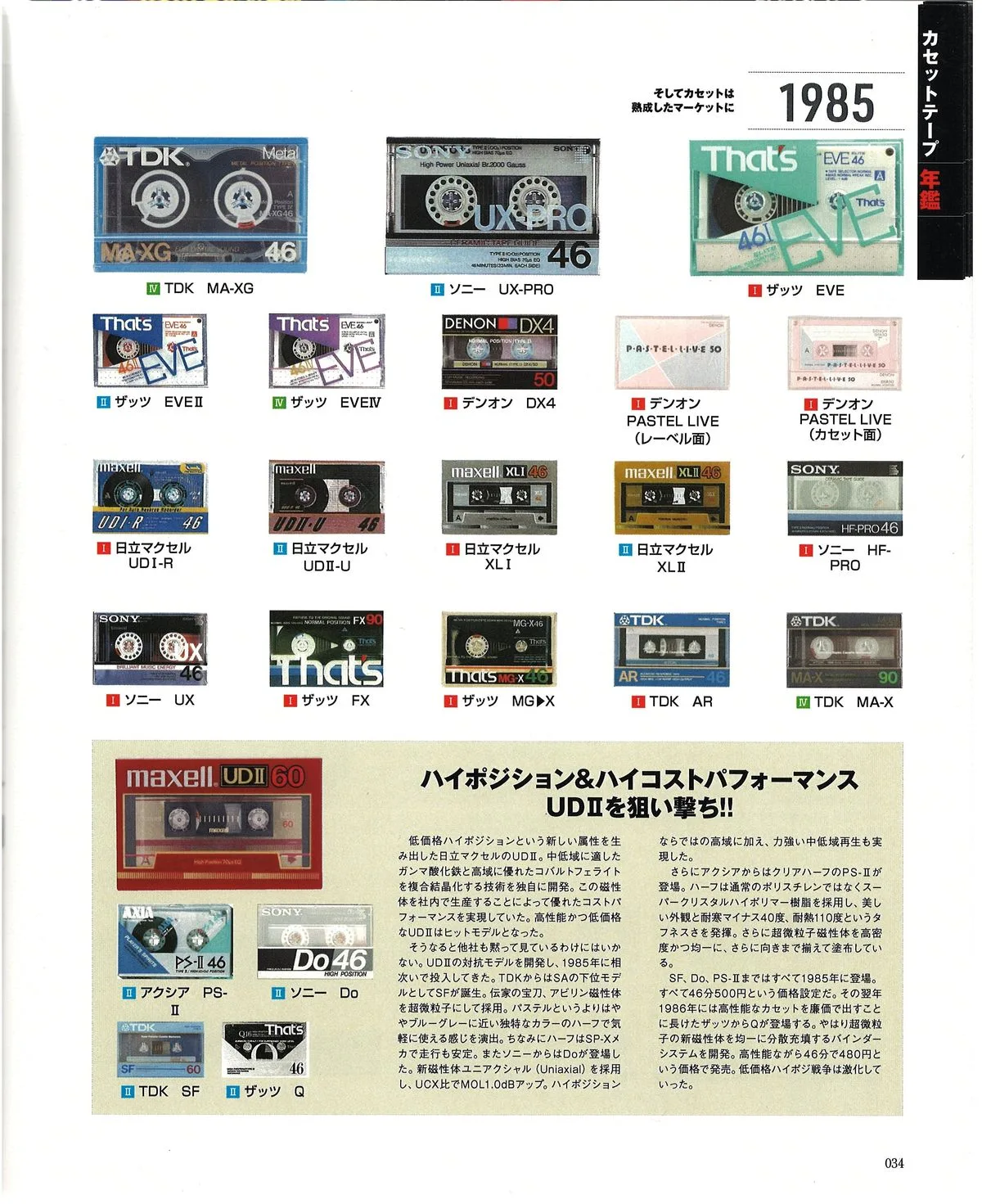
Type labels in the captions are retained as printed in the book. For Sony UX and That’s MG▶X, Type I in the captions conflicts with the packaging and table, where they are classified as High and Metal respectively.
Affordable high position: UDII’s competitors
Hitachi Maxell UDII created a new category of affordable high-position cassettes. The company independently developed a technology for co-crystallising gamma iron oxide, suitable for mid and low frequencies, with cobalt ferrite, which performs well at high frequencies. By producing this magnetic material at its own plant, it achieved a favourable balance of price and quality. The high-quality, inexpensive UDII became a hit.
Other manufacturers could not simply watch: they developed competitors to UDII and brought them to market one after another in 1985. TDK introduced SF as a model below SA. It used ultrafine particles of the proven アビリン (Avilyn) magnetic material. The distinctive shell colour, more blue-grey than pastel, gave the cassette a casual look. A shell with the SP-X mechanism ensured stable tape movement. Sony released Do with a new magnetic material, ユニアクシャル (Uniaxial): its maximum output level, MOL, was 1.0 dB higher than UCX. In addition to the high frequencies characteristic of high position, it delivered powerful mid and low frequencies.
AXIA introduced PS-II with a transparent shell. Instead of ordinary polystyrene, it used スーパークリスタルハイポリマー (super-crystalline high polymer) resin, giving it an attractive appearance and strength: the shell withstood cold down to minus 40 and heat up to 110 degrees. The ultrafine magnetic material was applied in an even, densely packed layer, with the particles oriented in one direction.
SF, Do and PS-II appeared in 1985, and each 46-minute cassette cost 500 yen. The following year, 1986, That’s, a company adept at making high-quality cassettes affordably, introduced Q. It also developed a binder system that evenly distributed and firmly held the new ultrafine-particle magnetic material. Despite its high performance, the 46-minute cassette cost 480 yen. The affordable high-position cassette war was heating up.