
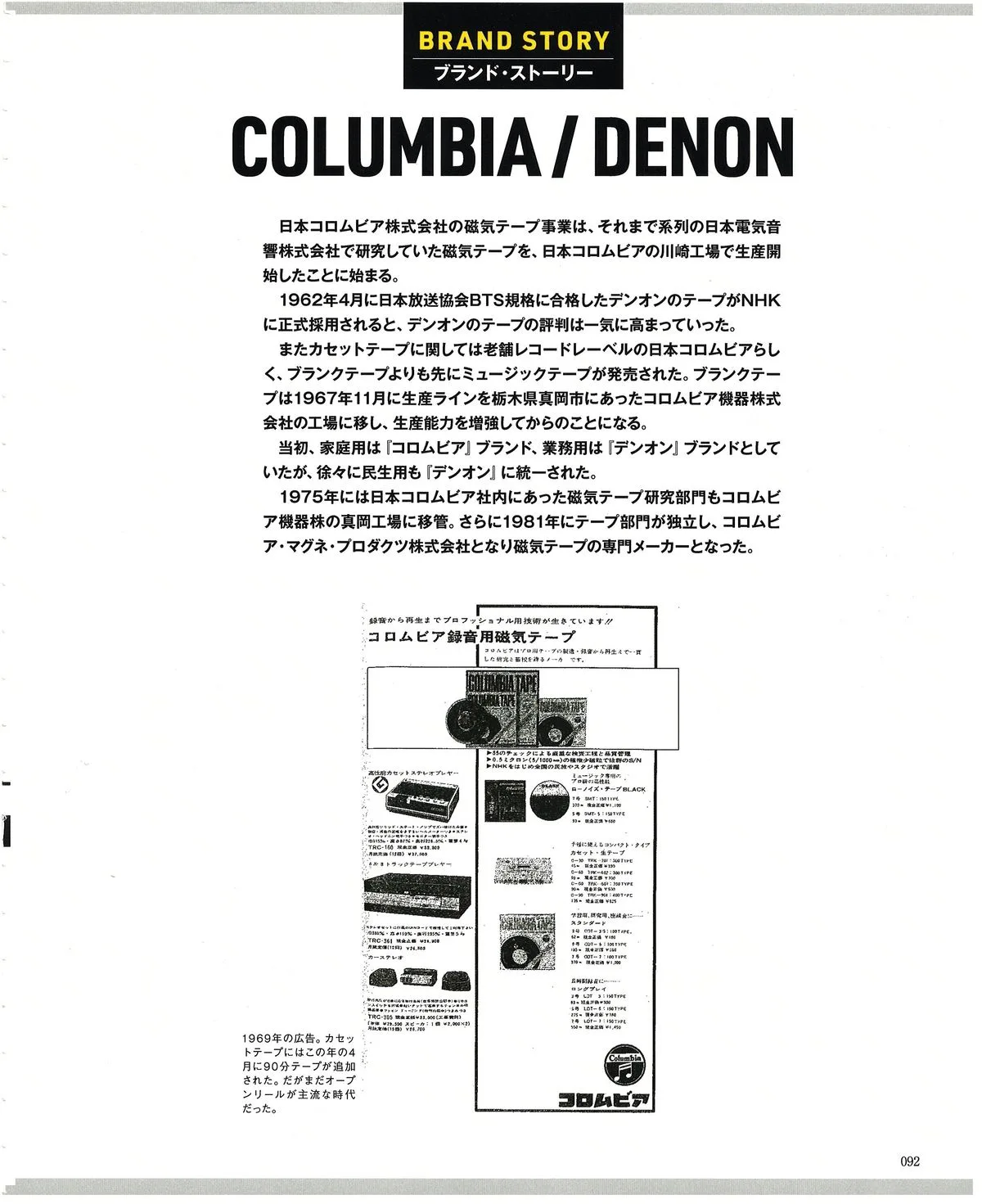
Nippon Columbia’s magnetic-tape production began at its Kawasaki plant, using tape researched by fellow group company Nippon Denki Onkyo. In April 1962 Denon tape passed the Japanese Broadcasting Corporation’s BTS standard and was officially adopted by NHK, rapidly gaining a reputation.
Like an established record company, Nippon Columbia first released music cassettes and only later blank tapes. Blank-cassette production began after the line moved to Columbia Kiki in Moka, Tochigi, in November 1967. Columbia was initially used for consumer products and Denon for professional products, but consumer products gradually joined the Denon brand. The magnetic-tape research division moved to Moka in 1975 and became the specialist Columbia Magne Products company in 1981.
RD/RD-X/RD-Z
In 1978 Nippon Columbia decided to sell its Columbia cassettes under the professional DENON brand. The range became DX: normal DX1, DX3 and DX4, ferrichrome DX5, high-position DX7 and DX8, and metal DXM.
In 1985 the first non-DX model appeared in Denon’s main range, HD-S. DX began to recede and the new range was divided into RD for normal, HD for high position and MD for metal. The RD series appeared in 1986 with non-porous cobalt-coated iron oxide, the same type used in high position. After an update in 1987, RD-Z joined the range below RD; together with RD-X, it formed Denon’s normal-position family.
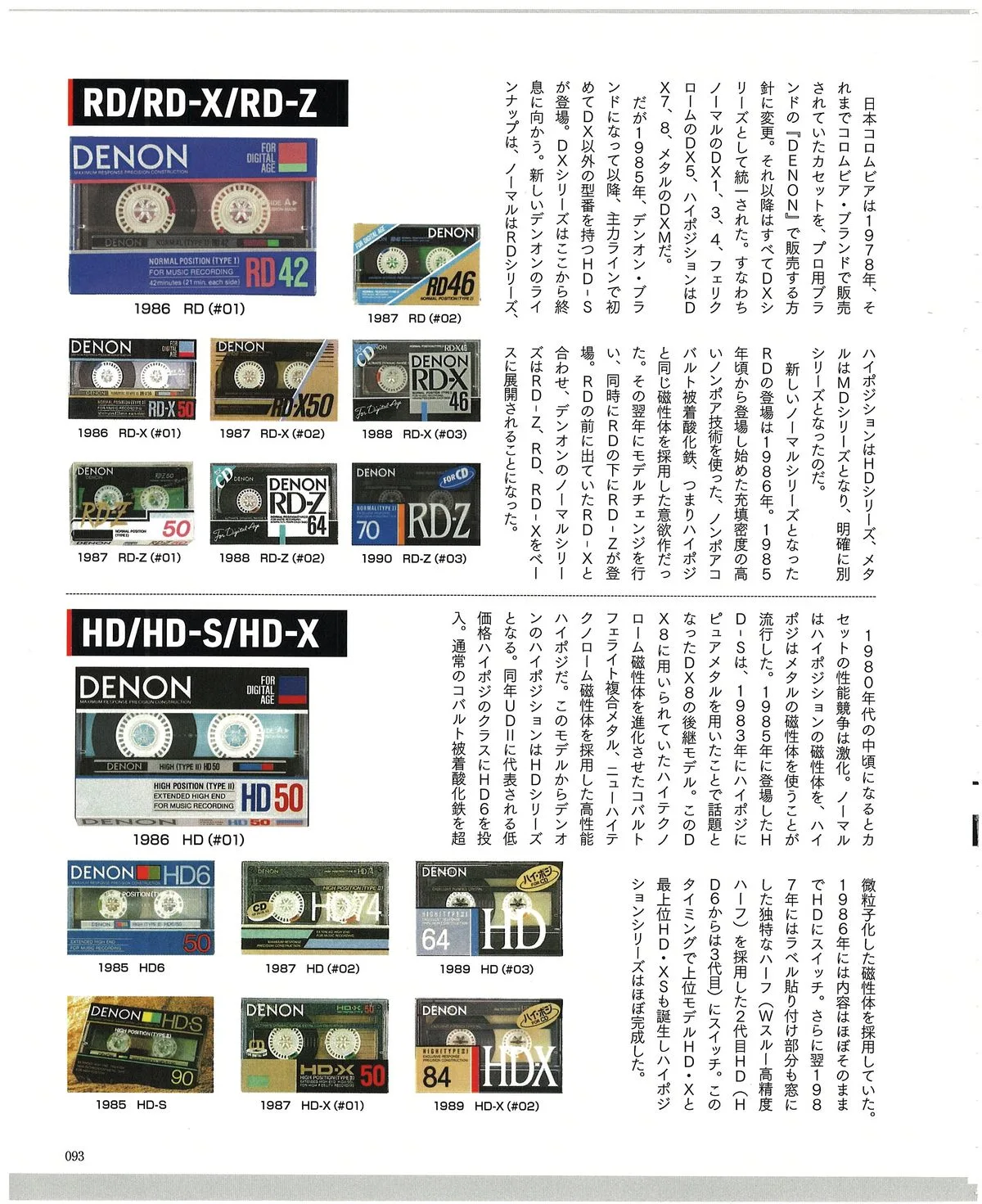
RD 1986 (#01); RD 1987 (#02); RD-X 1986 (#01), 1987 (#02), 1988 (#03); RD-Z 1987 (#01), 1988 (#02), 1990 (#03).
HD/HD-S/HD-X
By the mid-1980s cassette-performance competition had intensified. High-position magnetic materials were used in normal tape, and metal materials in high position. HD-S, introduced in 1985, succeeded DX8, which had attracted attention in 1983 by using pure metal in a high-position cassette.
HD-S was a premium high-position cassette using New High Technolome, a cobalt-ferrite metal composite developed from the High Technolome material in DX8. From this model Denon’s high-position cassettes carried the HD name. That year Denon also released inexpensive HD6, a UD II competitor using ordinary iron oxide with ultra-fine cobalt-coated particles.
In 1986 HD6 became HD with almost the same contents. A second generation followed in 1987. It used an unusual W-through precision shell with two windows, one also serving as the label area. The senior HD-X and flagship HD-XS appeared at the same time, completing the high-position range.
HD 1986 (#01); HD6 1985; HD 1987 (#02) and 1989 (#03); HD-S 1985; HD-X 1987 (#01) and 1989 (#02).