
Hikohachi Sato (佐藤彦八), who had researched ceramic materials before the war, developed a titanium-oxide ceramic capacitor. Taiyo Yuden was founded in March 1950 to mass-produce it. The company later turned to ferrite and in 1954 released a nickel-zinc ferrite core for transistor-radio transformers.
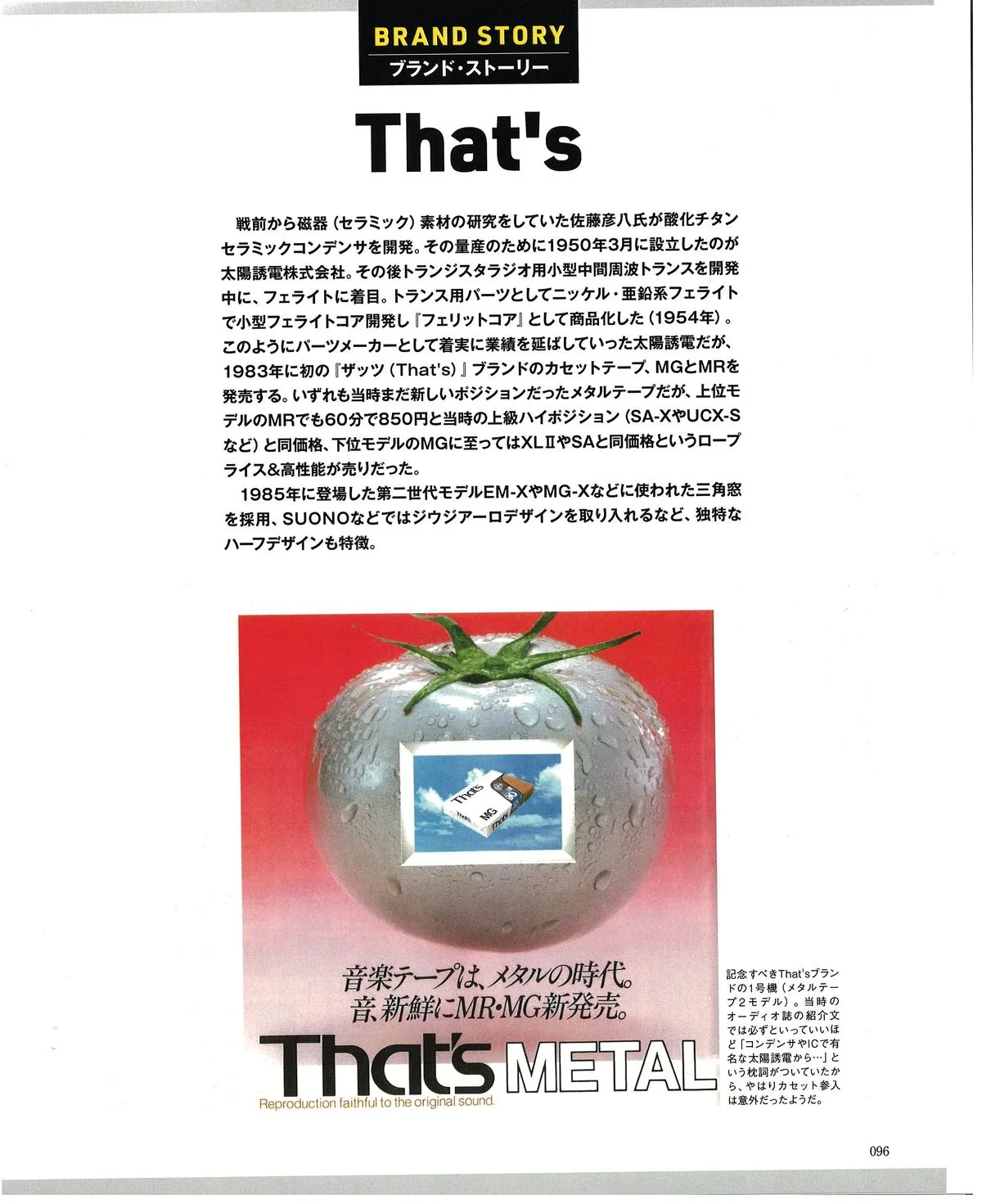
Taiyo Yuden became a successful component maker and in 1983 released its first That’s cassettes, MG and MR. Both were metal tapes, still a new class. Even the 60-minute MR cost 850 yen, the same as premium high-position models such as SA-X and UCX-S. Low prices and high performance were their main strengths. The brand also became known for unusual shells, from the triangular windows of EM-X and MG-X to Giorgetto Giugiaro’s SUONO design.
EVE
The shell with its large triangular window made an unforgettable impression. The story began in 1985 with the second-generation MG-X, EM-X and FX. That’s first offered performance a class above the price, then released the colourful RX series, extending the design idea to High and Metal with EVE.
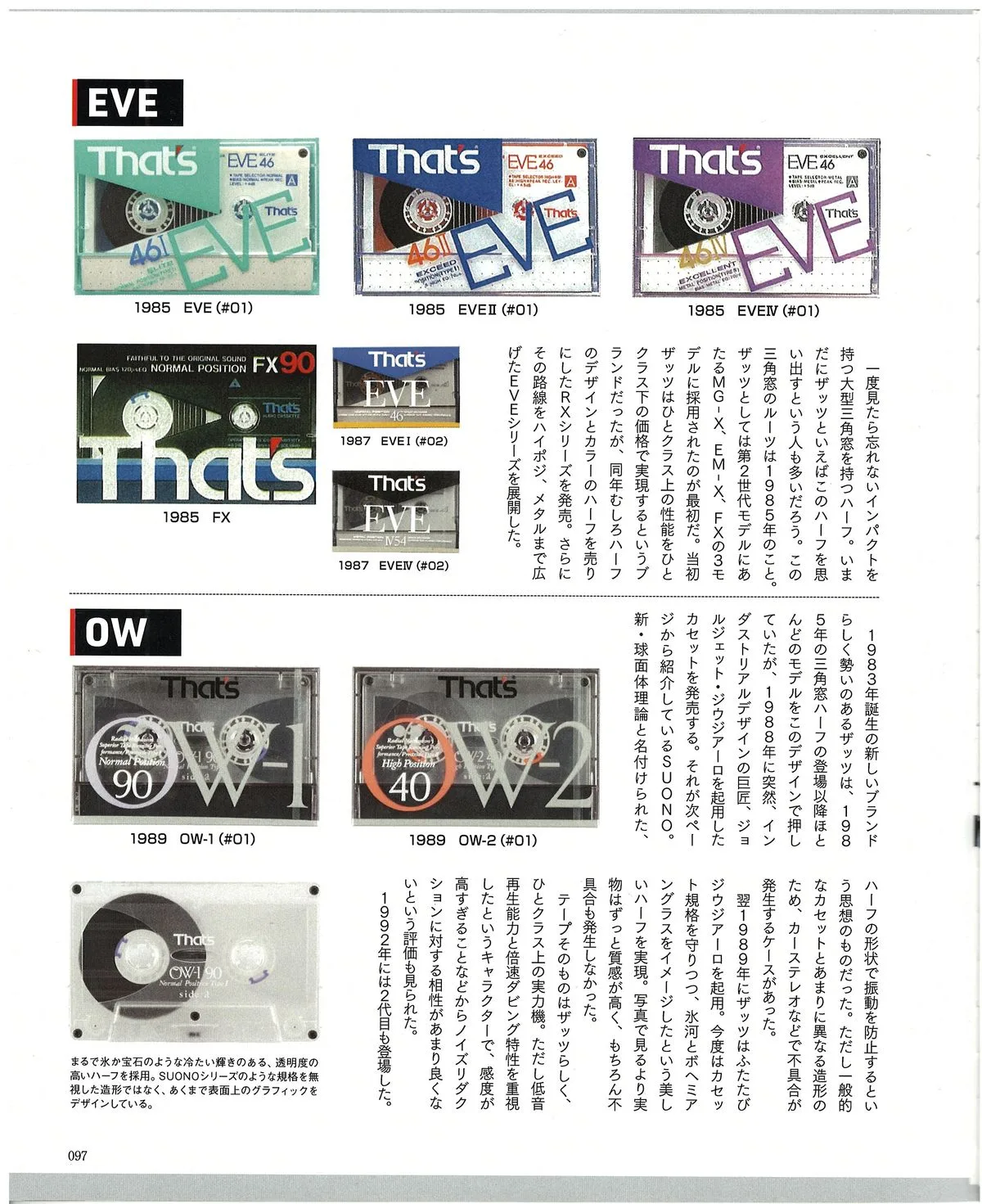
EVE, EVE II and EVE IV 1985 (#01); FX 1985; EVE I and EVE IV 1987 (#02).
OW
After the triangular-window shell appeared in 1985, the energetic young That’s brand used it for almost every model. In 1988 it unexpectedly invited industrial designer Giorgetto Giugiaro to create SUONO, based on a “new spherical-body theory” intended to prevent vibration. Its unusual shape could cause problems in car stereos.
In 1989 Giugiaro returned and designed a beautiful shell inspired by glaciers and Bohemian glass while respecting the cassette standard. OW looked far better in person than in photographs and caused no compatibility problems. The tape had performance a class above, but its emphasis on low frequencies and double-speed copying, together with high sensitivity, led some listeners to find it a poor match for noise reduction. A second generation appeared in 1992.
OW-1 and OW-2, 1989 (#01). The transparent shell had a cold shine like ice or a gemstone; unlike SUONO, its shape stayed within the standard and the design was limited to surface graphics.