


Scotch
Soon after the war, in 1947, the American company 3M developed the world’s first sound-recording tape and released acetate-based #111 in 1948. It was imported into Japan in the 1950s. 3M later made computer and video tape as well. Nippon Minnesota 3M was established in 1960, Sumitomo Minnesota in 1961, and Sumitomo 3M in 1962. Japanese sound-tape production, including #111, began in 1963. The Sagamihara magnetic-products plant opened in 1970 and Yamagata 3M’s cassette-assembly plant followed in 1971. Video tape gradually became the main product, and the Japanese cassette business was repeatedly reduced before fading away.
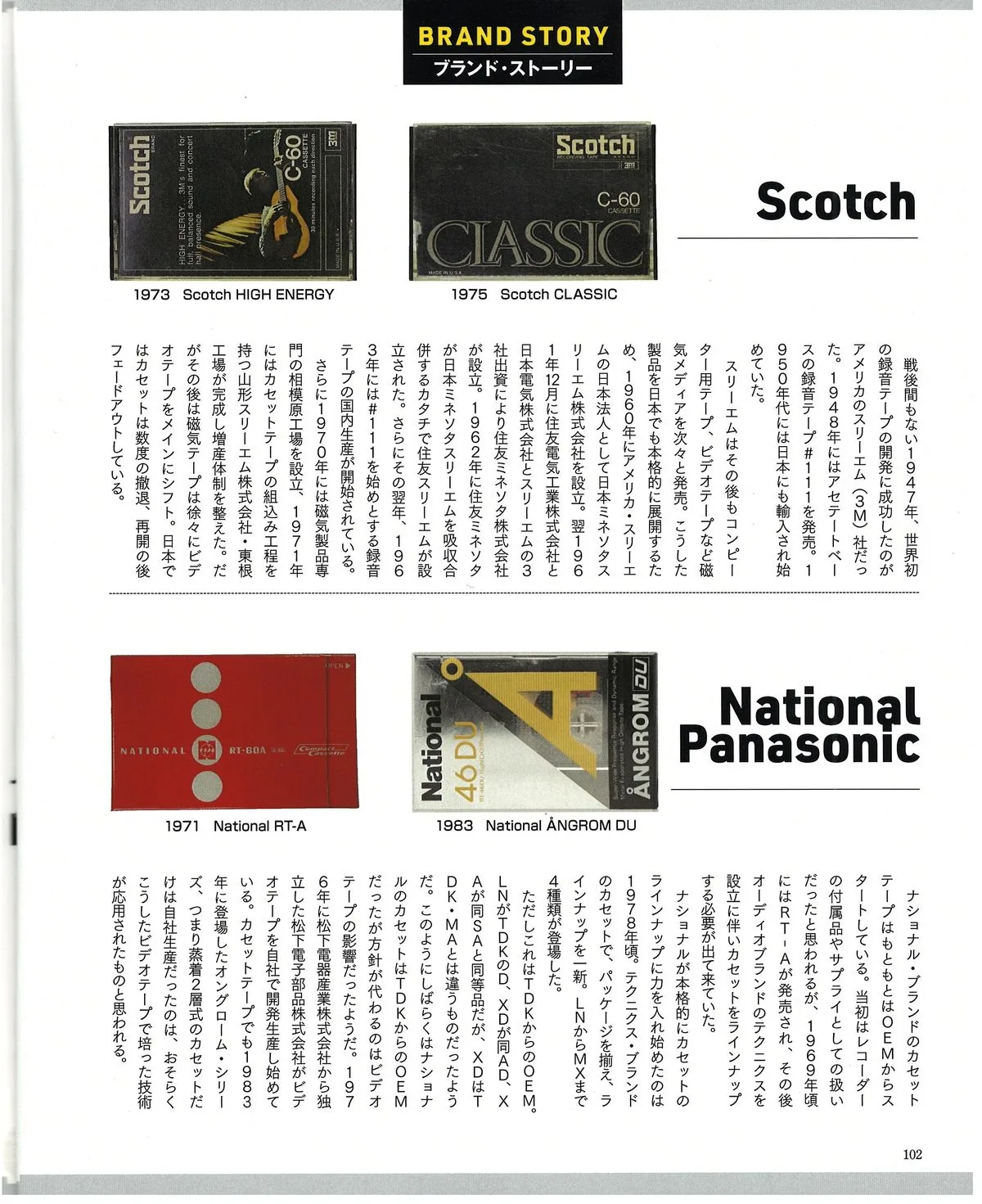
Scotch HIGH ENERGY 1973; Scotch CLASSIC 1975.
National / Panasonic
National cassettes were initially made to OEM order, probably as accessories or consumables for tape recorders. RT-A appeared around 1969, and the creation of the Technics audio brand created a need for cassettes in its range. Around 1978 National expanded the line seriously. Technics packaging was unified and the range was renewed from LN to MX.
TDK made the OEM cassettes: LN corresponded to TDK D, XD to AD and XA to SA, although XD seems to have differed from TDK MA. Matsushita’s video-tape technologies later led to the independently produced two-layer ÅNGROM series, introduced in 1983.
National RT-A 1971; National ÅNGROM DU 1983.
Victor
Japan Victor’s cassette history began in 1967, when it became the first Japanese company to release music cassettes. Blank cassettes followed in 1968. A tape division was created in March 1971 and its Mito plant completed in October. Victor is best remembered for metal tape and for being the first Japanese maker to release a metal-compatible cassette deck, developed in cooperation with Scotch. Victor’s own blank-cassette production began in earnest after the tape division became Victor Magne Tape in 1979. The company later grew successfully, helped by the video-tape boom.
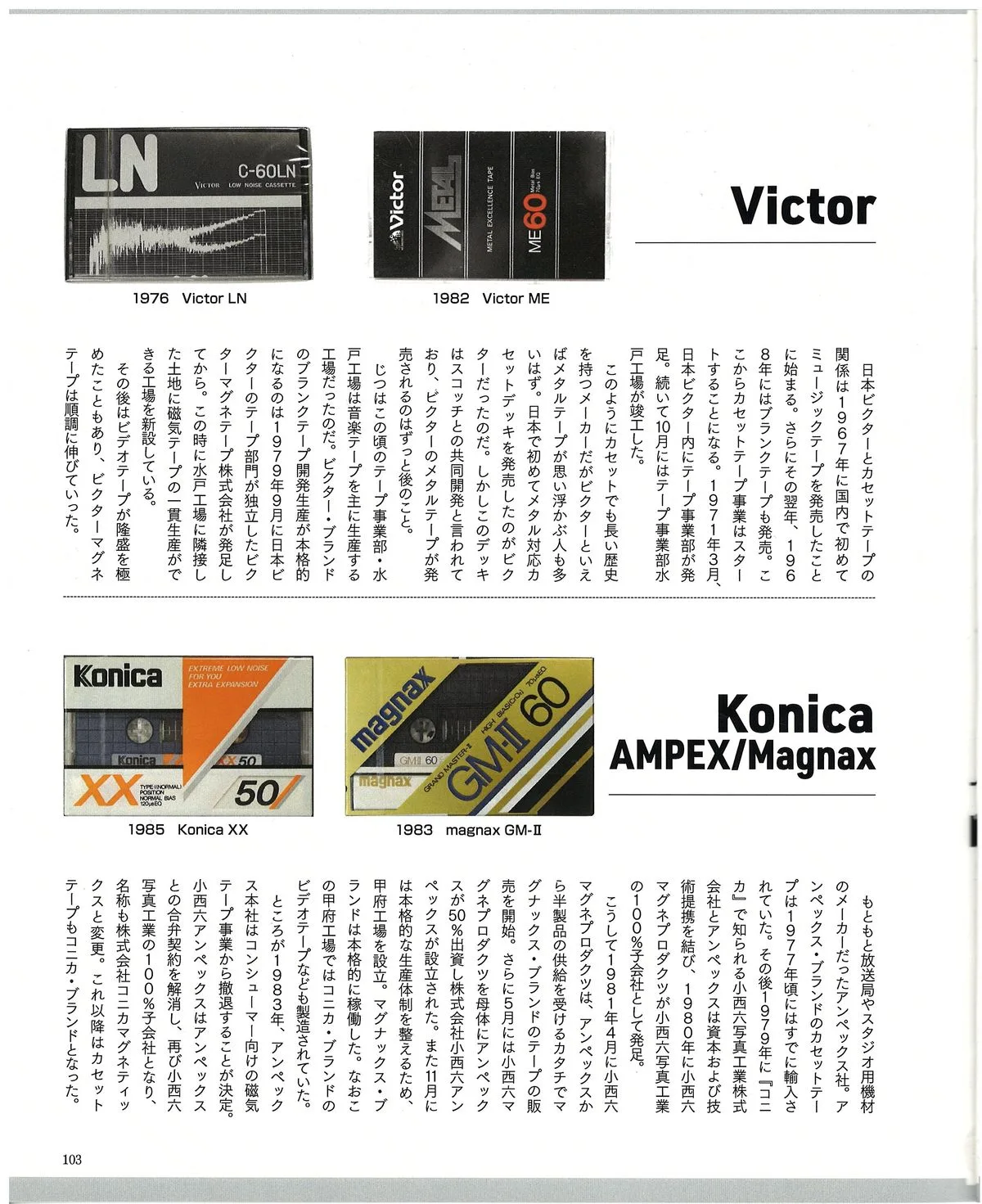
Victor LN 1976; Victor ME 1982.
Konica / AMPEX / Magnax
Ampex originally made broadcast and studio equipment. Its cassettes were imported into Japan by about 1977. In 1979 Ampex signed a capital and technical cooperation agreement with Konishiroku Photo Industry, the Konica brand. Konishiroku Magne Products was established as a wholly owned subsidiary in 1980.
In April 1981 it began selling Magnax tape using semi-finished material from Ampex. Konishiroku Ampex was established in May with Ampex contributing half the capital, and a Kofu plant opened in November for full production. Konica video tape was made there as well. When Ampex withdrew from consumer magnetic tape in 1983, the joint venture ended, the company became Konica Magnetics, and cassettes were sold under the Konica name.
Konica XX 1985; magnax GM-II 1983.