





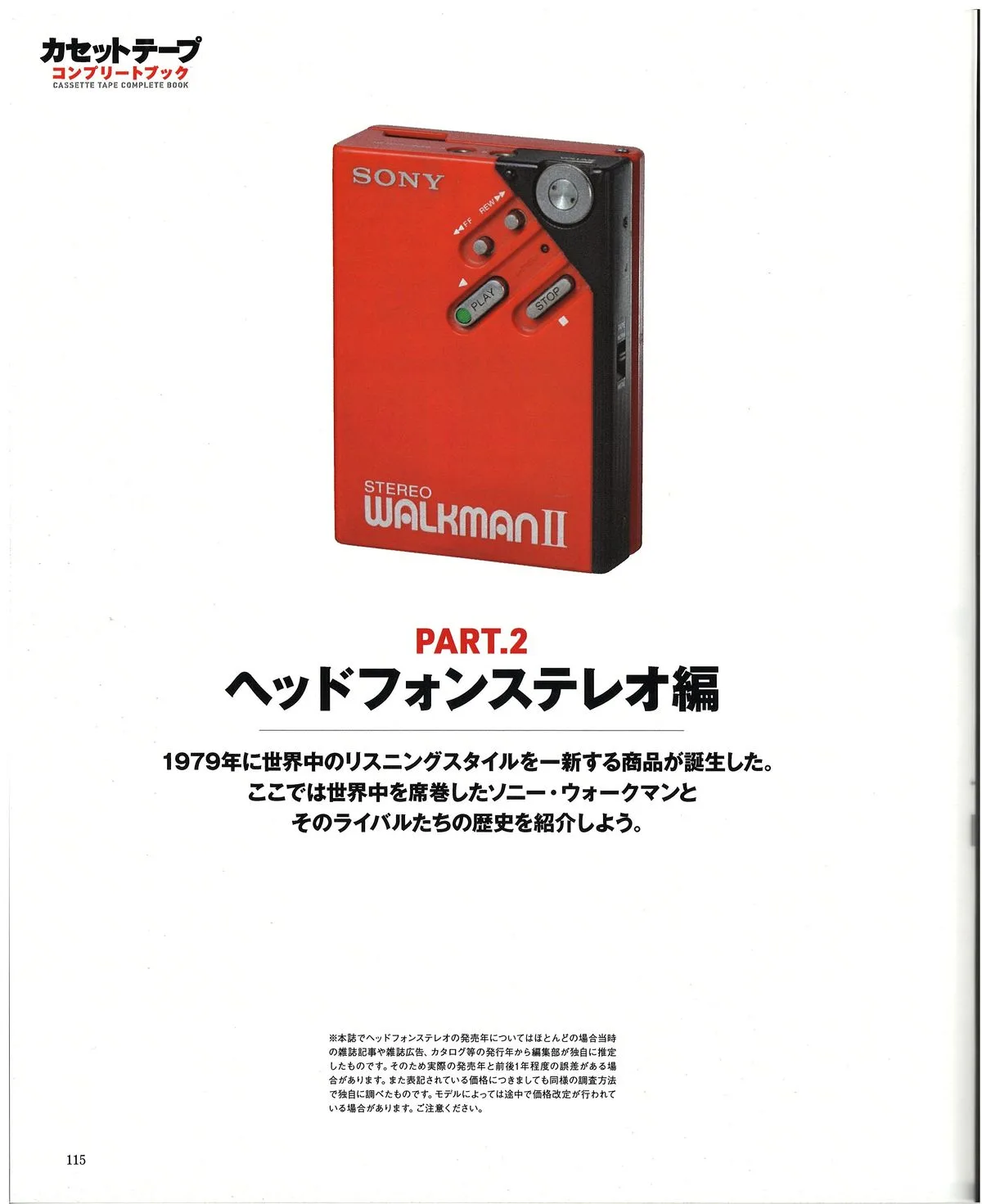
Part 2. Portable headphone stereos
In 1979 a product changed the way people around the world listened to music. This section follows Sony Walkman and its rivals. Release years in the book were reconstructed from period articles, advertisements and catalogues and may differ by about a year; prices were researched in the same way.
The evolution of portable cassette players
The story began with Sony TPS-L2 in 1979. Portable players transformed music from a living-room activity into something enjoyed on the way to work, school or travel. Japanese makers then competed in miniaturisation, durability and battery life. WM-20 reached cassette-case size in 1983, and WM-101 achieved a genuinely flat cassette-sized body in 1985 with a flat rechargeable battery. Designers refined mechanisms for lower power consumption until the last Walkman shipped in 2008.
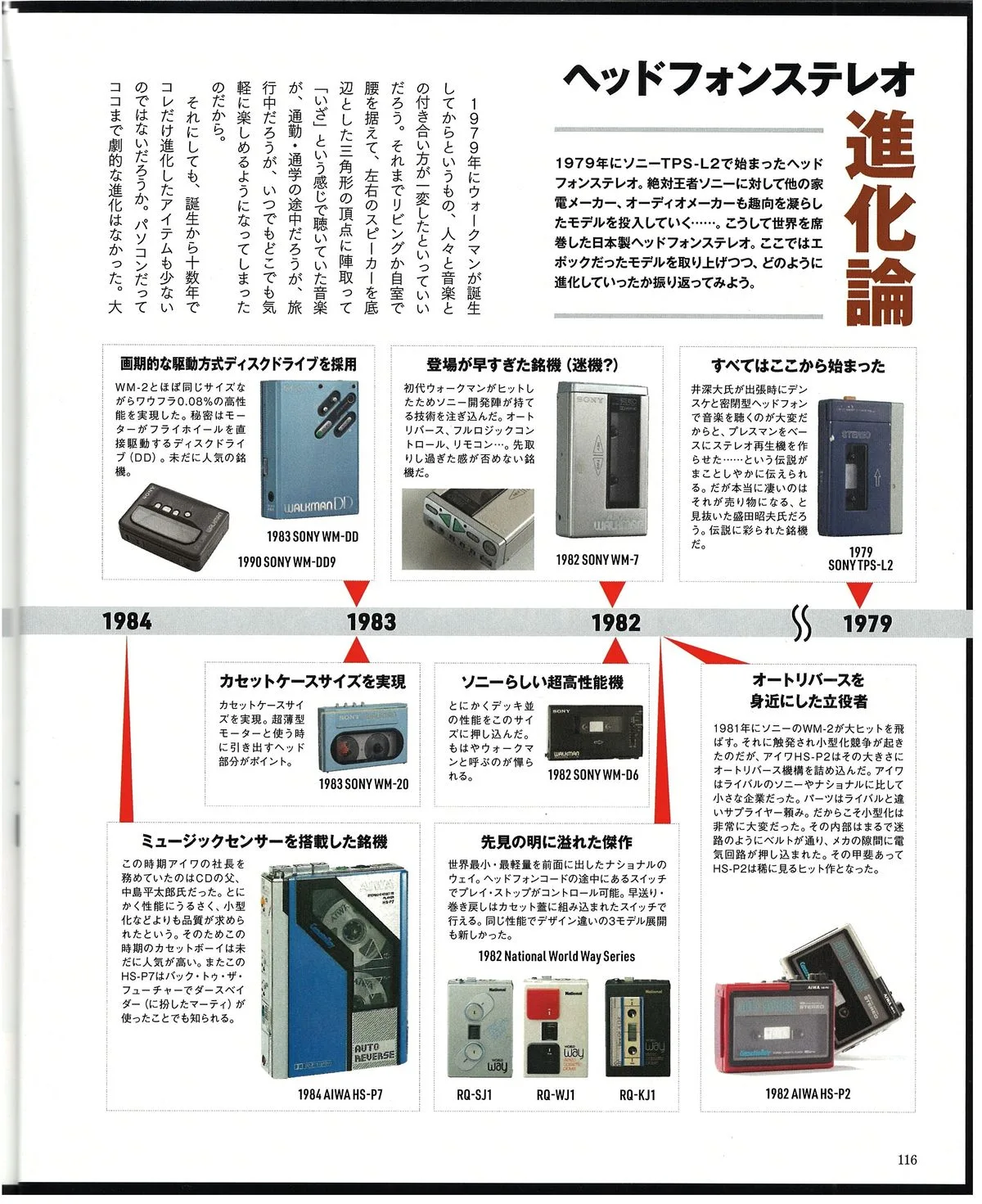
It started here
1979 Sony TPS-L2. The legend says Masaru Ibuka wanted music during business trips and asked for a stereo player based on Pressman. Akio Morita’s real insight was recognising that it could be sold.
A famous model that arrived too early
1982 Sony WM-7. Auto-reverse, full-logic control and a remote packed in every available technology. It was ahead of its time.
Revolutionary disc drive
1983 Sony WM-DD and 1990 WM-DD9. Directly driving the flywheel from the motor achieved wow and flutter of only 0.08 percent in almost WM-2 dimensions.
Making auto-reverse affordable
1982 Aiwa HS-P2. Aiwa fitted auto-reverse into the WM-2 size, using a maze of belts and electronics squeezed between mechanical parts. The effort made HS-P2 a remarkable success.
A full deck’s performance
1982 Sony WM-D6. Its deck-level performance in a body this size made it almost embarrassing to call it a Walkman.
Cassette-case size
1983 Sony WM-20. A thin motor and sliding head block achieved cassette-case dimensions.
A visionary product
1982 National World Way Series RQ-SJ1, RQ-WJ1 and RQ-KJ1. The series stressed world-leading size and weight, with cord controls and a cassette-door rewind switch.
A music-sensor model
1984 Aiwa HS-P7. Aiwa president Heitaro Nakajima demanded performance over miniaturisation. HS-P7 was also used by Marty disguised as Darth Vader in Back to the Future.
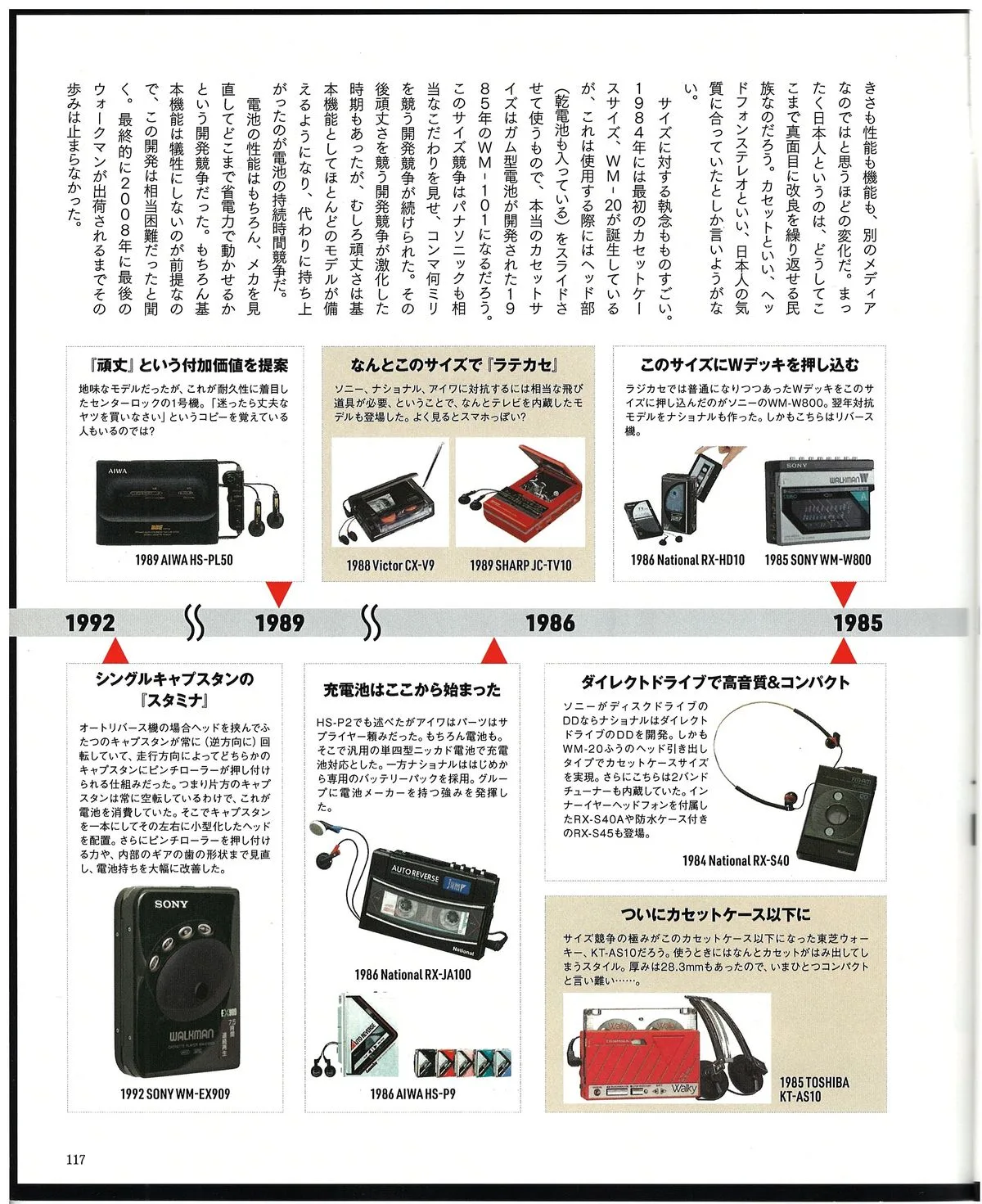
Two decks in a tiny shell
1985 Sony WM-W800 and 1986 National RX-HD10. Sony fitted two decks into a portable body, and National followed with a rival that also had reverse.
Radio, television and cassette player
1988 Victor CX-V9 and 1989 Sharp JC-TV10. To compete with Sony, National and Aiwa, makers even built players with an integrated television.
Durability as an extra virtue
1989 Aiwa HS-PL50. An understated model, it was the first with a central latch and an emphasis on strength.
Direct drive for quality and compactness
1984 National RX-S40. National’s DD meant Direct Drive, unlike Sony’s Disc Drive. A sliding head block achieved cassette-case size, and a dual-band tuner was built in.
Rechargeable batteries begin
1986 National RX-JA100 and Aiwa HS-P9. Aiwa used standard AAA nickel-cadmium cells, while National developed a proprietary battery pack within its group.
Finally smaller than a cassette case
1985 Toshiba KT-AS10. Toshiba Walky became smaller than a cassette case, with the cassette protruding during use, although its 28.3 mm thickness limited its practicality.
Endurance with one capstan
1992 Sony WM-EX909. Auto-reverse players normally kept two capstans spinning in opposite directions, wasting battery power. Sony used one capstan, smaller heads on both sides, revised pinch pressure and redesigned gear teeth to extend battery life.