
A very small world
Sony’s recording machines ranged from reel-to-reel decks to microcassette recorders. The Walkman also had a professional recording version: WM-D6 and WM-D6C.
Photo: Takamasa Miyakoshi (宮越孝政). Text: Shigeo Makino (牧野茂雄). With Sony’s cooperation. Adapted from Stereo Generation vol. 4.
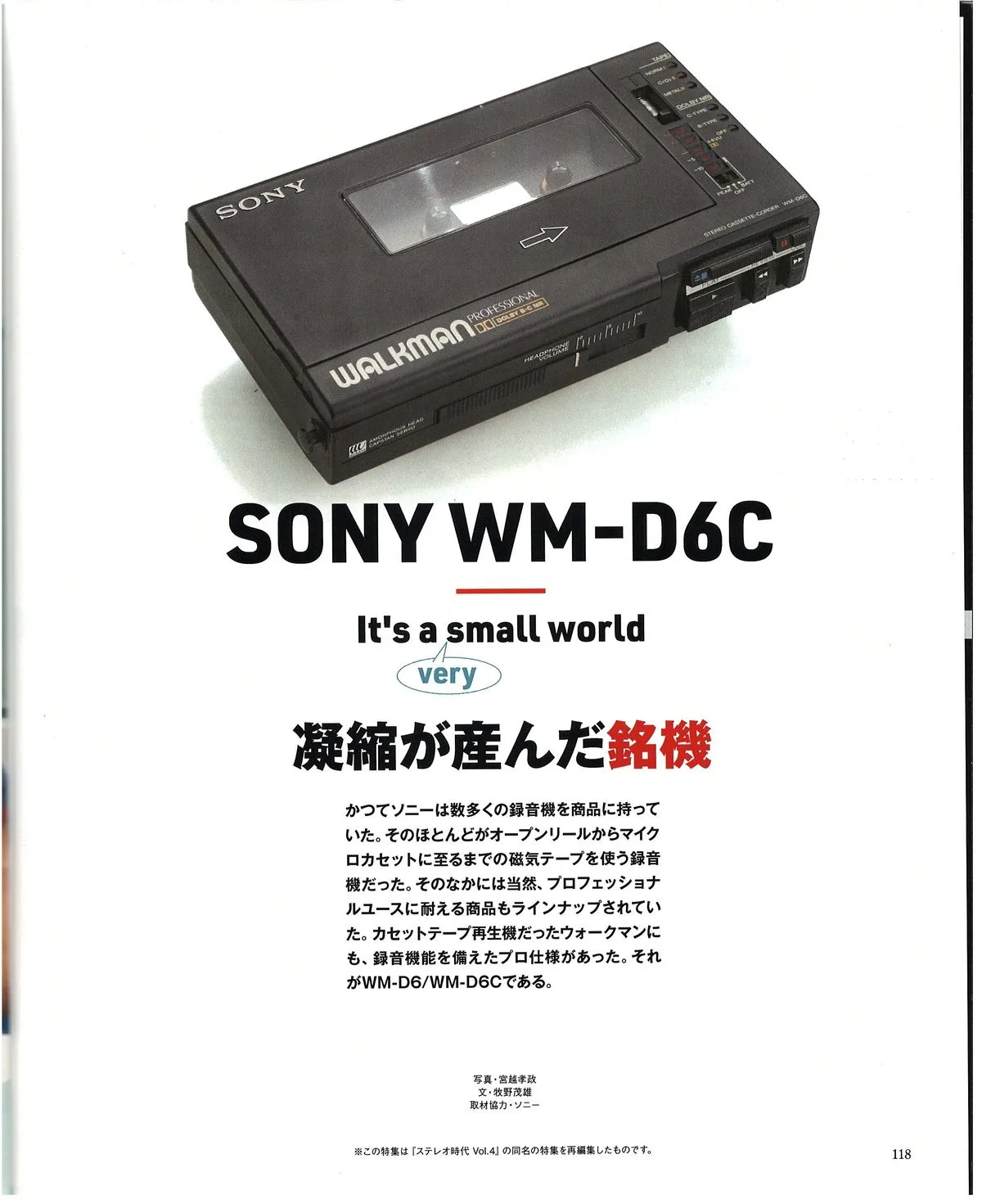
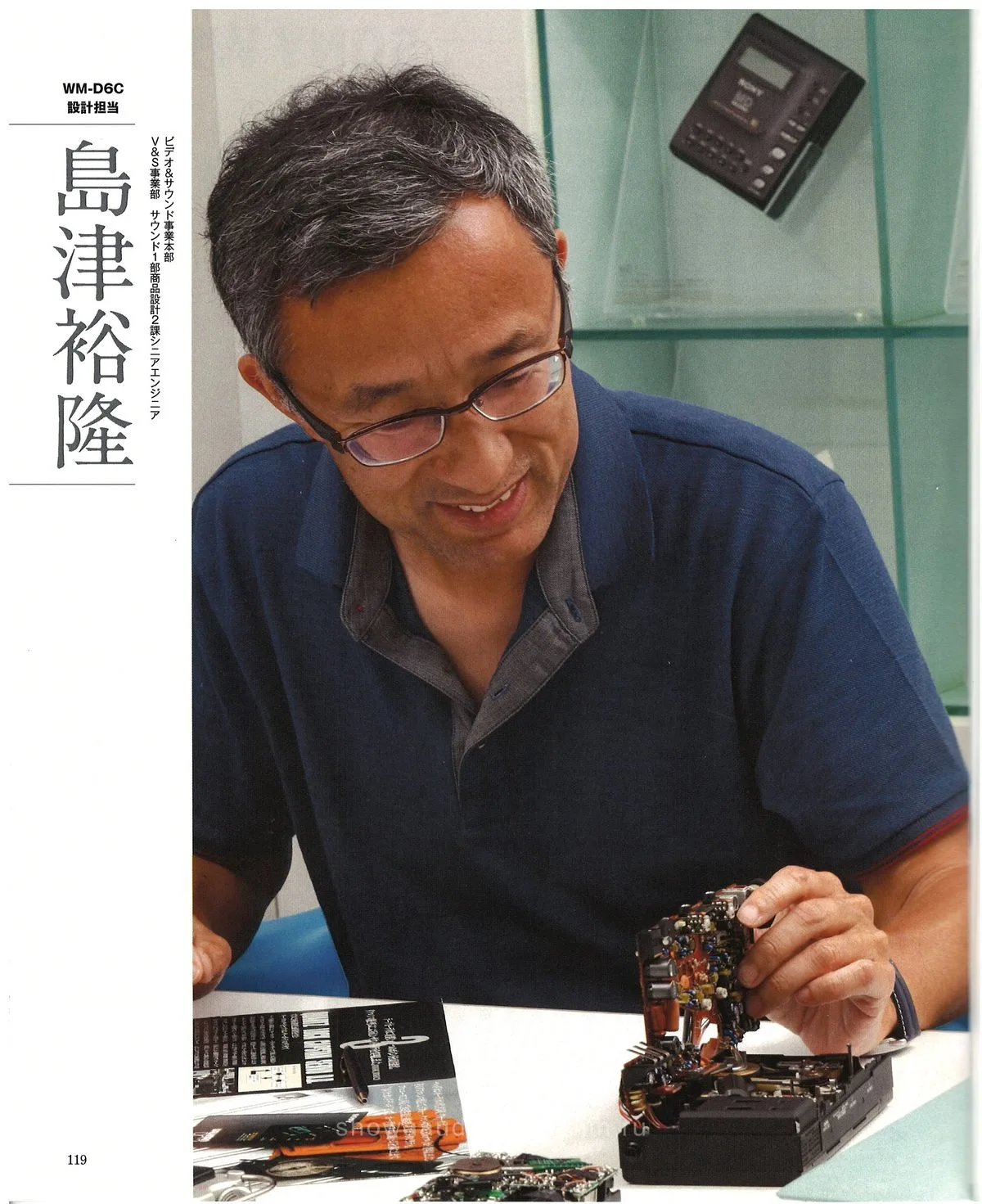
Senior engineer Hirotaka Shimazu (島津裕隆) was responsible for WM-D6C. Although the outside of D6 and D6C barely changed, their interiors were almost entirely different. D6C added Dolby C, separated line and microphone inputs and allowed the red level LEDs to be switched off. To make room, one of D6’s two headphone sockets was removed.
Dolby C in a portable recorder
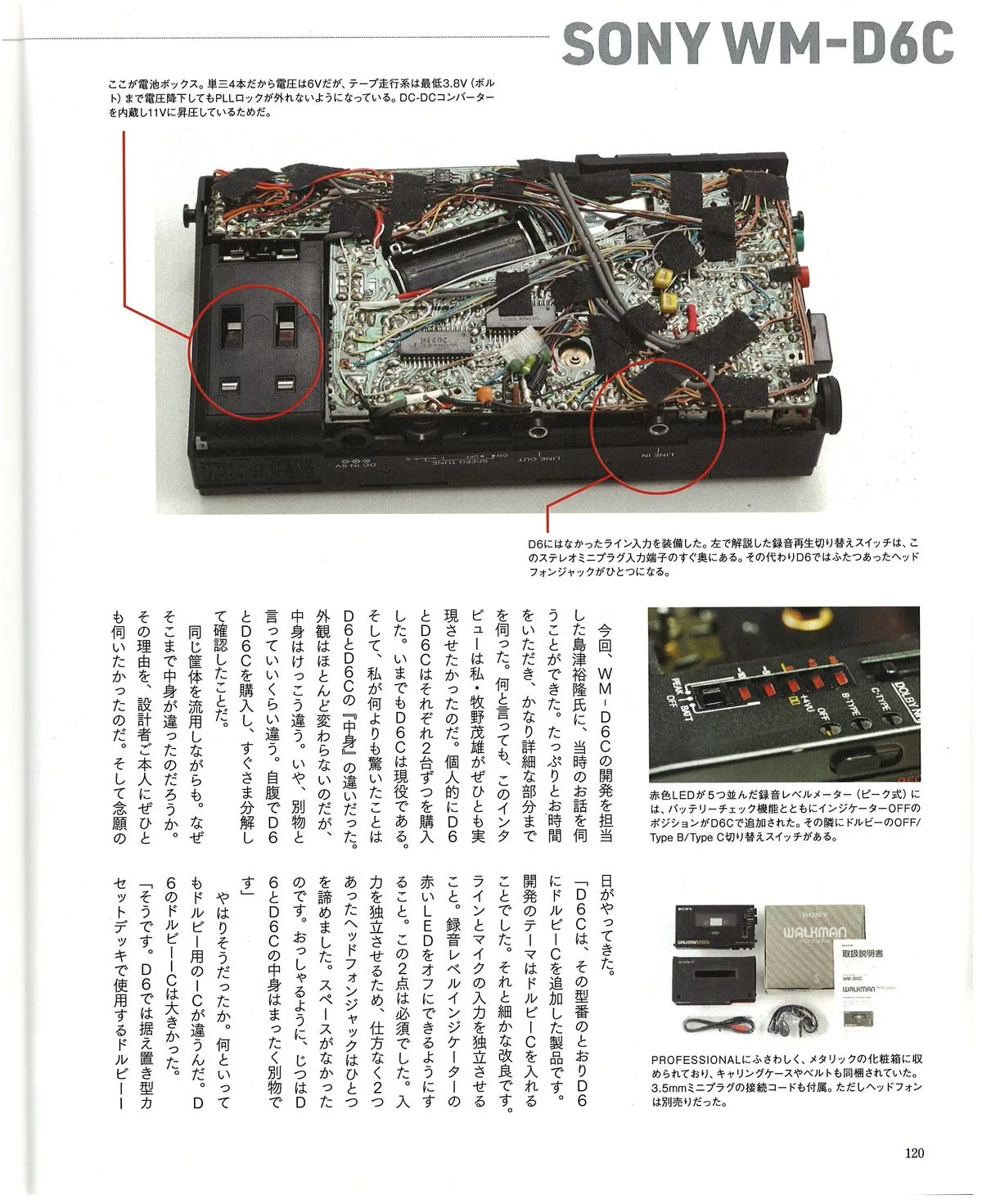
Four AA cells supply 6 V, while a DC-DC converter raises the voltage to 11 V and the PLL transport remains synchronised down to 3.8 V. Sony developed a compact Dolby C chip for portable equipment and a new servo chip as well. The fixed shell dimensions left no room for error, so Shimazu laid out leaded components at their maximum permitted dimensions, bending leads and placing parts almost by hand.
The professional package included a metal-finish box, case, strap and 3.5 mm connecting cable. Headphones were sold separately.
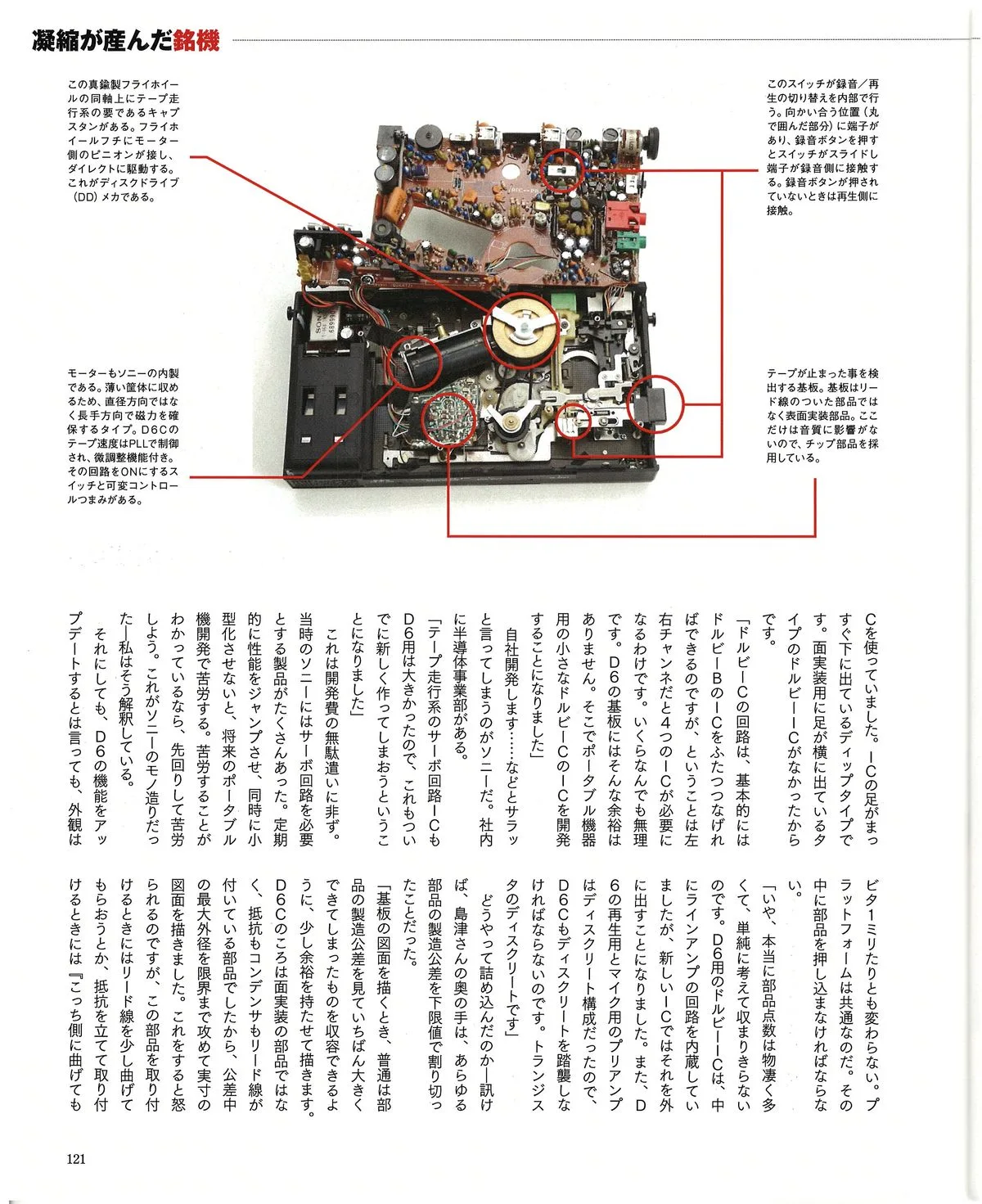
The DD mechanism directly drives the brass flywheel from the motor gear. Sony made the thin motor itself, using length rather than diameter for magnetic force. PLL speed control offered fine adjustment. Surface-mount parts were used only where they did not affect sound; audio-critical positions retained leaded components to preserve the character of the original D6.
Without CAD, Shimazu first fitted the circuit with paper and pencil. About 80 connecting wires proved impossible to manufacture; redesign reduced them to about 40, and later production around serial number 270,000 changed to surface-mount components.
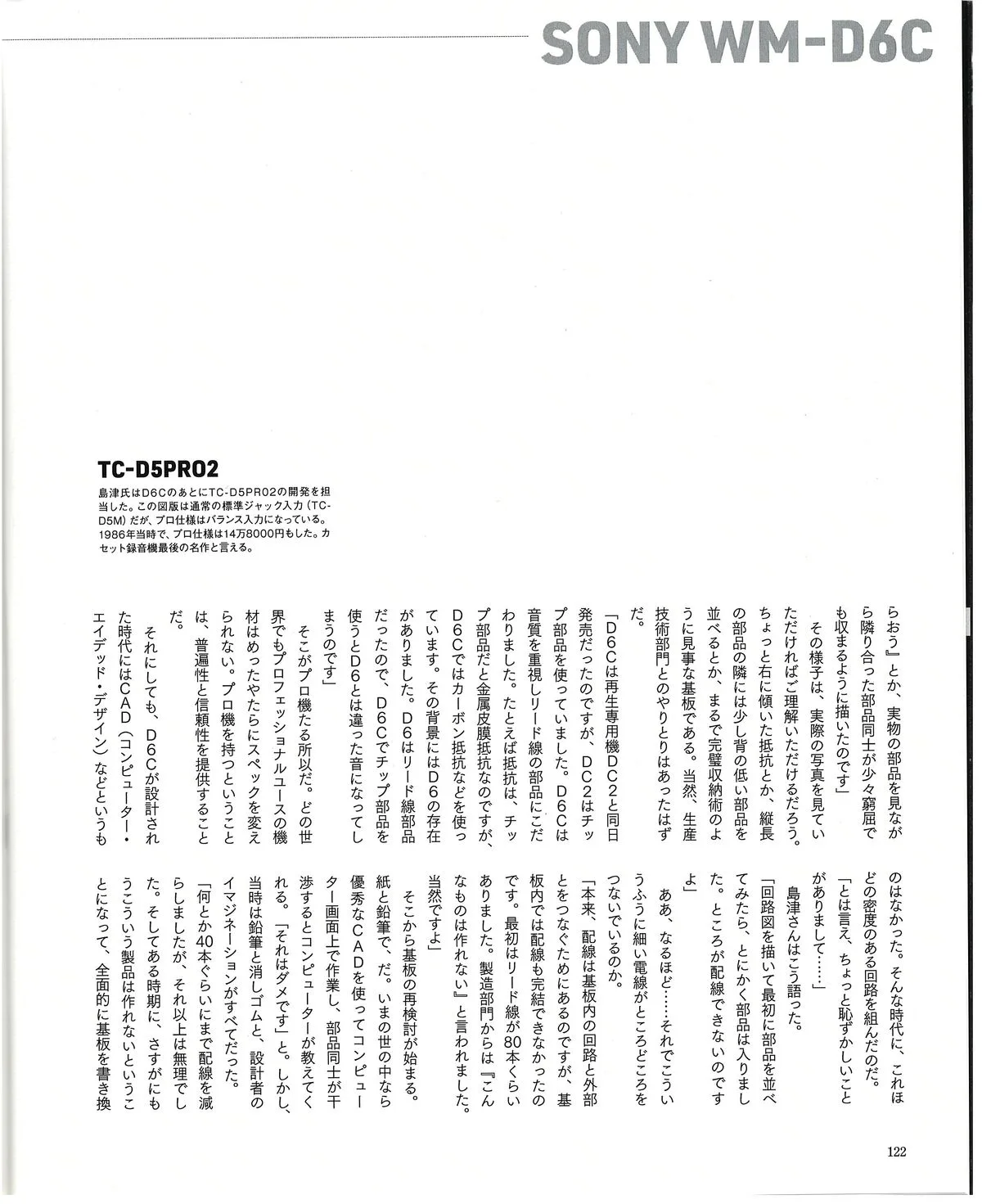
After D6C, Shimazu developed TC-D5PRO2 with balanced inputs. He also explained that Dolby C required repeated calibration for Normal, High and Metal tapes. A non-flat response is exaggerated by Dolby C, so Sony had to tune each tape type and obtain Dolby Laboratories approval.
A product of its era
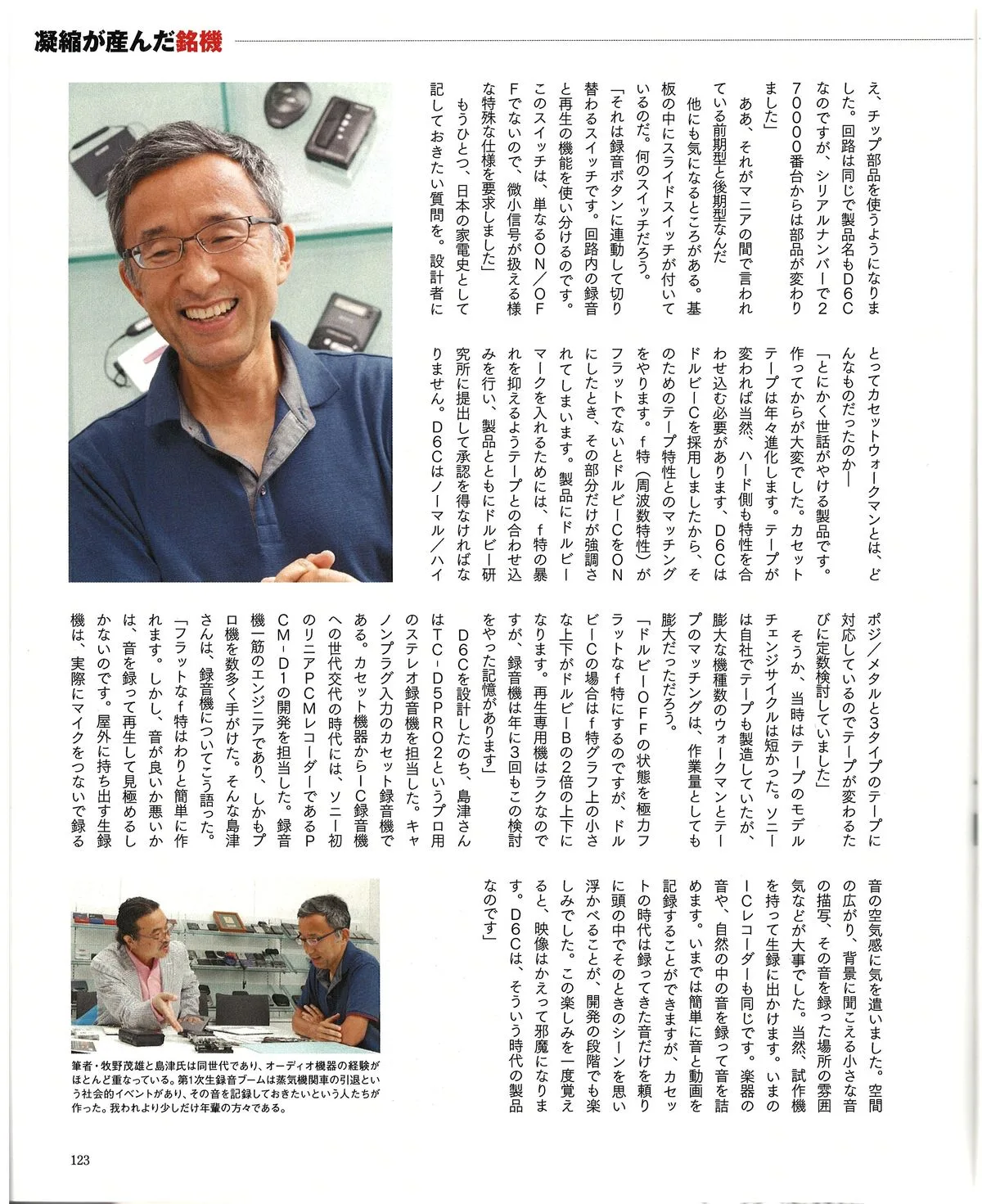
Shimazu later worked on Sony’s PCM-D1 linear PCM recorder. He says a flat frequency response is easy to obtain; judging sound requires recording and playback. For live recording the engineers valued space, quiet background sounds and a sense of place. WM-D6C belongs to an era when a developer could imagine a scene from the recording alone, without a screen.