
How an NR System Works
As you become more skilled at using tape, tape noise begins to bother you. This is where an NR (noise reduction) system comes to the rescue. It greatly reduces the tape noise generated during recording and playback. Let’s look at its principle and how to use it.
Tape Noise Is Most Noticeable in Pianissimo Passages
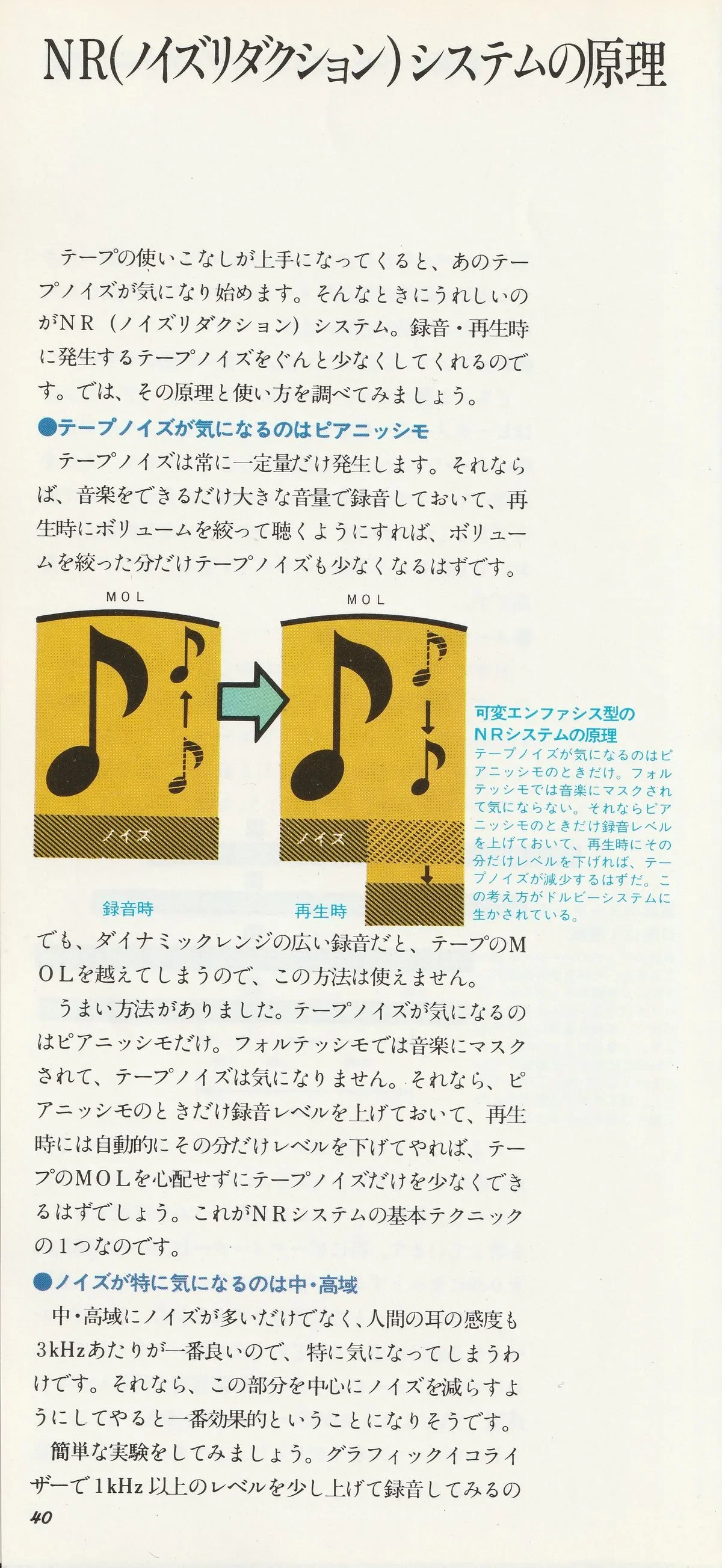
Tape noise always occurs at the same constant level. So if we record music as loudly as possible and turn down the volume during playback, the tape noise should in theory fall by exactly the amount we turn the volume down.
But this method is unsuitable for recording with a wide dynamic range: the signal would exceed the tape’s MOL.1
Fortunately, a solution was found. Tape noise is only bothersome in pianissimo passages. In fortissimo passages it is masked by the music, so there is no need to worry about it. If we raise the recording level only in pianissimo passages and automatically lower it by the same amount during playback, we can reduce only the tape noise without worrying about the tape’s MOL. This is one of the basic techniques of an NR system.
The principle of sliding-emphasis NR (caption to page 40): Tape noise is bothersome only in pianissimo passages. In fortissimo passages it is masked by the music and goes unnoticed. So if the recording level is raised only in pianissimo passages and lowered by the same amount during playback, tape noise should in theory be reduced. This idea is the basis of the Dolby system.
Noise Is Especially Noticeable at Mid and High Frequencies
It is not just that there is more noise in the mid and high frequencies: the human ear is also most sensitive around 3 kHz, so noise is especially conspicuous there. It therefore seems most effective to reduce noise first in this range.
Let’s perform a simple experiment. Take a graphic equalizer and make a recording with the level above 1 kHz slightly raised. Then set the equalizer to the inverse curve, lowering the level above 1 kHz by the same amount, and play the tape. In theory, the tone will not change at all, while tape noise will decrease.
This is another important NR technique. Recording and playback with a permanently altered frequency response is called “fixed emphasis”. A method in which this change depends on the level of the music is called “sliding emphasis”. This is the basic technique on which systems such as Dolby are built.
There are many NR systems, but almost all can be considered combinations of these techniques. Each system has its own combination and operating method, however, so if you use one system for recording and another for playback, the tone will change.
An NR system is designed to preserve the tone of the program source - a record, FM broadcast and so on - while reducing only the noise generated on tape during recording. Therefore, a noisy record will be recorded faithfully with all its noise. NR is most effective with good-sounding sources that are as free of noise as possible.
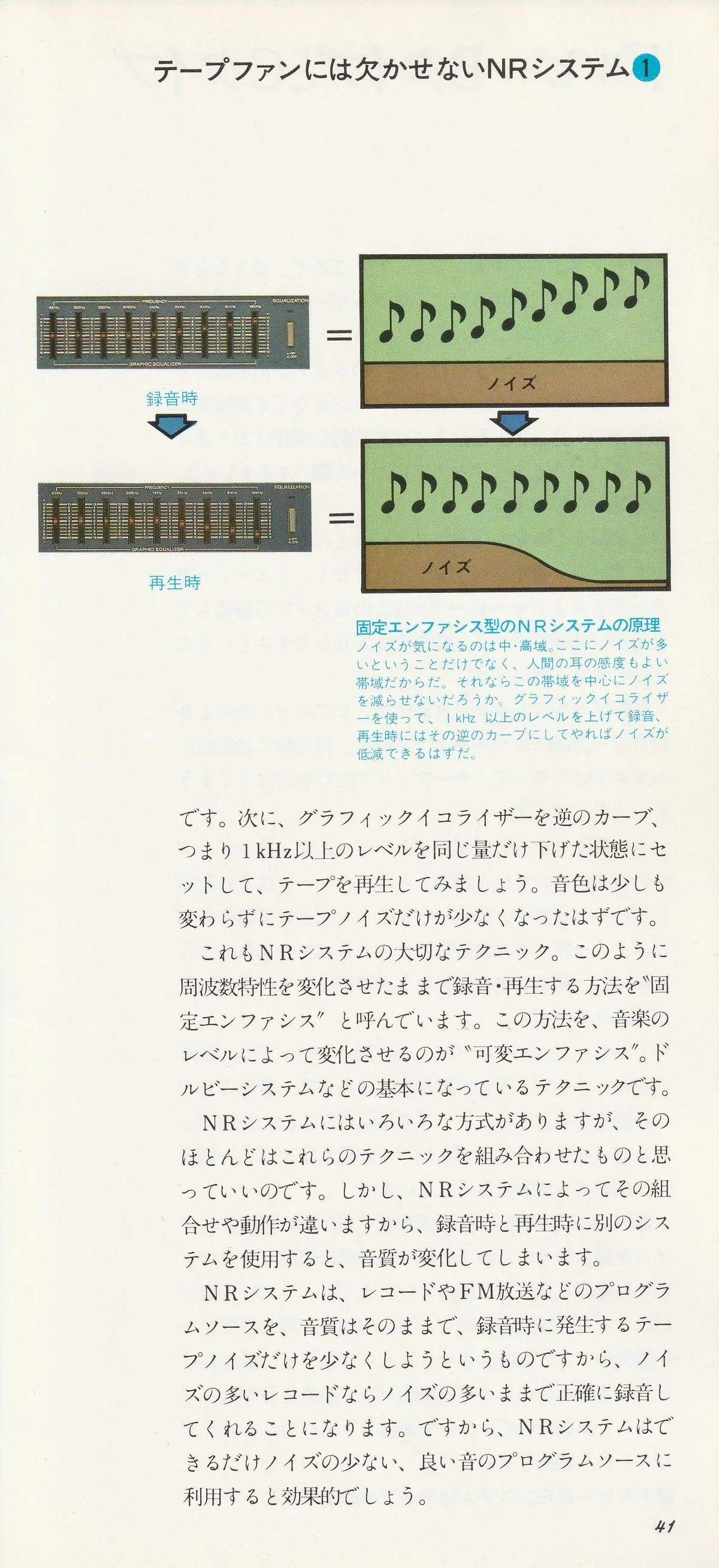
The principle of fixed-emphasis NR (caption to page 41): Noise is bothersome at mid and high frequencies. Not only is there more noise there, but this is also the range where the human ear is sensitive. Could we reduce noise in this range? Using a graphic equalizer, raise the level above 1 kHz during recording, then use the inverse curve on playback. In theory, the noise should decrease.
Dolby B-type and C-type
Now that we understand the NR principle, let’s look at Dolby NR, used in almost every deck.
There are three types of Dolby NR, but A-type is a professional system for recording studios and does not directly concern us. Let’s examine the other two.
Standard B-type
B-type is the most familiar. Not only is it used in almost every cassette deck, but prerecorded music cassettes from major labels are also usually recorded with B-type. I think it is fair to call it the standard NR system.
It works on the sliding-emphasis principle. The idea is to raise the mid and high frequencies during recording only in pianissimo passages, then lower them on playback, reducing only tape noise.
Its reference point is Dolby level.2 The □□ (Dolby) mark on the deck’s meter scale indicates this level. Above it, tape noise is considered fully masked by the music and not bothersome, so no special processing is needed.
Below Dolby level, however, tape noise begins to show through between the notes. The lower the music level, the more bothersome the noise, so Dolby NR boosts high frequencies more during recording as the level falls.
As a result, noise above 5 kHz is reduced by about 10 dB, to roughly one third, which is more than enough for listening to tape in an ordinary room. The reason noise reduction operates only at mid and high frequencies is twofold: it removes noise where the ear is most sensitive, while low frequencies often contain relatively powerful signals such as the rhythm section, so noise there should not be especially troublesome.
Tape Sensitivity Is Crucial in Dolby NR
Dolby NR automatically changes mid- and high-frequency levels according to music level during recording and playback. Therefore, if recording and playback levels differ, the NR processing will differ too.
If tape sensitivity is high and the signal plays back at a higher level than it was recorded, the playback NR system treats it as an originally louder signal and processes it accordingly. It restores the signal with less reduction than the boost applied during recording, leaving the high-frequency response raised by the difference. Conversely, if tape sensitivity is low, the high frequencies will be muffled.
The secret to Dolby NR, then, is to use good tape.
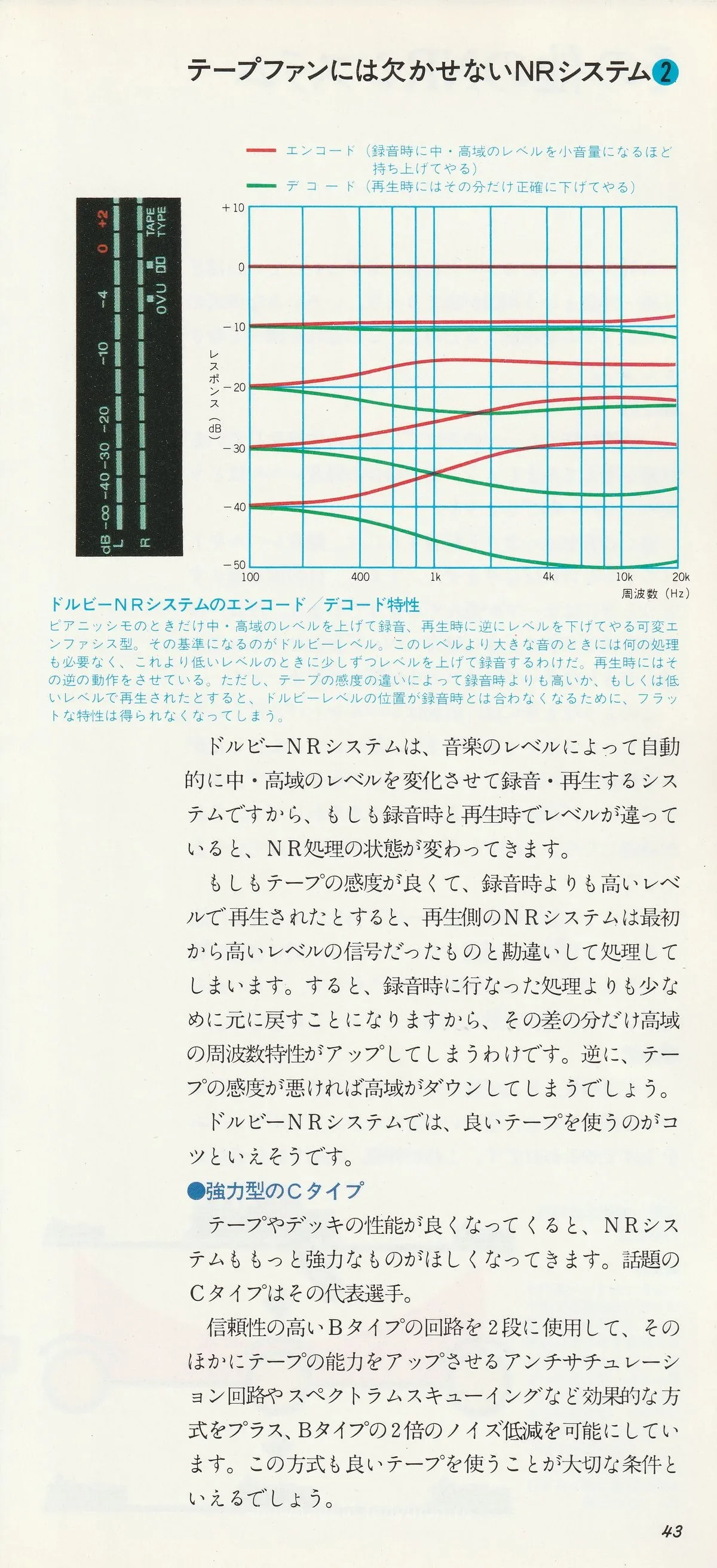
Dolby NR encode/decode characteristics (caption to page 43): In sliding emphasis, mid and high frequencies are raised during recording only in pianissimo passages and lowered during playback. Dolby level is the reference. Signals louder than this need no processing; below it, the recording level is gradually raised. Playback performs the inverse operation. However, if different tape sensitivity causes playback at a higher or lower level than recording, Dolby level no longer coincides with its position during recording and a flat response cannot be obtained.
Graph legend: Encoding - during recording, mid and high frequencies are raised more as the signal gets quieter. Decoding - during playback, they are lowered by exactly the same amount.
Enhanced C-type
As tapes and decks improve, we also want something more powerful from NR. The most prominent example is the much-discussed C-type.
It uses the proven B-type circuit twice in succession and adds effective techniques that increase tape capability: an anti-saturation circuit3 and spectral skewing.4 Together these allow twice as much noise reduction as B-type. Here too, good tape is an important requirement.
Other NR Systems
The terms “compression” and “expansion” almost certainly appear in NR system catalogs. To understand the different types, let’s see what they mean.
Compression
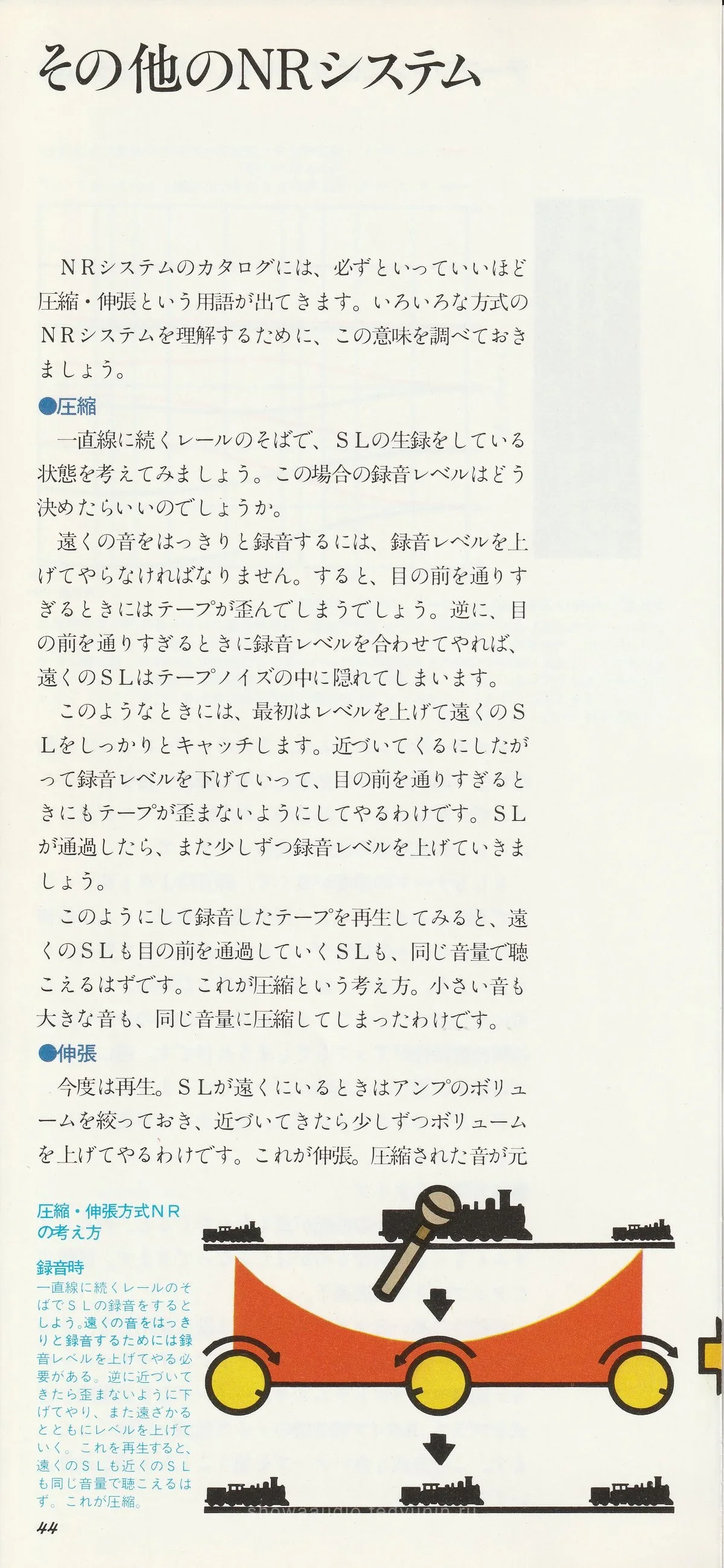
Imagine making a live recording of an SL (steam locomotive) beside a railway line as straight as an arrow. How should we choose the recording level?
To record the distant sound clearly, we must raise the level. But when the locomotive passes us, the tape will distort. Conversely, if we set the level for the moment it passes directly in front of us, the distant SL will be drowned in tape noise.
Instead, we first raise the level and capture the distant SL well. As it approaches, we gradually lower the recording level so the tape will not distort even as it passes directly in front of us. After it passes, we gradually raise the recording level again.
When a recording made this way is played back, both the distant SL and the one passing right in front of us should theoretically sound equally loud. This is the idea of “compression”. Both quiet and loud sounds have been compressed to the same volume.
Expansion
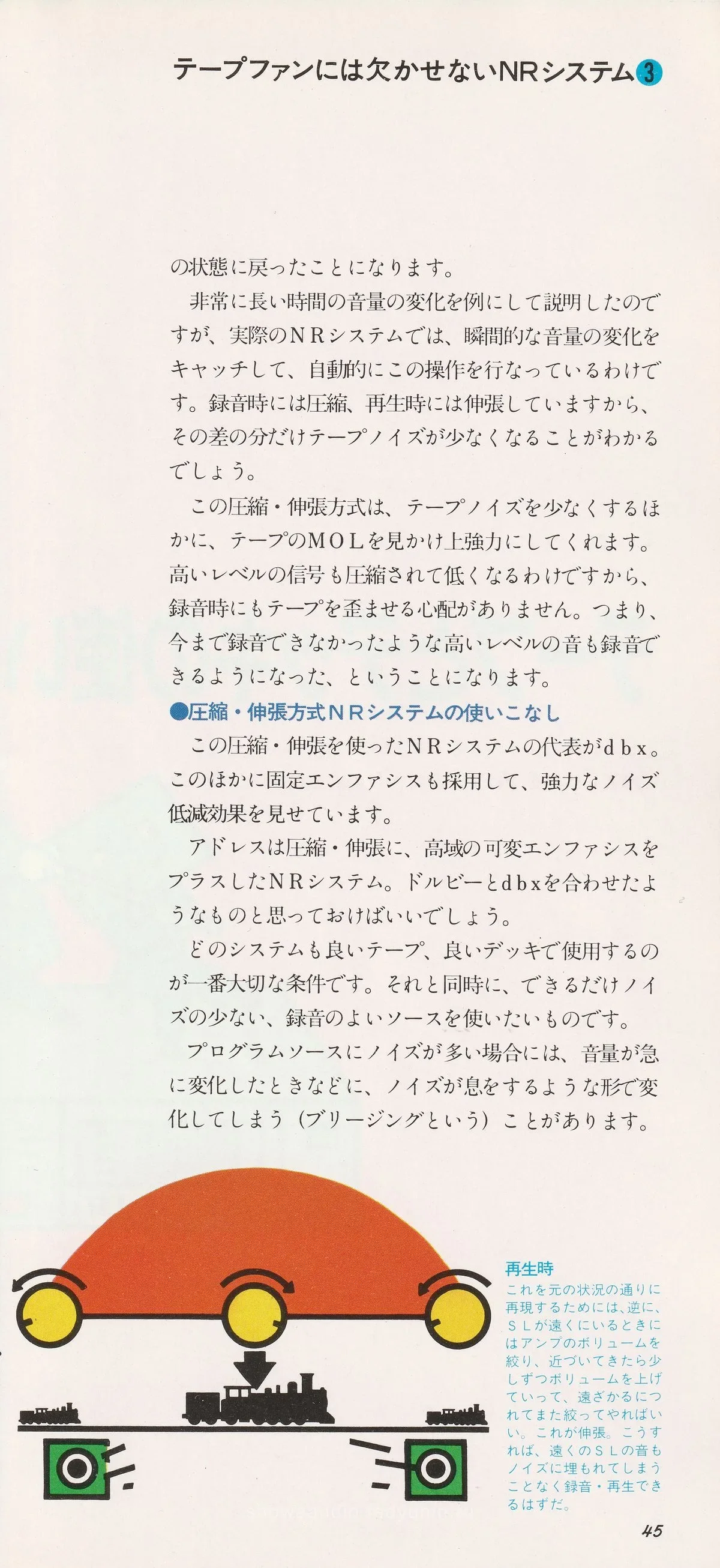
Now for playback. While the SL is still far away, keep the amplifier volume turned down; as it approaches, gradually turn it up. This is “expansion”. The compressed sound is returned to its original state.
I have explained this with very slow volume changes, but an actual NR system automatically detects instantaneous changes and performs the operation itself. Recording uses compression, playback uses expansion, and tape noise is reduced by the difference between the two.
Besides reducing tape noise, this compression-expansion method effectively increases the tape’s MOL. High-level signals are also compressed and made quieter, so there is no need to fear tape distortion during recording. In other words, even loud sounds that could not previously be recorded can now be recorded.
The idea of compression-expansion NR. Recording (caption to page 44): Suppose we record an SL beside a railway line as straight as an arrow. To capture the distant sound clearly, raise the recording level. As the train approaches, lower the level to prevent distortion; as it recedes, raise it again. On playback, both the distant and nearby SL should sound equally loud. This is compression.
Playback (caption to page 45): To reproduce everything in its original form, do the opposite: turn the amplifier volume down while the SL is distant, gradually raise it as it approaches, then lower it again as it recedes. This is expansion. In this way even the distant SL can theoretically be recorded and reproduced without being drowned in noise.
Using Compression-Expansion NR Systems
The principal example of a compression-expansion NR system is dbx.5 It also uses fixed emphasis, producing a powerful noise reduction effect.
Adres6 is an NR system that adds sliding emphasis at high frequencies to compression-expansion. It can be considered a kind of combination of Dolby and dbx.
For any of these systems, the most important condition is to use good tape and a good deck. It is also desirable to use a source with as little noise as possible and good recording quality.
If the program source has a lot of noise, sudden changes in volume can cause the noise to change as though breathing. This is called breathing.7
Примечания
-
MOL means Maximum Output Level, the maximum output level of cassette tape. The higher the MOL, the louder a recording can be made without saturation and distortion. It depends on tape type. ↩
-
Dolby level is the reference recording level in Dolby NR, usually 200 nWb/m. The ▽ or □□ mark on a deck’s level meter indicates this level. NR works correctly only when recording and playback levels match this reference. ↩
-
The anti-saturation circuit in Dolby C limits high frequencies during encoding to prevent tape saturation at peaks. Source: Dolby Laboratories white papers. ↩
-
Spectral skewing is an additional Dolby C filter that attenuates the highest frequencies during encoding and restores them during decoding, reducing modulation noise. Source: Dolby Laboratories white papers. ↩
-
dbx is an American audio equipment manufacturer; its NR system uses pure 2:1 compression-expansion without emphasis. It was patented by David E. Blackmer in 1971. ↩
-
Adres, Adaptive Range Expansion System, is a Toshiba NR system developed in 1976. It combines compression-expansion with sliding emphasis at high frequencies. An analogue of the later Dolby C. ↩
-
Breathing is an artifact of compander NR systems (dbx, Adres) in which tape noise “breathes” or becomes audible during sudden program volume changes as the system tries to follow the signal envelope. It is most noticeable with sources that have high background noise. ↩