
Cassette Tape Construction
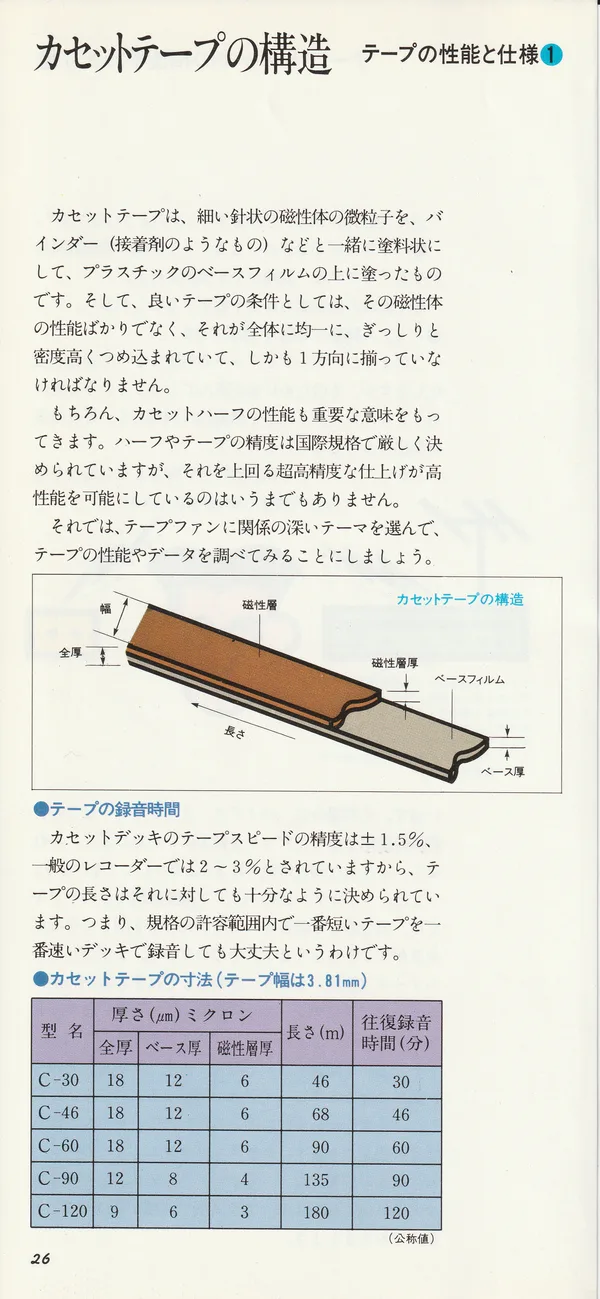
Cassette tape is made by mixing fine, needle-shaped magnetic particles with a binder (rather like glue) and other ingredients into a paint-like coating, which is applied to a plastic base film. A good tape depends not only on the properties of the magnetic material itself: the particles must be distributed evenly over the whole tape, packed densely and oriented in the same direction.
The characteristics of the cassette shell are important too, of course. International standards strictly prescribe the manufacturing precision of the shell and tape, but it goes without saying that the extremely precise finishing which exceeds those standards makes high performance possible.
Now let’s choose some subjects of particular interest to tape enthusiasts and look at tape characteristics and data.
Tape Recording Time
The speed accuracy of a cassette deck is ±1.5%, and that of ordinary tape recorders is 2-3%, so tape lengths are determined with enough margin to accommodate these values. In other words, even if you record with the shortest tape permitted by the standard on the fastest deck, it will be all right.
Cassette Tape Dimensions (Tape Width: 3.81 mm)
| Type | Total thickness (μm) | Base thickness (μm) | Magnetic layer thickness (μm) | Length (m) | Recording time on both sides (min) |
|---|---|---|---|---|---|
| C-30 | 18 | 12 | 6 | 46 | 30 |
| C-46 | 18 | 12 | 6 | 68 | 46 |
| C-60 | 18 | 12 | 6 | 90 | 60 |
| C-90 | 12 | 8 | 4 | 135 | 90 |
| C-120 | 9 | 6 | 3 | 180 | 120 |
(Nominal values)
Sensitivity
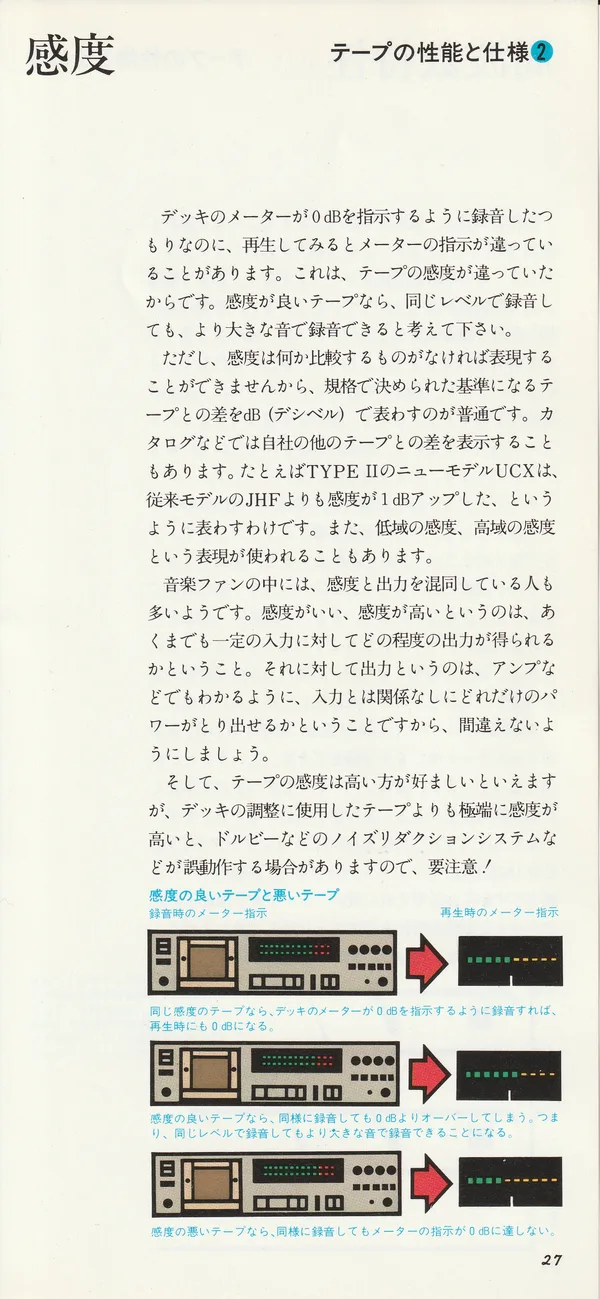
You may record with the deck’s meter indicating 0 dB, only to find that the meter gives a different reading on playback. This happens because the sensitivity of the tape differs. Think of a tape with good sensitivity as one that can record sound louder even at the same recording level.
Sensitivity cannot be expressed without something to compare it with, however, so it is normally expressed in dB (decibels) as the difference from a standard reference tape. Catalogs and similar publications sometimes give the difference from other tapes made by the same manufacturer. For example, they may say that the sensitivity of the new TYPE II UCX has increased by 1 dB compared with the previous JHF model. The expressions “low-frequency sensitivity” and “high-frequency sensitivity” are also used.
Many music lovers seem to confuse sensitivity and output level. Saying that sensitivity is “good” or “high” always refers to the output level obtained for a given input signal. Output level, as can be seen with amplifiers and the like, refers to the output obtained without reference to the input signal, so don’t confuse the two.
Although one can say that the higher a tape’s sensitivity, the better, take care: if its sensitivity is excessively higher than that of the tape used to adjust the deck, noise reduction systems such as Dolby may operate incorrectly!
Tapes with good and poor sensitivity. If the tape’s sensitivity is the same as the reference, a recording made at 0 dB will also play back at 0 dB. With a tape of good sensitivity, the reading on playback will exceed 0 dB for the same recording - in other words, sound can be recorded louder at the same recording level. With a tape of poor sensitivity, the reading will not reach 0 dB.
Frequency Response
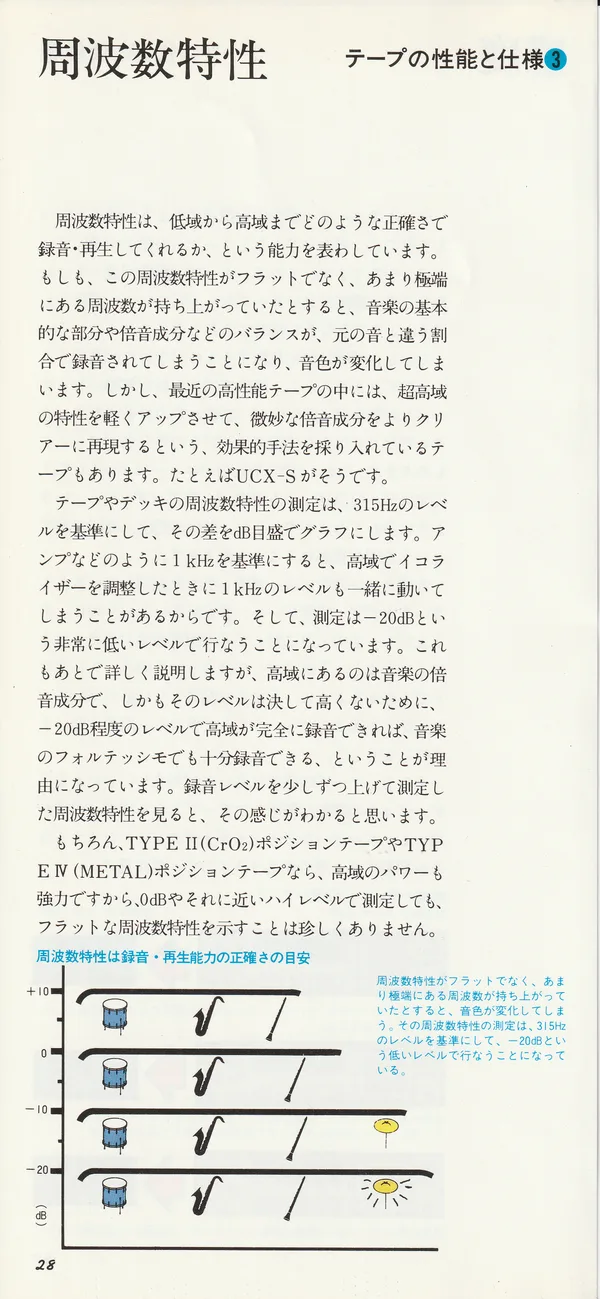
Frequency response expresses how accurately a tape can record and reproduce sound from low to high frequencies. If the response is not flat and a particular frequency is boosted too much, the balance between the fundamental and harmonic components of the music is recorded in a different proportion from the original sound, changing the tone. Among today’s high-quality tapes, however, some use an effective technique: they slightly raise the response at very high frequencies to reproduce delicate harmonic components more clearly. UCX-S is one example.
Tape or deck frequency response is measured by taking the level at 315 Hz as the reference and plotting the difference from it in dB. If 1 kHz were taken as the reference, as with amplifiers and similar equipment, the 1 kHz level would shift as well when the high-frequency equalizer was adjusted. Measurements are conventionally made at the very low level of -20 dB. We will explain this in detail later, but the harmonic components of music are found at high frequencies and their level is not very high. So if the high frequencies are fully recorded at around -20 dB, even fortissimo music can be recorded with room to spare. Looking at frequency-response measurements made as the recording level is gradually increased should make this clearer.
Of course, TYPE II (CrO₂) and TYPE IV (METAL) tapes also have strong high-frequency output, so they often show a flat frequency response even when measured at the high level of 0 dB or close to it.
MOL: Maximum Output Level
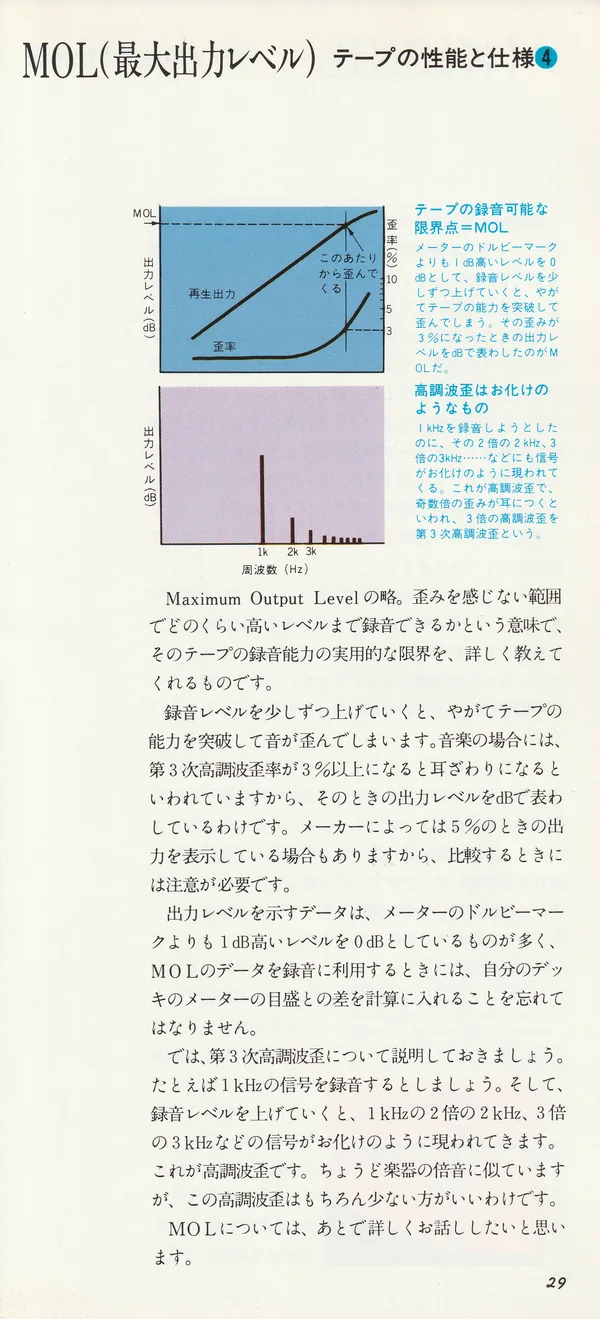
Maximum Output Level indicates how high a level can be recorded without audible distortion. It gives a detailed indication of the practical recording limit of a tape.
If the recording level is gradually raised, the tape’s capacity is eventually exceeded and the sound distorts. With music, third harmonic distortion of 3% or more is considered distinctly audible, so the output level at that point is expressed in dB. Some manufacturers specify output at 5%, so take care when comparing figures.
Output-level data often takes as 0 dB a level 1 dB above the Dolby mark on the meter. When using MOL data for recording, remember to account for the difference from your own deck’s meter scale.
Third Harmonic Distortion
Let’s explain third harmonic distortion. Suppose, for example, that we record a 1 kHz signal. As we increase the recording level, signals appear like ghosts at twice that frequency, 2 kHz, three times that frequency, 3 kHz, and so on. These are harmonic distortions. They resemble the harmonics of musical instruments, but of course the less harmonic distortion, the better. Odd-order distortion is considered audible, which is why third harmonic distortion is singled out.
Noise and S/N
As you become skilled at recording, you gradually begin to notice tape noise. In particular, a hissing sound in the pianissimo passages of music can become distracting and prevent you from fully immersing yourself in it.
This noise is inherent in tape: even if you play a freshly unwrapped blank tape, you can hear a faint hiss. If you turn the recording level control all the way down, start recording, then rewind and play that section, you should hear noise slightly louder than on the blank tape. It is this tape noise generated during recording that becomes a problem in tape recording. Since it arises when bias current is applied, it is sometimes called bias noise.
To reduce this noise from blank tape, the magnetic particles should be as small as possible, uniform in size, and evenly and densely packed. In other words, the conditions for a good tape are also the conditions for a low-noise tape.
Besides bias noise, there are many kinds of tape noise, including modulation noise arising from the deck mechanism or the stability of tape travel. Tape performance is always realized in combination with a deck. You can now see why, to enjoy powerful, good-sounding tape reproduction, you need a properly maintained deck with the best possible performance.
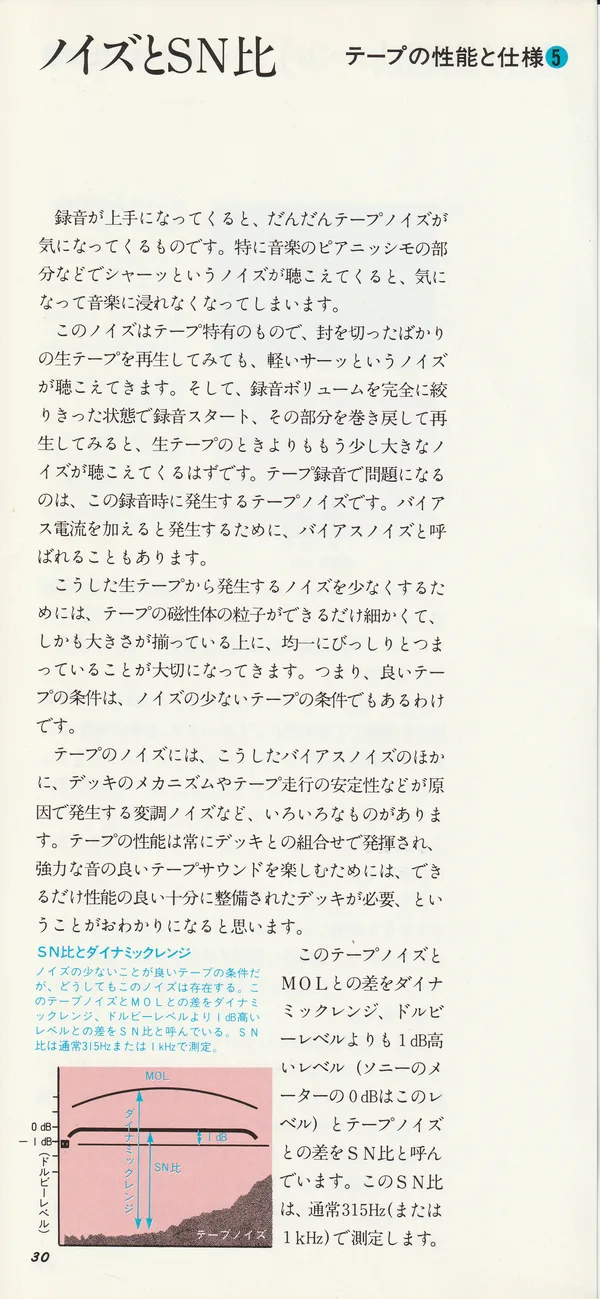
S/N and dynamic range. Although low noise is a condition of a good tape, some noise remains. The difference between this tape noise and MOL is called the dynamic range; the difference between the level 1 dB above Dolby level (0 dB on a Sony meter is this level) and tape noise is called S/N. S/N is normally measured at 315 Hz (or 1 kHz).
Bias Characteristics and Print-Through
Bias Characteristics
Changing the bias current changes various characteristics, including sensitivity, MOL and distortion. The optimum point among these is determined by the design concept of the tape or deck.
Data in catalogs and similar sources on bias characteristics at each frequency, their relationship to recording level and so on serves as a reference for actual recording. Tapes vary: some react sensitively to changes in bias, while others change relatively gradually, and their behavior changes again depending on the deck. Those with relatively gradual changes are sometimes described as having a “wide bias characteristic.”
Print-Through
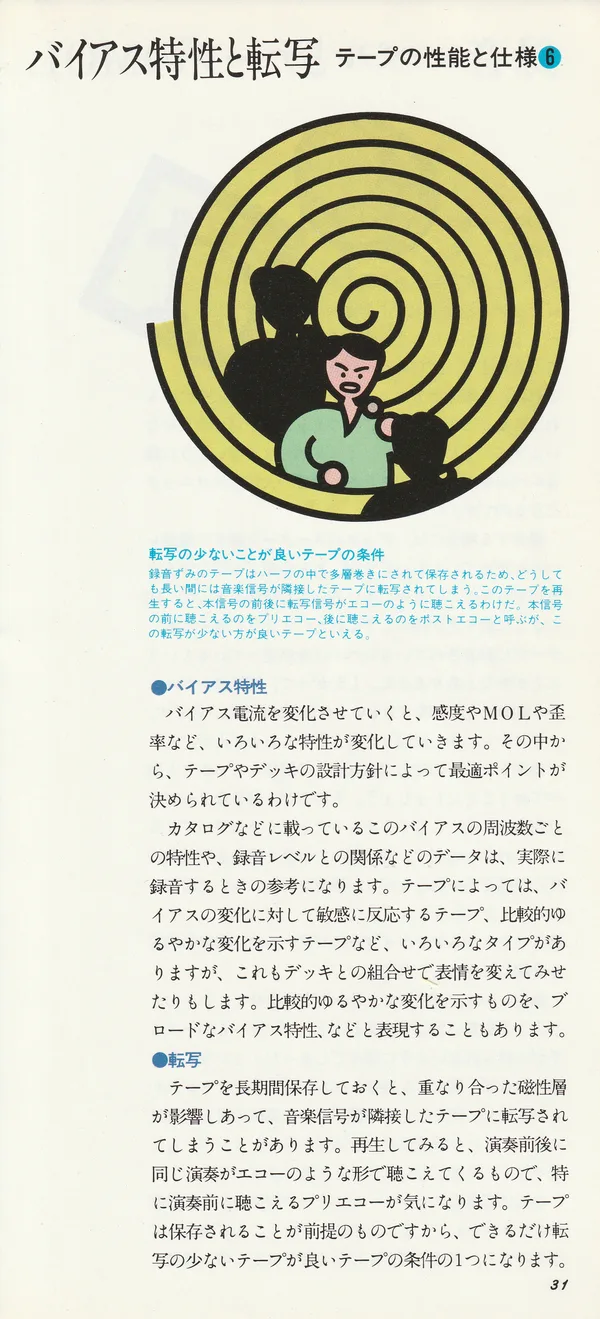
When tape is stored for a long time, adjacent layers of magnetic coating affect one another and the music signal is copied onto neighboring layers. On playback the same performance can be heard as an echo before and after the music, with the pre-echo heard before the performance being particularly troublesome. Since tape is intended for storage, minimal print-through is one of the requirements of a good tape.