
Practical Tapes and High-Grade Tapes
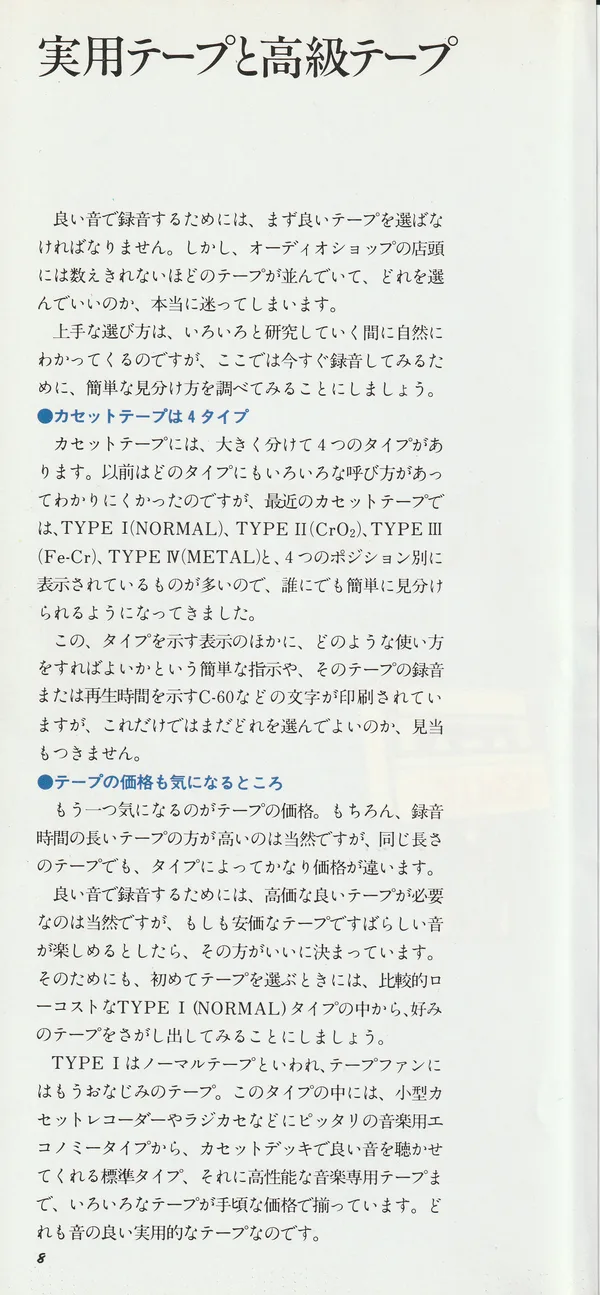
To make a good-sounding recording, you first need to choose a good tape. But audio shops display so many tapes that it can be genuinely difficult to know which one to choose.
You naturally learn how to choose by experimenting, but so that you can start recording right away, let’s look at some simple ways of telling tapes apart.
Four Types of Cassette Tape
Cassette tapes can broadly be divided into four types. In the past there were different names for each type, which was confusing, but most modern cassette tapes are marked with one of four designations: TYPE I (NORMAL), TYPE II (CrO₂), TYPE III (Fe-Cr) or TYPE IV (METAL). Now anyone can easily tell them apart.
In addition to the type designation, the package carries simple instructions on how to use the tape, and symbols such as C-60 indicating recording or playback time. But this information alone is not enough to tell you which tape to choose.
Tape Price Matters Too
Another concern is the price. Naturally, a tape with a longer recording time costs more, but even tapes of the same length vary greatly in price depending on the type.
Of course, a good, expensive tape is needed for good sound, but if you could get excellent sound from an inexpensive tape, that would surely be preferable. So when choosing tape for the first time, look for one you like among the relatively inexpensive TYPE I (NORMAL) tapes.
TYPE I is called normal tape and is already familiar to enthusiasts. It includes a range of reasonably priced tapes, from economical music tapes ideal for small cassette recorders and radio-cassette players, to standard tapes that sound good in a cassette deck, and high-performance tapes made especially for music. All are practical tapes that sound good.
Besides TYPE I, there are TYPE II, TYPE III and TYPE IV, which are, so to speak, exceptionally high-performance tapes. Each uses special materials in its magnetic layer to achieve high performance, so they sometimes cannot be used in simple recorders, and incorrect use can have the opposite effect. We will discuss how to use these high-grade tapes in detail later.
Convenient Genre Tapes
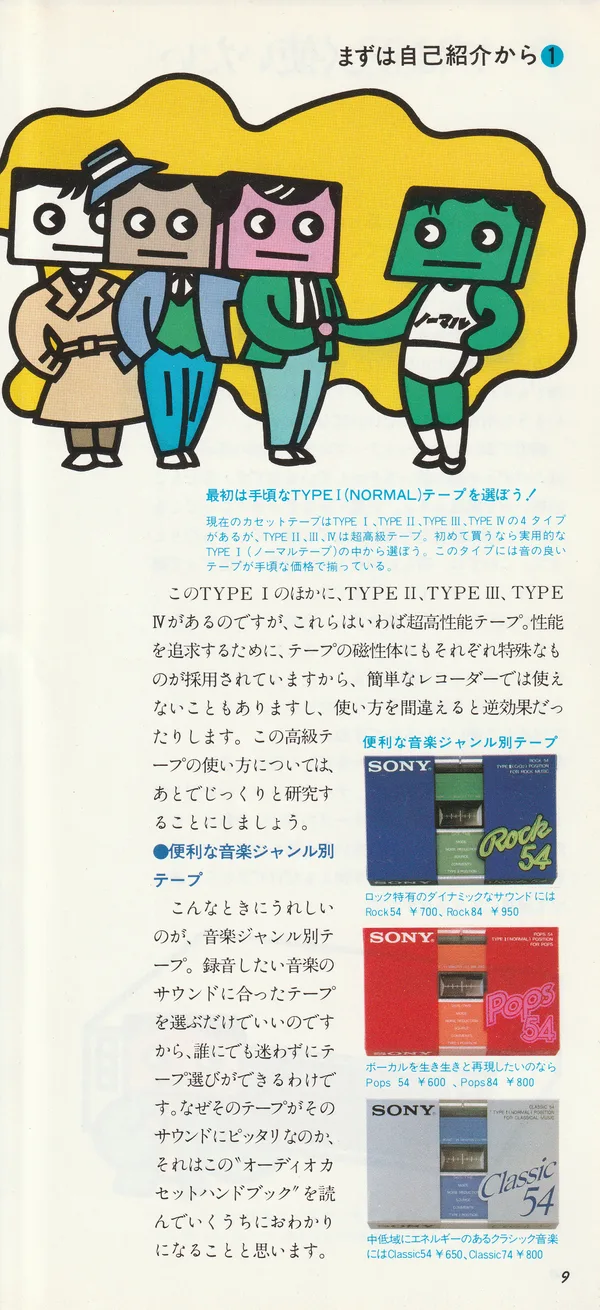
In such cases, genre tapes for music are welcome. You only need to choose a tape suited to the sound of the music you want to record, so anyone can make a selection without hesitation. As you read the “Audio Cassette Handbook”, you will understand why each tape is ideally suited to that particular sound.
Sony Rock 54 (TYPE I, GO! POSITION) - for the dynamic sound characteristic of rock. Rock 54 ¥700, Rock 84 ¥950.
Sony Pops 54 (TYPE I, NORMAL POSITION) - for lively reproduction of vocals. Pops 54 ¥600, Pops 84 ¥800.
Sony Classic 54 (TYPE I, NORMAL POSITION) - for classical music with energy in the mid-low frequencies. Classic 54 ¥650, Classic 74 ¥800.
Tape Must Be Used Correctly
Have you ever thought, “I bought the most expensive tape to get good sound, but the opposite happened - the sound got worse”?
As mentioned in the previous section, there are different types of cassette tape, each using special magnetic materials and the like to improve performance. The deck must therefore be prepared accordingly so that the tape can deliver its capabilities as easily as possible.
The cassette tape type designations we studied in the previous section are essentially instructions for how to use the deck. If you get this wrong, the volume may become very low, or previously recorded sound may not be erased and may remain. Then the new recording mixes with the old one and becomes difficult to listen to, doesn’t it?
Even when the result is not quite so terrible, the high frequencies may be recorded indistinctly, as if muffled, or conversely, only the high frequencies may be heard, hissing and harsh. To avoid recordings like that, you want to use cassette tape correctly, don’t you?
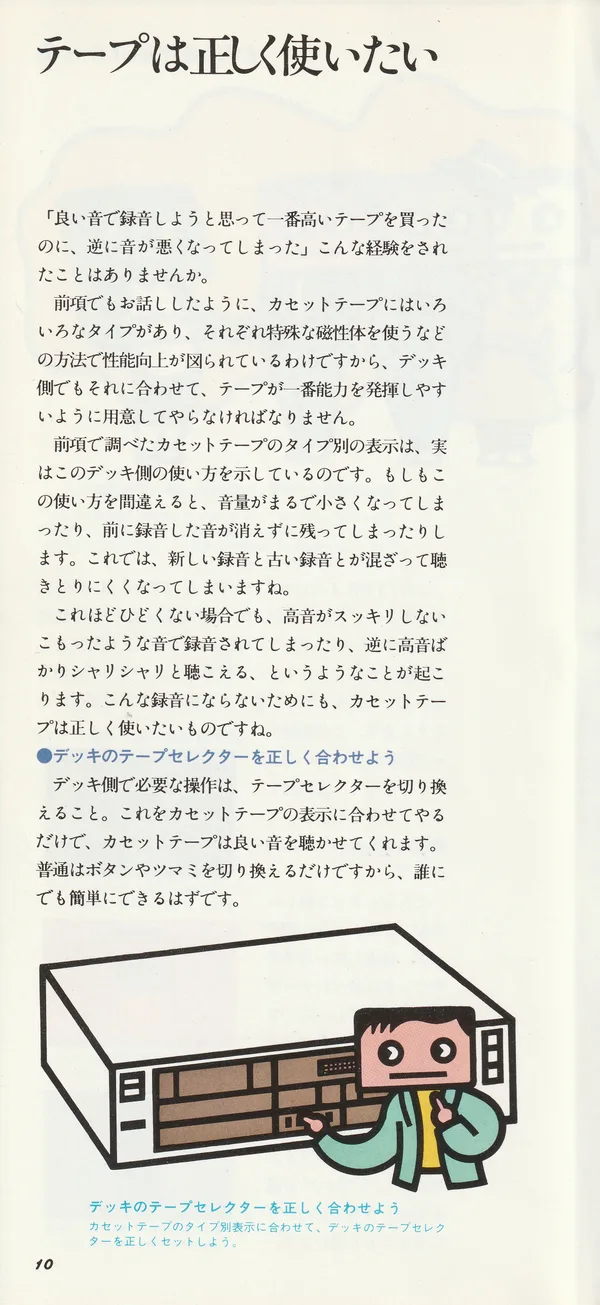
Set the Deck’s Tape Selector Correctly
There is only one thing you need to do on the deck: switch the tape selector. Set it to match the designation on the cassette tape and the tape will give you good sound. Usually this just means changing a button or knob, so anyone can do it easily.
The Wrong Tape Selector Setting Produces Strange Sound
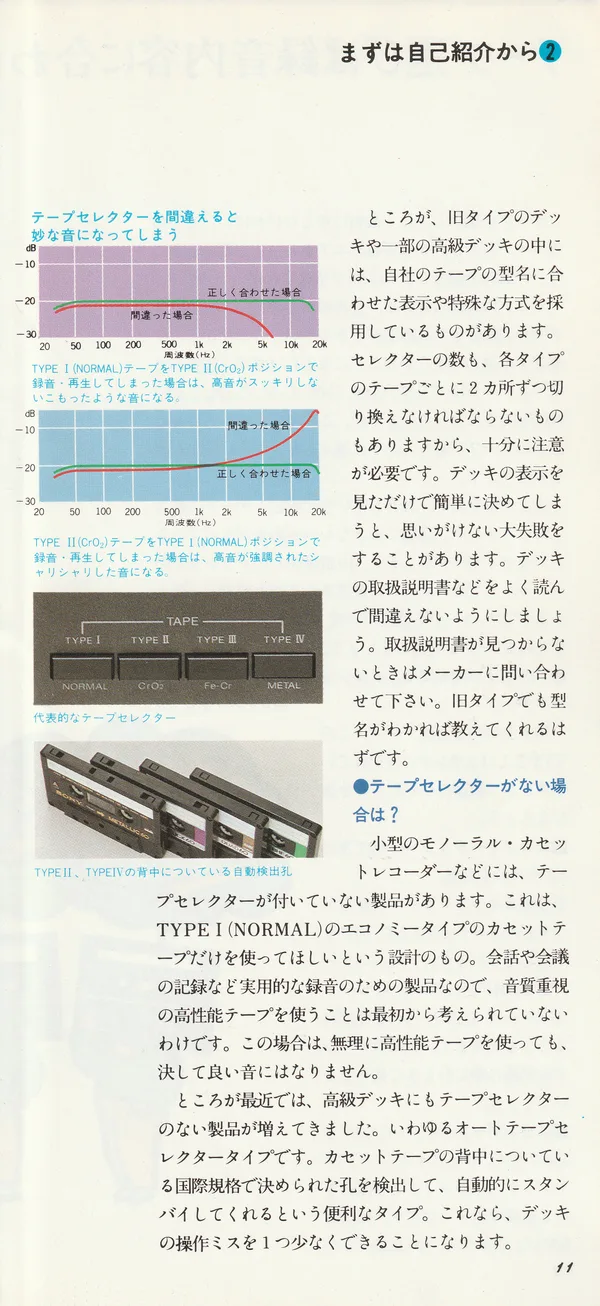
If TYPE I (NORMAL) tape is recorded and played back in the TYPE II (CrO₂) position, the high frequencies become indistinct and muffled.
If TYPE II (CrO₂) tape is recorded and played back in the TYPE I (NORMAL) position, the high frequencies become emphasized, hissing and harsh.
A typical tape selector switches between TYPE I (NORMAL), TYPE II (CrO₂), TYPE III (Fe-Cr) and TYPE IV (METAL).
TYPE II and TYPE IV cassettes have automatic detection holes on the top of the cassette shell.
However, some older decks and some high-grade decks use designations corresponding to the manufacturer’s own tape models or employ special methods. Some also require you to change two selector settings for each tape type, so extra care is needed. Judging simply by the labels on the deck may lead to a surprisingly serious mistake. Read the deck’s instructions carefully. If you cannot find them, contact the manufacturer. Even for older models, they should be able to help if you know the model name.
What If There Is No Tape Selector?
Some small monaural cassette recorders and similar machines have no tape selector. They are designed to use only economical TYPE I (NORMAL) cassette tapes. Since these products are intended for practical recordings such as conversations and meetings, they were not designed to use high-performance tapes that prioritize sound quality. In this case, even forcing the use of a high-performance tape will not give good sound.
Recently, however, more high-grade decks have also appeared without a tape selector. These are the so-called automatic tape-selector type. They detect the internationally standardized holes on top of the cassette and automatically set themselves accordingly. This convenient system eliminates one possible operating mistake.
Choosing Tape for What You Want to Record
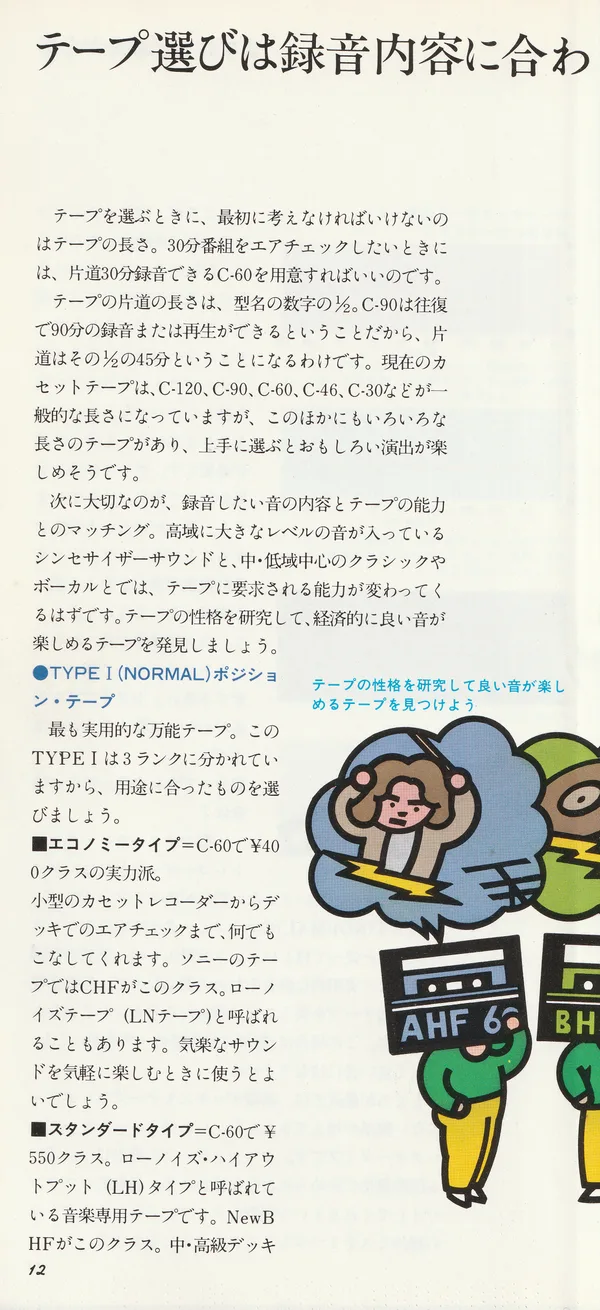
When choosing tape, first consider its length. If you want to record a 30-minute broadcast, a C-60, which can record 30 minutes on one side, is sufficient.
The time on one side is half the number in the model name. C-90 means 90 minutes can be recorded or played on both sides, so one side is half that, or 45 minutes. Common lengths for today’s cassette tapes include C-120, C-90, C-60, C-46 and C-30, but there are other lengths too, and a skillful choice lets you enjoy interesting productions.
Next, it is important to match the sound you want to record to the tape’s capabilities. Synthesizer sounds containing high-level signals at high frequencies and classical music or vocals concentrated in the mid and low frequencies make different demands on tape. Study each tape’s character and find one that lets you enjoy good sound economically.
TYPE I (NORMAL) Position Tapes
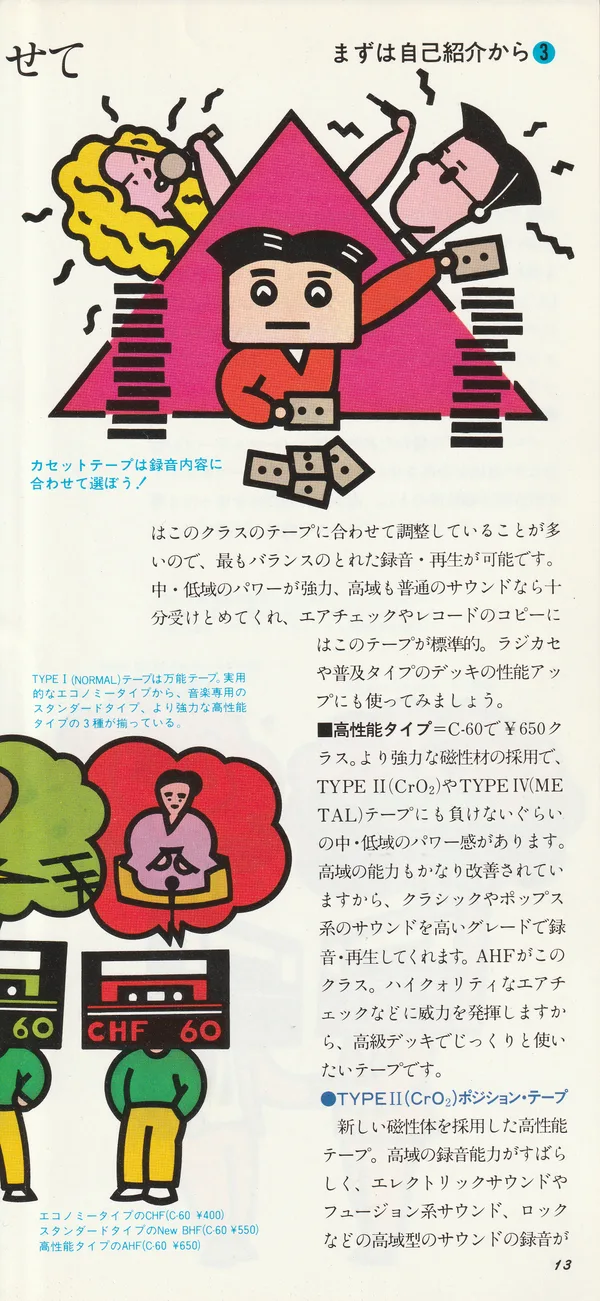
The most practical all-purpose tape. TYPE I is divided into three grades, so choose according to your purpose.
Economy type = a sturdy performer in the ¥400-per-C-60 class. It handles everything from small cassette recorders to recording broadcasts on a deck. Sony’s CHF belongs to this class. It is sometimes called low-noise tape (LN tape). Use it when you want to enjoy a light sound casually.
Standard type = the ¥550-per-C-60 class. A tape made especially for music, called the low-noise high-output (LH) type. NewBHF belongs to this class. Mid-range and high-grade decks are often adjusted for tapes of this class, giving the most balanced recording and playback. Mid-low frequency output is strong, while high frequencies also have enough headroom for ordinary sound. This is a standard tape for recording broadcasts or copying records. Try it to improve the performance of radio-cassette players and mass-market decks too.
High-performance type = the ¥650-per-C-60 class. Thanks to a more powerful magnetic material, its sense of power in the mid-low frequencies is not inferior to TYPE II (CrO₂) or TYPE IV (METAL). Its high-frequency capabilities are also considerably improved, so it records and reproduces classical and pop sounds at a high level. AHF belongs to this class. It excels at high-quality broadcast recording and is a tape worth using thoroughly on a high-grade deck.
TYPE II (CrO₂) Position Tapes
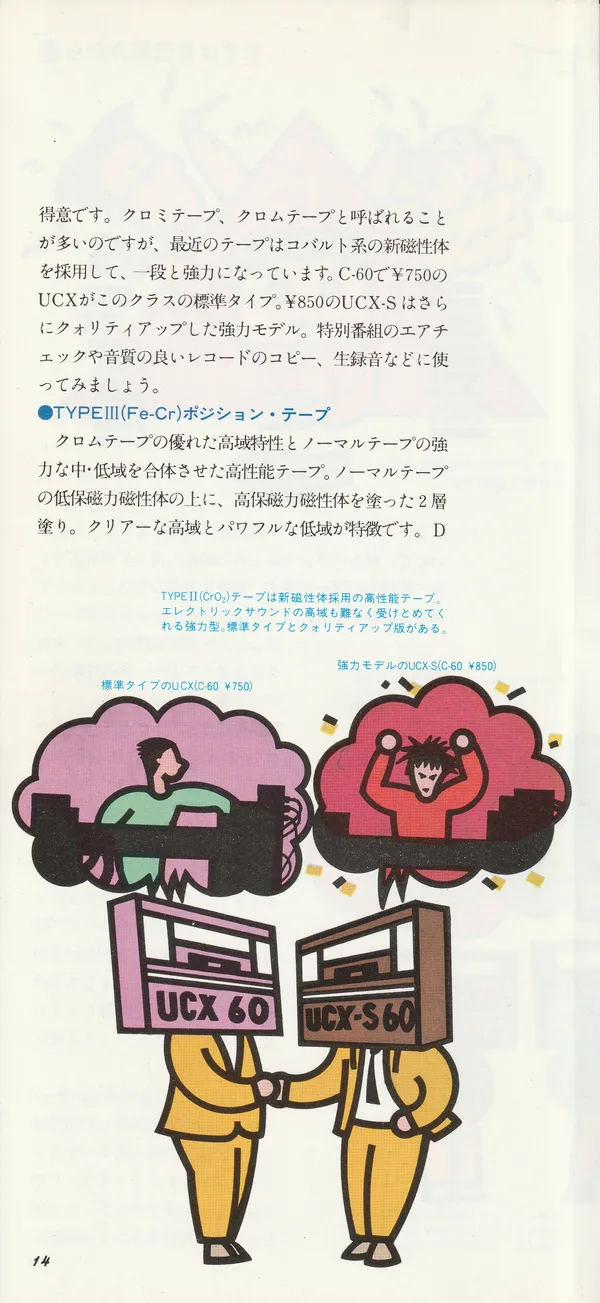
High-performance tapes using a new magnetic material. Their high-frequency recording capability is excellent, so they record fusion, electronic sounds, rock and other sounds with an emphasis on high frequencies well.
They are often called chrome tapes, but modern tapes use a new cobalt-based magnetic material and have become even more powerful. The standard type in this class is UCX at ¥750 per C-60. UCX-S at ¥850 is an even higher-quality, more powerful model. Try them for recording special broadcasts, copying records with good sound quality, field recordings and so on.
TYPE III (Fe-Cr) Position Tapes
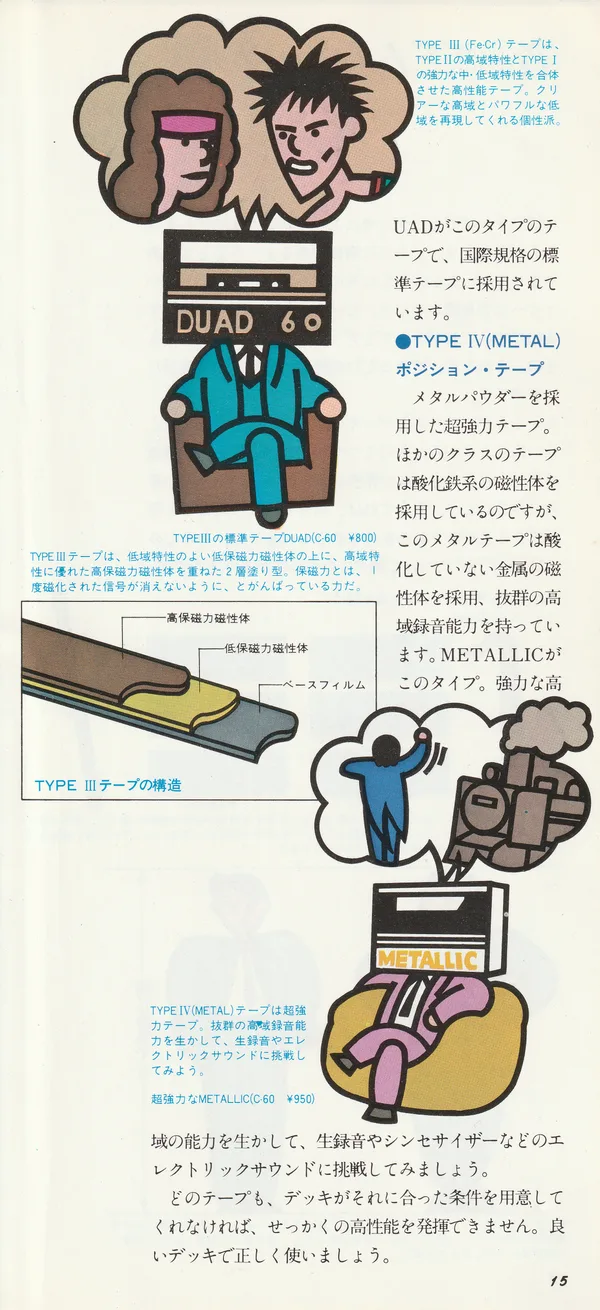
A high-performance tape combining chrome tape’s excellent high-frequency characteristics with the powerful mid and low frequencies of normal tape. It has a double coating: a high-coercivity magnetic material is applied over the low-coercivity1 magnetic material of normal tape. Clear high frequencies and powerful bass are its distinctive features. DUAD is a tape of this type adopted as a reference tape under the international standard.
The standard TYPE III tape is DUAD (C-60 ¥800).
TYPE IV (METAL) Position Tapes
An exceptionally powerful tape using metal powder. Tapes in the other classes use iron-oxide-based magnetic material, whereas this metal tape uses a non-oxidized metallic magnetic material and has outstanding high-frequency recording capability. METALLIC belongs to this type. Using its strong high-frequency capability, try field recording and electronic sounds such as synthesizers.
The exceptionally powerful METALLIC (C-60 ¥950).
Whatever tape you choose, its hard-won high performance will not be realized unless the deck provides suitable conditions for it. Use it correctly and on a good deck.
Примечания
-
Coercivity (保磁力) is the ability to resist erasure of a magnetized signal. The higher the coercivity of the magnetic layer, the more stably the recorded signal is retained. Source: general magnetic recording theory (Wikipedia: “Coercivity”). ↩