ONKYO
オンキヨー
Onkyo Corporation (オンキヨー株式会社) is a Japanese audio-equipment maker, founded in 1946 in Osaka by engineer Takeshi Goda as Osaka Denki Onkyo K.K. (大阪電気音響, "Osaka Electrical Acoustics"); the short name Onkyo grew out of that title. The word 音響 ("on-kyo") translates as "sound and resonance" - a compound of 音 (sound) and 響 (echo, reverberation) - and shares its root with DENON, whose name likewise descends from Denki Onkyo, "electrical acoustics". The head office sat at the Kitahama Central Building in Osaka. In March 2015 Onkyo bought Pioneer's Home Electronics division, with Pioneer taking a 14.95% stake in Onkyo in return. On 13 May 2022 Onkyo Home Entertainment filed for bankruptcy; since then the brand name has been run by a September-2021 joint venture between Premium Audio Company (Voxx International, 75%) and Sharp Corporation (25%) - an arrangement that has no direct continuity with the Showa-era Onkyo. … more

- Japanese name
- オンキヨー
- Catalogs in the Museum:
- 2
- Catalog years:
- 1980-1988
- Equipment types
- Cassette Decks, Speakers
About the brand
Onkyo Corporation (オンキヨー株式会社) is a Japanese audio-equipment maker, founded in 1946 in Osaka by engineer Takeshi Goda as Osaka Denki Onkyo K.K. (大阪電気音響, “Osaka Electrical Acoustics”); the short name Onkyo grew out of that title. The word 音響 (“on-kyo”) translates as “sound and resonance” - a compound of 音 (sound) and 響 (echo, reverberation) - and shares its root with DENON, whose name likewise descends from Denki Onkyo, “electrical acoustics”. The head office sat at the Kitahama Central Building in Osaka. In March 2015 Onkyo bought Pioneer’s Home Electronics division, with Pioneer taking a 14.95% stake in Onkyo in return. On 13 May 2022 Onkyo Home Entertainment filed for bankruptcy; since then the brand name has been run by a September-2021 joint venture between Premium Audio Company (Voxx International, 75%) and Sharp Corporation (25%) - an arrangement that has no direct continuity with the Showa-era Onkyo.
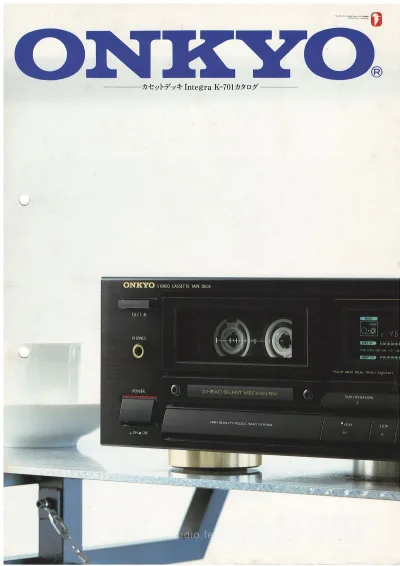
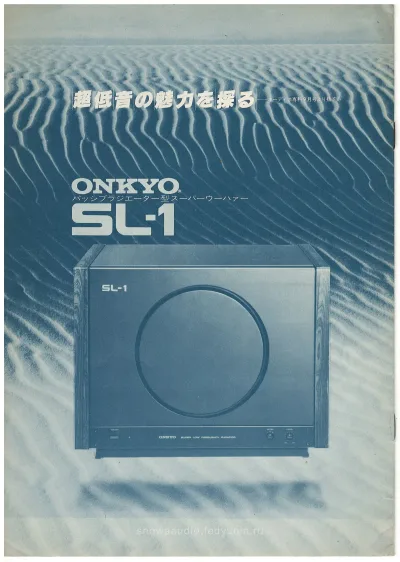
The company’s marquee hi-fi line, Integra (インテグラ), was launched in 1969 with a flagship amplifier and remained the top tier of the Onkyo catalogue through the whole Showa period. In 1980 Onkyo released the SL-1 active subwoofer at ¥150,000, built around a 38 cm driver on a passive bass radiator with a built-in amplifier; the catalogue introducing it took the unusual form of a dialogue between the audio critic Hirasawa and the reviewer Egawa about why a separate subwoofer belongs in a home system at all. In July 1988 the Integra K-701 cassette deck at ¥69,800 used a PCOCC monocrystal oxygen-free copper head - one of the early uses of PCOCC conductors in tape heads - in a three-head transport with a silent tape mechanism and Dolby HX-Pro. In 1993 Onkyo obtained THX certification from Lucasfilm and released what the company claims as the world’s first THX-certified consumer AV receiver.
Onkyo built its catalogue around three main axes: loudspeakers, cassette decks and AV receivers. The speaker line ran from the SL-1 active subwoofer of 1980 through the Scepter monitor series at the top of the range. Cassette decks carried the Integra K badge, headed by the K-701 of 1988 with its PCOCC three-head transport, silent tape mechanism, Dolby HX-Pro to widen recordable high-frequency response, a super-linear power supply and the Airless Base (アイレスベース) tape-path guide, a bearingless aero-supported tape transport, together with a four-segment real-time tape-remaining counter that read out remaining playback time even while rewinding. On the amplifier and receiver side Integra extended through the A-series integrated amplifiers and the TX-series AV receivers, splitting the catalogue with the ONKYO models without the Integra prefix that ran in the middle of the range.
- Founded:
- 1946, Osaka
- Founder:
- Takeshi Goda
- Full name:
- Onkyo Corporation (オンキヨー株式会社, formerly Osaka Denki Onkyo K.K.)
- Links:
- Wikipedia