


Around 1970, as the cassette gradually gained recognition as a fully fledged audio medium, Scotch (Sumitomo 3M) sold the same tapes in Japan as it did overseas. From around the previous year, the company began adding products and packaging made specifically for Japan. BASF also became BASF Japan this year and offered a range comparable to that in its home market.
AGFA (Nippon Agfa-Gevaert), by contrast, had been in the cassette market from the beginning. Although it did not leave, advertisements in audio magazines and other evidence suggest that it was paying noticeably less attention to it.
Changes among Japanese tapes had begun in the previous year, 1973. Hitachi, whose group included the Maxell brand, released UD and other models made for it by Hitachi Maxell on an OEM basis. Sony released HF and other cassettes under the CBS brand. Both companies expanded their sales channels in this way.
In 1974 Fuji Film also began updating its range. First came the main FX model, which can be considered the successor to FM. Its packaging was predominantly black, a colour associated with high performance. This distinguished it from earlier products, which were coloured like the company’s photographic film.
Among the new entrants that year was Nagaoka, known for turntable styli, which released a cassette. A few years later Nagaoka sold cassettes under the JEWELTONE brand, but its first product, FRESH-CASSETTE, bore the Nagaoka name. AIWA also entered the market. Given that it released a ferrichrome tape the following year, the products may have been made by Sony on an OEM basis, though this has not been confirmed.
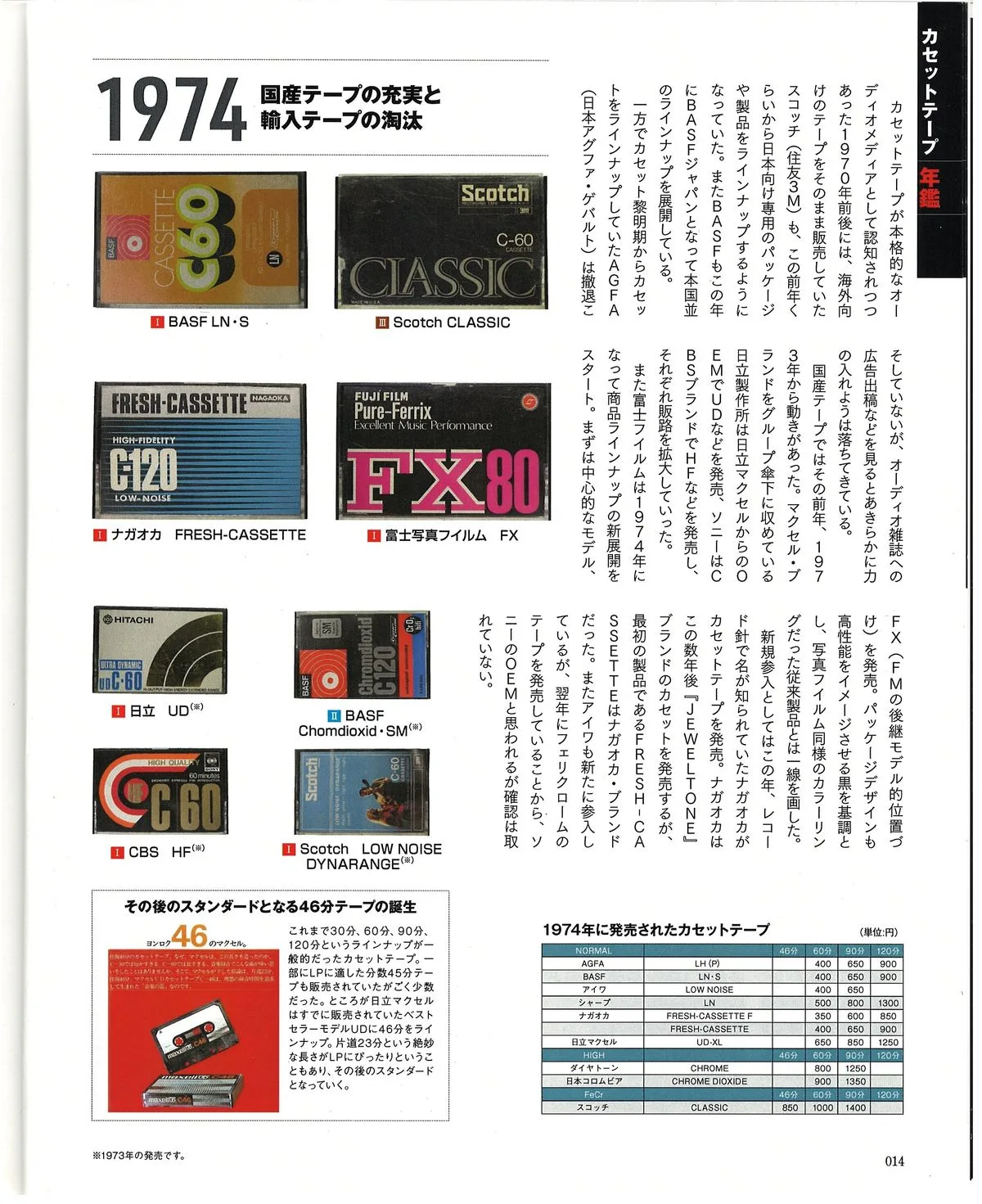
Notes from photo captions: Hitachi UD (*); BASF Chromdioxid・SM (*); CBS HF (*); Scotch LOW NOISE DYNARANGE (*).
* Released in 1973.
The arrival of the 46-minute tape that later became standard
Until then, the usual range consisted of 30-, 60-, 90- and 120-minute cassettes. Forty-five-minute tapes suitable for LPs were also sold, but were very rare. Hitachi Maxell added a 46-minute version to its already popular UD model. Each side ran for 23 minutes, ideally suited to an LP, and this length subsequently became standard.
Cassettes released in 1974 (prices in yen)
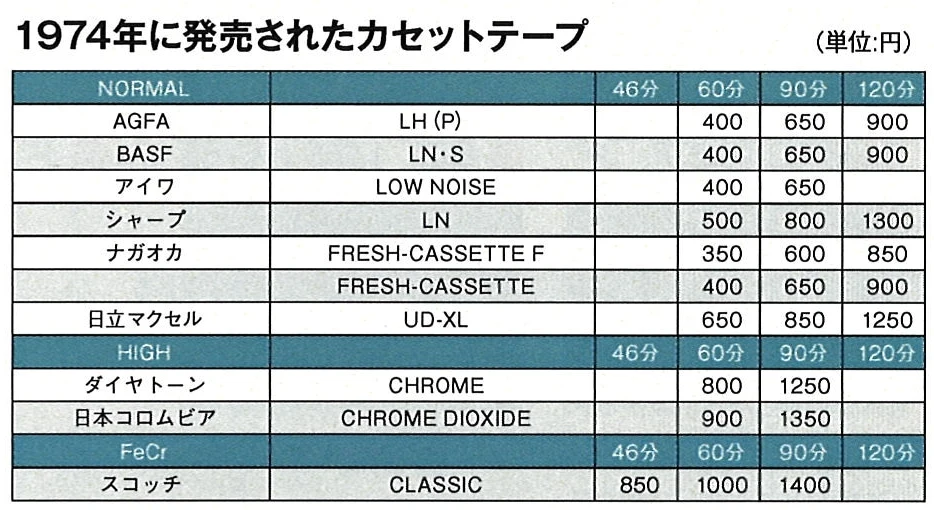
NORMAL
| Brand | Model | 46 | 60 | 90 | 120 |
|---|---|---|---|---|---|
| AGFA | LH (P) | 400 | 650 | 900 | |
| BASF | LN・S | 400 | 650 | 900 | |
| AIWA | LOW NOISE | 400 | 650 | ||
| Sharp | LN | 500 | 800 | 1300 | |
| Nagaoka | FRESH-CASSETTE F | 350 | 600 | 850 | |
| FRESH-CASSETTE | 400 | 650 | 900 | ||
| Hitachi Maxell | UD-XL | 650 | 850 | 1250 |
HIGH
| Brand | Model | 46 | 60 | 90 | 120 |
|---|---|---|---|---|---|
| Diatone | CHROME | 800 | 1250 | ||
| Nippon Columbia | CHROME DIOXIDE | 900 | 1350 |
FeCr
| Brand | Model | 46 | 60 | 90 | 120 |
|---|---|---|---|---|---|
| Scotch | CLASSIC | 850 | 1000 | 1400 |