


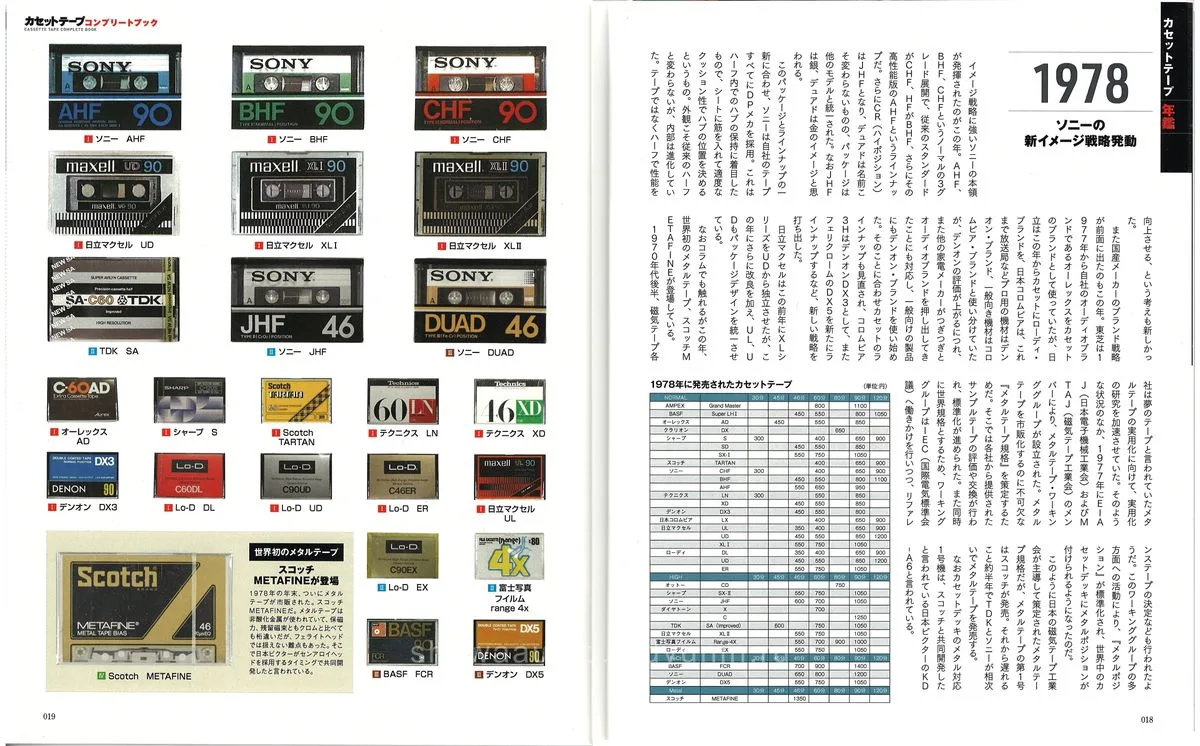
This year Sony demonstrated its skill at building an image. Its normal-position range consisted of three grades: the former standard model became CHF, HF became BHF, and a more advanced AHF appeared above it. CR, the ハイポジション (high-position) tape, became JHF. The Duad name stayed the same, but its packaging was brought into line with the other models. JHF apparently acquired a silver image and Duad a gold one.
Along with the new packaging and range, Sony introduced the DPメカ (DP mechanism) in all its cassettes. The design focused on holding the reels inside the shell: grooves were made in the sheet, whose elasticity helped keep the reels in place. The shell looked no different from before, but was improved inside. The idea of improving performance through the shell rather than the tape itself was also new.
Japanese manufacturers’ audio brands also came to the fore. Toshiba had used its own audio brand name, Aurex, for cassettes since 1977, and from this year Hitachi began releasing cassettes under the Lo-D name. Until then, Nippon Columbia had separated its brands: Denon for professional equipment, such as that used by broadcasters, and Columbia for consumer equipment. But as Denon gained recognition, and as other consumer electronics manufacturers promoted their audio brands one after another, the company began using Denon for consumer products too. The cassette range was revised at the same time: Columbia 3H became Denon DX3, and the ferrichrome DX5 was added. This marked the company’s new strategy.
In the previous year Hitachi Maxell had separated the XL series from UD; this year it made further improvements and unified the packaging designs of UL and UD.
As noted in the sidebar, this year also saw the first metal-particle tape in the world: Scotch METAFINE.
In the second half of the 1970s, magnetic tape manufacturers accelerated research into practical use of metal-particle tape, which was known as the dream tape. In 1977, members of EIAJ (the Electronic Industries Association of Japan) and MTAJ (the Magnetic Tape Manufacturers Association of Japan) formed a working group on metal-particle tape. Its task was to develop the standard needed to bring the tape to market. Companies evaluated and exchanged one another’s samples, advancing standardisation. At the same time, the group worked with the IEC (International Electrotechnical Commission) to make the standard international and apparently selected a reference tape. Thanks to the group’s work on several fronts, the metal position was standardised and appeared on cassette decks around the world.
Thus the metal-particle tape standard was developed under the leadership of the Japanese magnetic tape manufacturers’ association, but Scotch released the first such tape. About six months later, TDK and Sony introduced their own metal-particle tapes one after the other.
The first deck to support metal-particle tape is believed to have been the Victor KD-A6, developed jointly with Scotch.
Scotch METAFINE arrives: the world’s first metal-particle tape
At the end of 1978, metal-particle tape finally went on sale: Scotch METAFINE. It used unoxidised metal, and its coercivity and residual magnetic flux exceeded those of chrome tape by orders of magnitude. There was a drawback, however: ferrite heads could not work with it. The joint development is believed to have taken place when Victor began using the センアロイヘッド (Sen-Alloy head).
Cassettes released in 1978 (prices in yen)
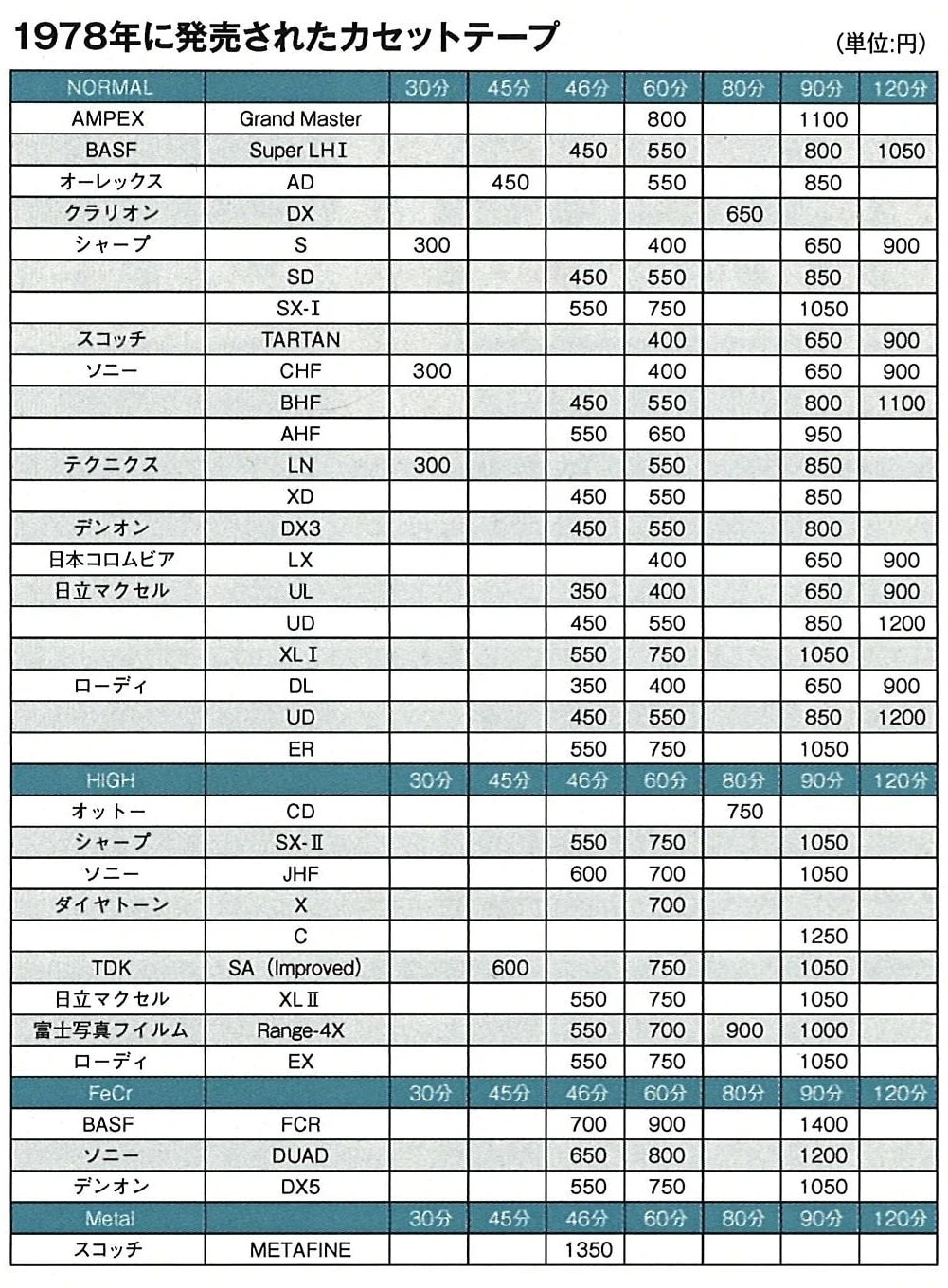
NORMAL
| Brand | Model | 30 | 45 | 46 | 60 | 80 | 90 | 120 |
|---|---|---|---|---|---|---|---|---|
| AMPEX | Grand Master | 800 | 1100 | |||||
| BASF | Super LH I | 450 | 550 | 800 | 1050 | |||
| Aurex | AD | 450 | 550 | 850 | ||||
| Clarion | DX | 650 | ||||||
| Sharp | S | 300 | 400 | 650 | 900 | |||
| SD | 450 | 550 | 850 | |||||
| SX-I | 550 | 750 | 1050 | |||||
| Scotch | TARTAN | 400 | 650 | 900 | ||||
| Sony | CHF | 300 | 400 | 650 | 900 | |||
| BHF | 450 | 550 | 800 | 1100 | ||||
| AHF | 550 | 650 | 950 | |||||
| Technics | LN | 300 | 550 | 850 | ||||
| XD | 450 | 550 | 850 | |||||
| Denon | DX3 | 450 | 550 | 800 | ||||
| Nippon Columbia | LX | 400 | 650 | 900 | ||||
| Hitachi Maxell | UL | 350 | 400 | 650 | 900 | |||
| UD | 450 | 550 | 850 | 1200 | ||||
| XL I | 550 | 750 | 1050 | |||||
| Lo-D | DL | 350 | 400 | 650 | 900 | |||
| UD | 450 | 550 | 850 | 1200 | ||||
| ER | 550 | 750 | 1050 |
HIGH
| Brand | Model | 30 | 45 | 46 | 60 | 80 | 90 | 120 |
|---|---|---|---|---|---|---|---|---|
| OTTO | CD | 750 | ||||||
| Sharp | SX-II | 550 | 750 | 1050 | ||||
| Sony | JHF | 600 | 700 | 1050 | ||||
| Diatone | X | 700 | ||||||
| C | 1250 | |||||||
| TDK | SA (Improved) | 600 | 750 | 1050 | ||||
| Hitachi Maxell | XL II | 550 | 750 | 1050 | ||||
| Fuji Photo Film | Range-4X | 550 | 700 | 900 | 1000 | |||
| Lo-D | EX | 550 | 750 | 1050 |
FeCr
| Brand | Model | 30 | 45 | 46 | 60 | 80 | 90 | 120 |
|---|---|---|---|---|---|---|---|---|
| BASF | FCR | 700 | 900 | 1400 | ||||
| Sony | DUAD | 650 | 800 | 1200 | ||||
| Denon | DX5 | 550 | 750 | 1050 |
Metal
| Brand | Model | 30 | 45 | 46 | 60 | 80 | 90 | 120 |
|---|---|---|---|---|---|---|---|---|
| Scotch | METAFINE | 1350 |