




As noted on the preceding pages, the role of the cassette became increasingly important after the first Walkman appeared in 1979. According to machinery statistics from Japan’s Ministry of International Trade and Industry, production of tape recorders reached 40 million units in 1976 but remained at roughly that level until 1979. Following the success of Walkman, other companies followed Sony: production exceeded 54 million units in 1980 and 60 million in 1981. The same happened with magnetic tape, although unfortunately the figures given here include videotape: about 240 million m² of magnetic tape were produced in 1976, about 416 million m² in 1980 and 630 million m² in 1981. Production grew markedly. Toshiba and AIWA followed Sony into the headphone stereo market, and there were still more entrants in 1981, when Sanyo and Marantz under its UNIX brand introduced new products. Practical use of permalloy, Sendust and other materials also improved the performance of the decks themselves. This was when audiophiles, too, began placing cassette decks at the centre of component systems.
As the user base expanded, many manufacturers reconsidered their tape ranges. The long-established overseas company BASF completely renewed its lineup with the PRO series, quite different from what had come before. The simple structure comprised PRO I-IV and the standard LH-X. The overseas brands also included magnax. In 1980 Konishiroku Photo Industry concluded a financial and technological agreement with America’s AMPEX and established 小西六マグネプロダクツ (Konishiroku Magne Products). In 1981 the company began receiving semi-finished products from AMPEX and releasing products under the magnax brand.
Fuji Photo Film, having renewed its series the previous year, quickly changed models again. To attract young people, the company chose YMO for its advertising. Sony first used metallised packaging for UCX-S and, from the following year, began using it widely across the range.
Sony’s own strategy: attracting users with individuality as well as performance
Since 1966 the Japanese cassette industry had steadily pursued higher performance. Whether because of the seriousness of Japanese engineers or the heated market and competition among developers, by 1980 Japanese cassettes were so far ahead in performance that overseas manufacturers could not compete.
Previously, all manufacturers had improved performance to satisfy audiophiles’ ears. But in the 1980s, Walkman and other devices brought cassettes into all aspects of life, particularly for young people, and the pursuit of performance alone could no longer meet users’ needs.
Sony offered cassettes that could be chosen by musical genre: Pops, Classic and Rock. Pops and Classic were normal-position tapes; Rock was ハイポジション (high position). It was a new approach, appealing to buyers through individuality and design as well as specifications. The cassettes were very much in the Sony spirit.
The first cassette with reels
TEAC later released cassettes with reels, followed by National, Toshiba and several other manufacturers. The TEAC STUDIO series and cartridge-type オー・カセ (Open Cassette) remain very popular. Judging by the available material, the first such cassette was this Thorens Super LH.
Thorens is a well-known, long-established turntable maker. Although its history begins in the nineteenth century, audiophiles are more likely to know it for the belt-drive turntables it had made since the 1950s. It belonged to the same group as EMT.
Around 1981 the audio industry was excited by the choice of a digital audio disc standard. Perhaps Thorens, concerned about the future of the analogue disc, turned its attention to cassettes. In any event, the move cannot be called a success: Thorens does not appear again in the history of cassettes after this.
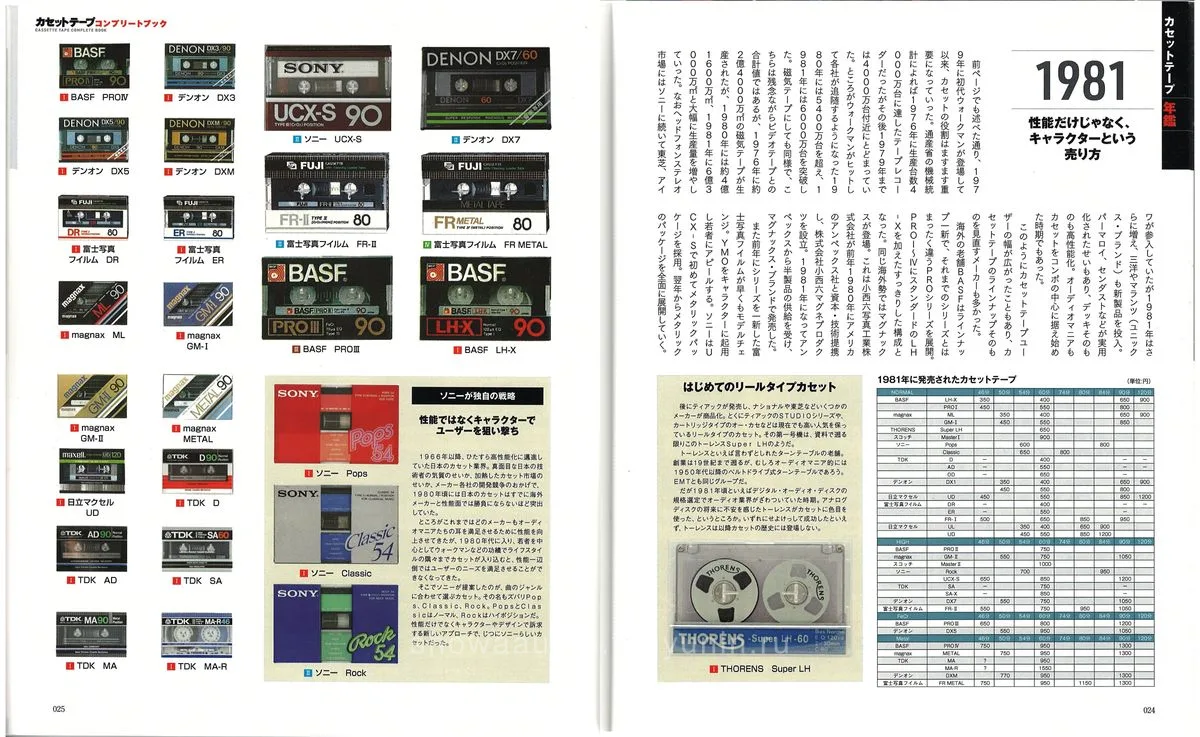
The type labels in the captions are retained as printed in the book. For some cassettes, including TDK MA and MA-R, Type I in the caption conflicts with the Metal designation on the packaging and in the table.
Cassettes released in 1981 (prices in yen)
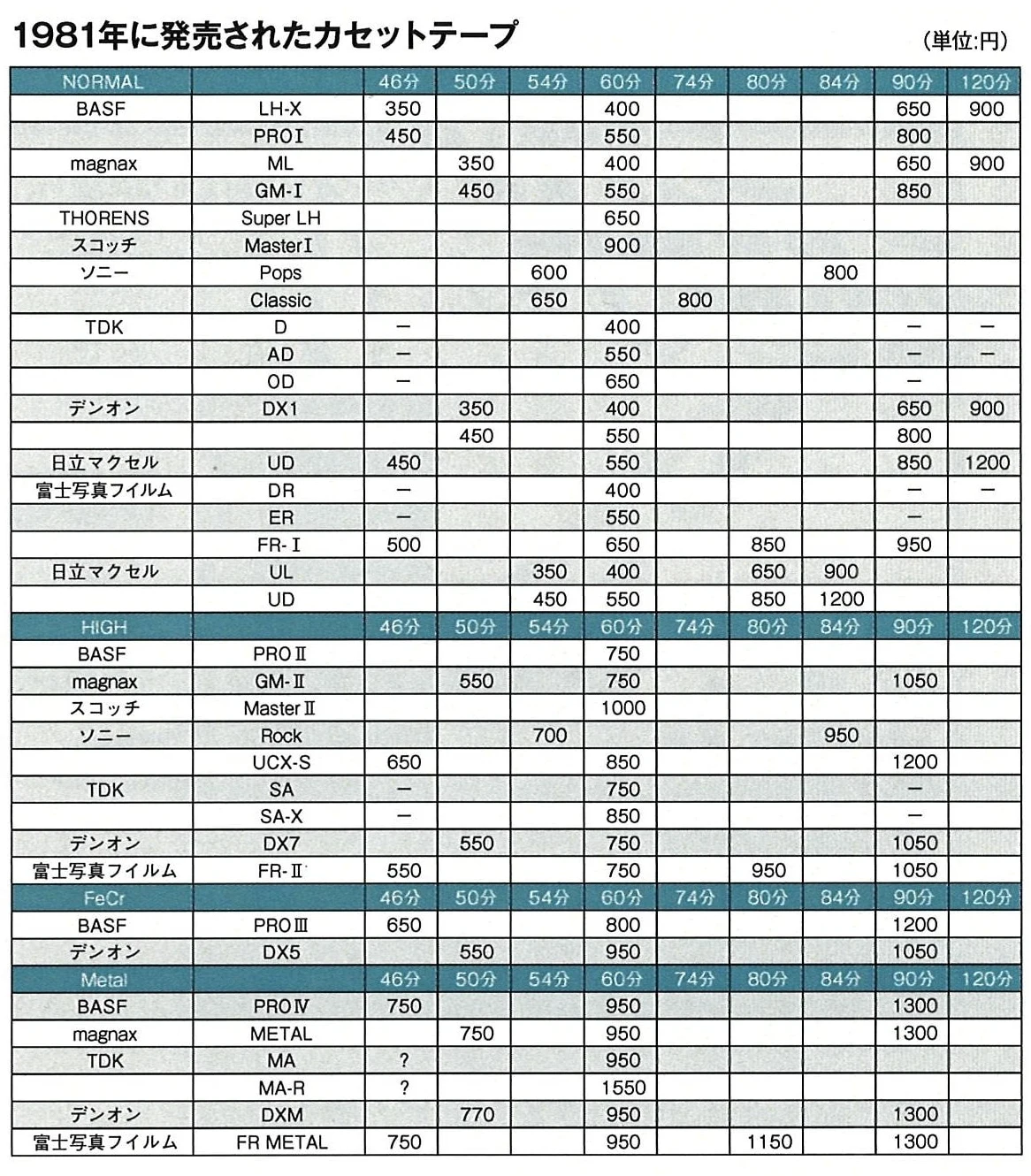
NORMAL
| Brand | Model | 46 | 50 | 54 | 60 | 74 | 80 | 84 | 90 | 120 |
|---|---|---|---|---|---|---|---|---|---|---|
| BASF | LH-X | 350 | 400 | 650 | 900 | |||||
| PRO I | 450 | 550 | 800 | |||||||
| magnax | ML | 350 | 400 | 650 | 900 | |||||
| GM-I | 450 | 550 | 850 | |||||||
| THORENS | Super LH | 650 | ||||||||
| Scotch | Master I | 900 | ||||||||
| Sony | Pops | 600 | 800 | |||||||
| Classic | 650 | 800 | ||||||||
| TDK | D | - | 400 | - | - | |||||
| AD | - | 550 | - | - | ||||||
| OD | - | 650 | - | |||||||
| Denon | DX1 | 350 | 400 | 650 | 900 | |||||
| 450 | 550 | 800 | ||||||||
| Hitachi Maxell | UD | 450 | 550 | 850 | 1200 | |||||
| Fuji Photo Film | DR | - | 400 | - | - | |||||
| ER | - | 550 | - | |||||||
| FR-I | 500 | 650 | 850 | 950 | ||||||
| Hitachi Maxell | UL | 350 | 400 | 650 | 900 | |||||
| UD | 450 | 550 | 850 | 1200 |
HIGH
| Brand | Model | 46 | 50 | 54 | 60 | 74 | 80 | 84 | 90 | 120 |
|---|---|---|---|---|---|---|---|---|---|---|
| BASF | PRO II | 750 | ||||||||
| magnax | GM-II | 550 | 750 | 1050 | ||||||
| Scotch | Master II | 1000 | ||||||||
| Sony | Rock | 700 | 950 | |||||||
| UCX-S | 650 | 850 | 1200 | |||||||
| TDK | SA | - | 750 | - | ||||||
| SA-X | - | 850 | - | |||||||
| Denon | DX7 | 550 | 750 | 1050 | ||||||
| Fuji Photo Film | FR-II | 550 | 750 | 950 | 1050 |
FeCr
| Brand | Model | 46 | 50 | 54 | 60 | 74 | 80 | 84 | 90 | 120 |
|---|---|---|---|---|---|---|---|---|---|---|
| BASF | PRO III | 650 | 800 | 1200 | ||||||
| Denon | DX5 | 550 | 950 | 1050 |
Metal
| Brand | Model | 46 | 50 | 54 | 60 | 74 | 80 | 84 | 90 | 120 |
|---|---|---|---|---|---|---|---|---|---|---|
| BASF | PRO IV | 750 | 950 | 1300 | ||||||
| magnax | METAL | 750 | 950 | 1300 | ||||||
| TDK | MA | ? | 950 | |||||||
| MA-R | ? | 1550 | ||||||||
| Denon | DXM | 770 | 950 | 1300 | ||||||
| Fuji Photo Film | FR METAL | 750 | 950 | 1150 | 1300 |