


Noboru Ikushima, manager of Disk Union Jazz TOKYO
Shigeo Makino, special adviser to Stereo Jidai
Why won’t cassettes disappear? Even in an age when high-resolution digital recordings are flourishing, the circle of cassette enthusiasts is growing: a younger generation is joining established audiophiles and music lovers. Two regular contributors to the magazine discuss the phenomenon.
Photography and article: Shigeo Makino
Makino: Disk Union Jazz TOKYO, which you manage, sells prerecorded cassettes. I regularly drop in to see what’s there, but to me music cassettes belong to the past. I’m surprised that new ones are being sold at all.
Ikushima: We order them from America, and the dealer we work with asked, “Are you sure you want cassettes? They’re cassettes - tape!” Lately, though, there seem to be many orders for cassettes, and wholesale prices have risen considerably. In return, we get outstanding jazz, rock and pop albums. Real music cassettes.
Makino: Who buys them? Men like me?
Ikushima: No, quite a lot of young people, actually. Some artists even release a cassette alongside a new CD.
Makino: Cassette decks, radio-cassette players and old blank tapes have also been popular at online auctions in recent years. Prices have reached what you could call bubble levels, and our editor-in-chief Sawamura has a hard time collecting cassettes for photography.
Ikushima: What? He buys them?
Makino: We try to buy every package design that neither Sawamura nor I already have. Sometimes a lot of about 50 sells for 200,000 yen. I think only a very small number of people want blank cassettes, but Stereo Jidai once made its own cassette and sold it by mail order only. It sold out in eight minutes. When Hitachi Maxell released a limited run of UD in its old packaging, 60,000 cassettes apparently disappeared almost instantly too.
Ikushima: There’s definitely demand. In Japan, only Maxell currently sells normal-position tape (Type I), so for high position (Type II) and metal (Type IV) you have to look for remaining stock. But I do think today’s high prices are excessive.
Makino: We belong to a generation that has long been used to cassette sound, so we still have recordings and working decks. But it’s hard to explain rationally why people today would deliberately buy playback equipment and start listening to cassettes.
Ikushima: Cassette sound isn’t hi-fi, of course, but somehow I feel it’s somewhere beyond hi-fi. Take jazz SP records: in terms of frequency response, they reach 10 kHz at best, yet I don’t feel they’re lacking in treble. The sound you hear isn’t determined by numerical specifications alone.
Makino: With high-position tape, a radio-cassette player reaches about 13 kHz at best. Above 10 kHz there’s a gradual roll-off. The lower limit is 80 Hz. Yet even with that narrow range you think, “Ah, that sounds good.”
Ikushima: There’s plenty of distortion on a cassette too (laughs). I think of those imperfections as seasoning.
Makino: Someone who headed the engineering division at a major audio manufacturer once told me: “If you eliminate distortion and pursue ever better electrical characteristics, the sound gradually becomes boring. I’d never say this publicly, but good sound ultimately has a moderate amount of distortion mixed in.”
Ikushima: For some reason, even the fluctuations in cassette sound are pleasant. I invite friends over to listen to records and also play a cassette on a radio-cassette player. There’s always a recording or a situation where someone says, “That sounds better.”
Makino: Really! You use a JBL Paragon, don’t you? The radio-cassette player sounds better than the Paragon!
Ikushima: Sometimes it does. It’s not a matter of reasoning it out.
Makino: I agree. To me, cassette sound is as if someone sprinkled it with magic powder. As if it had been dusted with that powder and fried in oil until crisp: perhaps bad for your health, but delicious…
Ikushima: Like the faint chemical smell when you tear the cellophane off an old imported record (laughs). That smell immediately takes you to a recording studio abroad in your imagination.
Makino: I’m not going to dismiss hi-res, but even if you keep increasing the sampling rate and extend the upper limit to 100 kHz, someone like me, approaching 60, won’t be able to hear it anyway (laughs). I know very high frequencies come out of the speakers and that their presence or absence completely changes the mood. But a cassette, with its original limit of 12-13 kHz, lets you hear only the essence of the music; the sound fluctuates a little and has plenty of impurities, giving it a flavour different from the performance-enhancing extract of high-resolution recordings (laughs).
Ikushima: The important thing is that it sounds enjoyable. That said, the ultimate capabilities of the cassette are very high.
Makino: You use the famous Nakamichi Dragon deck. I also keep high-end equipment like Nakamichi and Studer in working order, and when I listen to a cassette recorded from a record after carefully setting up playback, with the system in good condition, the sound can be so good it gives me chills.
Ikushima: Analogue source material is especially good. Cassettes are best suited to records that haven’t undergone digital-to-analogue conversion.
Makino: Analogue records that have been digitally processed surprise you in a different way from old ones, but when you record them onto cassette, somehow the impression is weaker. It’s things like this that make audio a mystery. That’s why you can’t give it up.
Ikushima: You don’t give it up because it’s enjoyable. I think the cassette is one of the best examples.
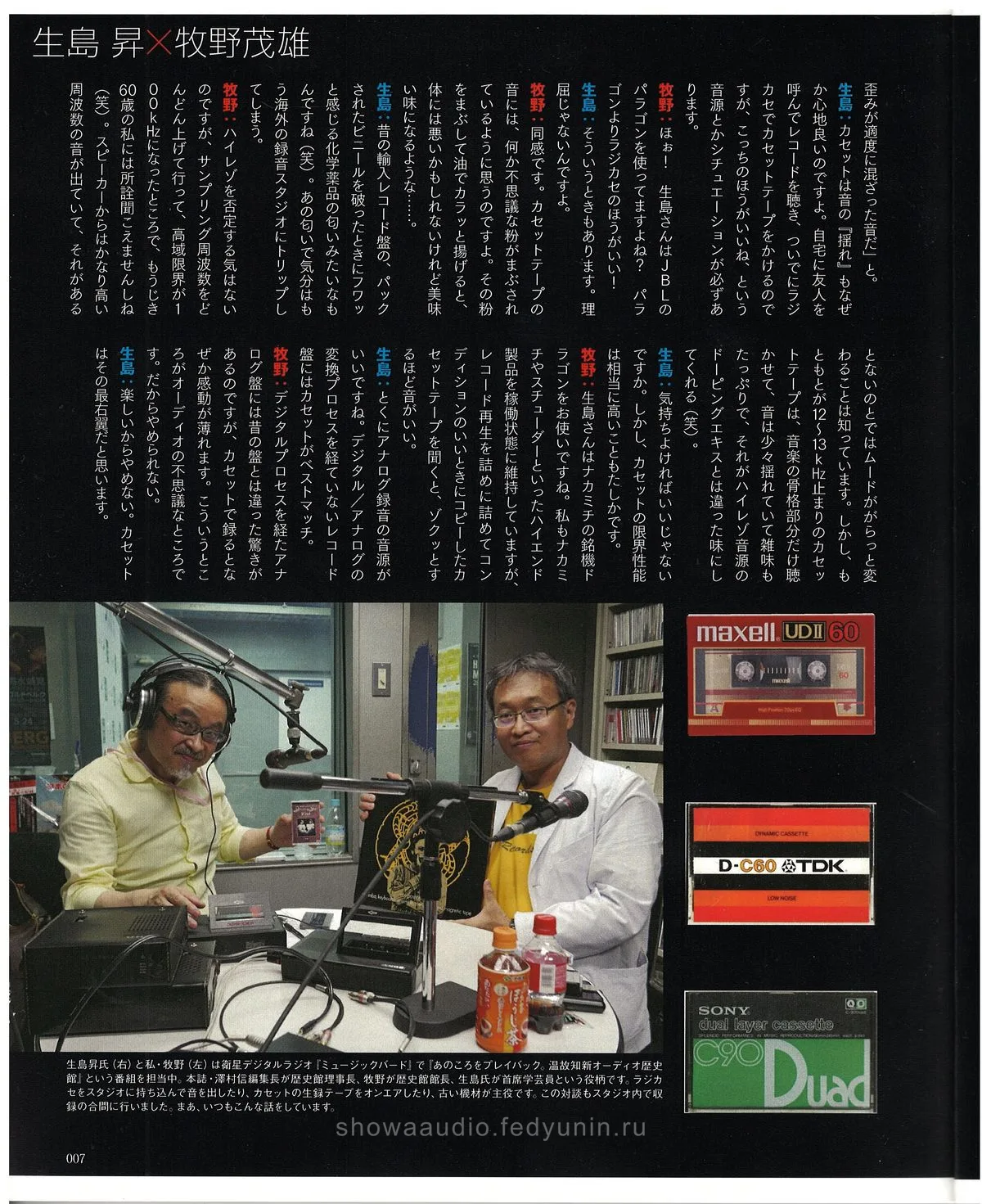
Noboru Ikushima (right) and I, Makino (left), present the programme “Playing Back Those Days: The Museum of Audio History, Learning from the Past” (あのころをプレイバック。温故知新オーディオ歴史館) on the digital satellite radio station Music Bird. Our editor-in-chief Sawamura plays the museum’s chair, Makino its director, and Ikushima its chief curator. We bring radio-cassette players into the studio and play them, and broadcast live recordings made on cassette; old equipment is the star of the programme. We recorded this conversation in the studio between recording sessions. Actually, we always talk about much the same things.