
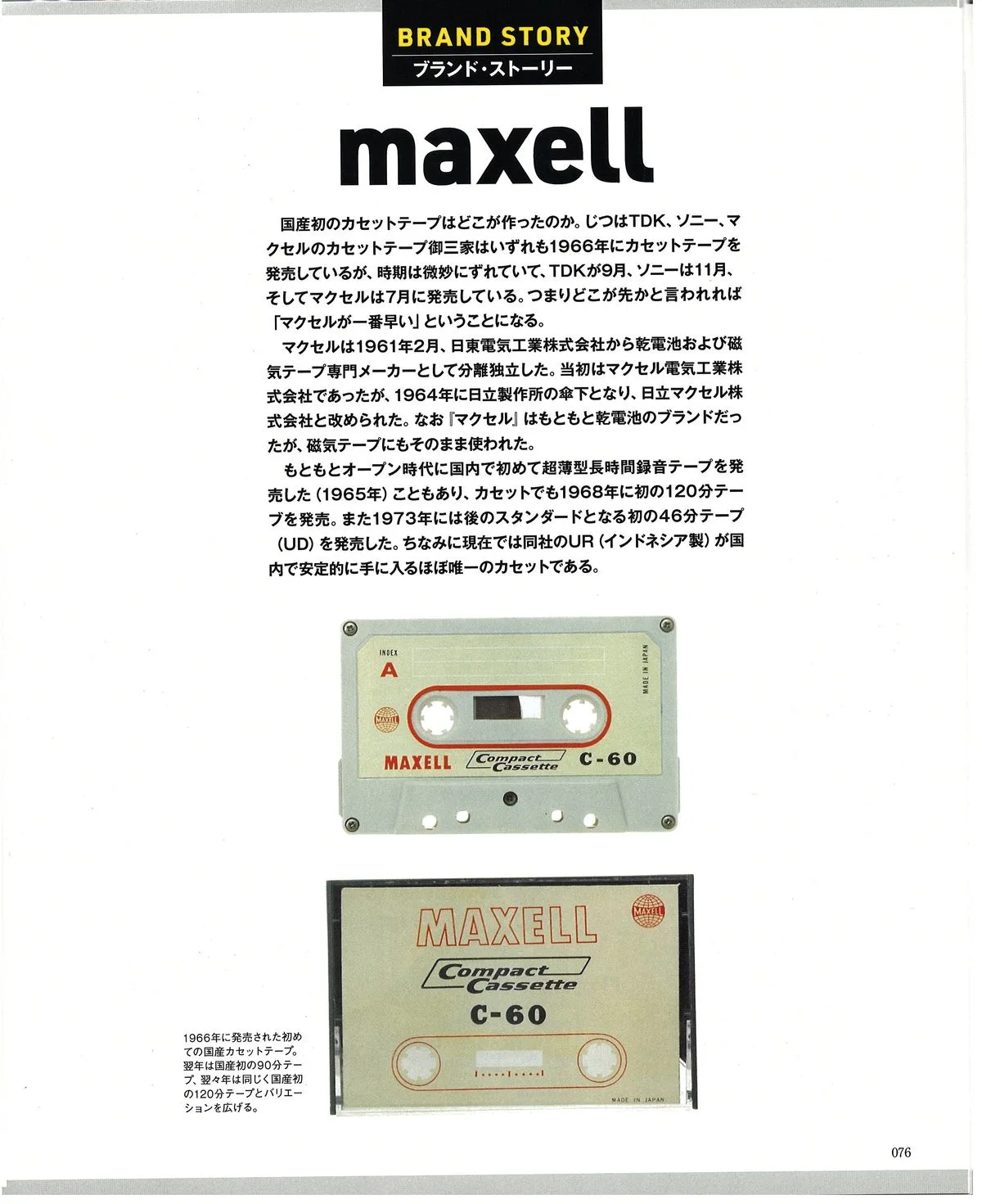
Who made Japan’s first cassette? TDK, Sony and maxell all released cassettes in 1966, but in different months: September, November and July. By that measure maxell was first.
In February 1961 maxell separated from Nitto Electric Industrial as an independent maker of dry batteries and magnetic tape. It was first called Maxell Electric Industrial, joined the Hitachi group in 1964 and became Hitachi Maxell. The maxell name began as a battery brand but was also used for magnetic tape. In 1965 the company released Japan’s first ultra-thin long-play tape, and in 1968 the first Japanese 120-minute cassette. Its 1973 UD was the first 46-minute cassette, the duration that later became standard.
UD
Hitachi Maxell began cassette production in 1966. The compact shell protected against dust, static, noise and print-through and ensured proper head contact, but early sound quality was considered unsuitable for music. After TDK SD appeared in 1968, demand for music cassettes grew quickly. In June 1970 maxell introduced UD (Ultra Dynamic), a single-layer iron-oxide tape whose performance made it popular. The second generation used PX gamma-haematite powder and a black shell. In June 1973 it became the world’s first 46-minute cassette.
UD remained a long-lived standard model, with successive improvements. UD-XL followed in 1974. In 1981 total UD production passed 200 million cassettes. The major 1983 update split the range into UD I for Normal and UD II for High. Silver and blue packaging, a non-porous magnetic material and performance above its class made UD I a major hit until 1988. Special UD I-R, UD I-S and UD I-N versions appeared along the way.
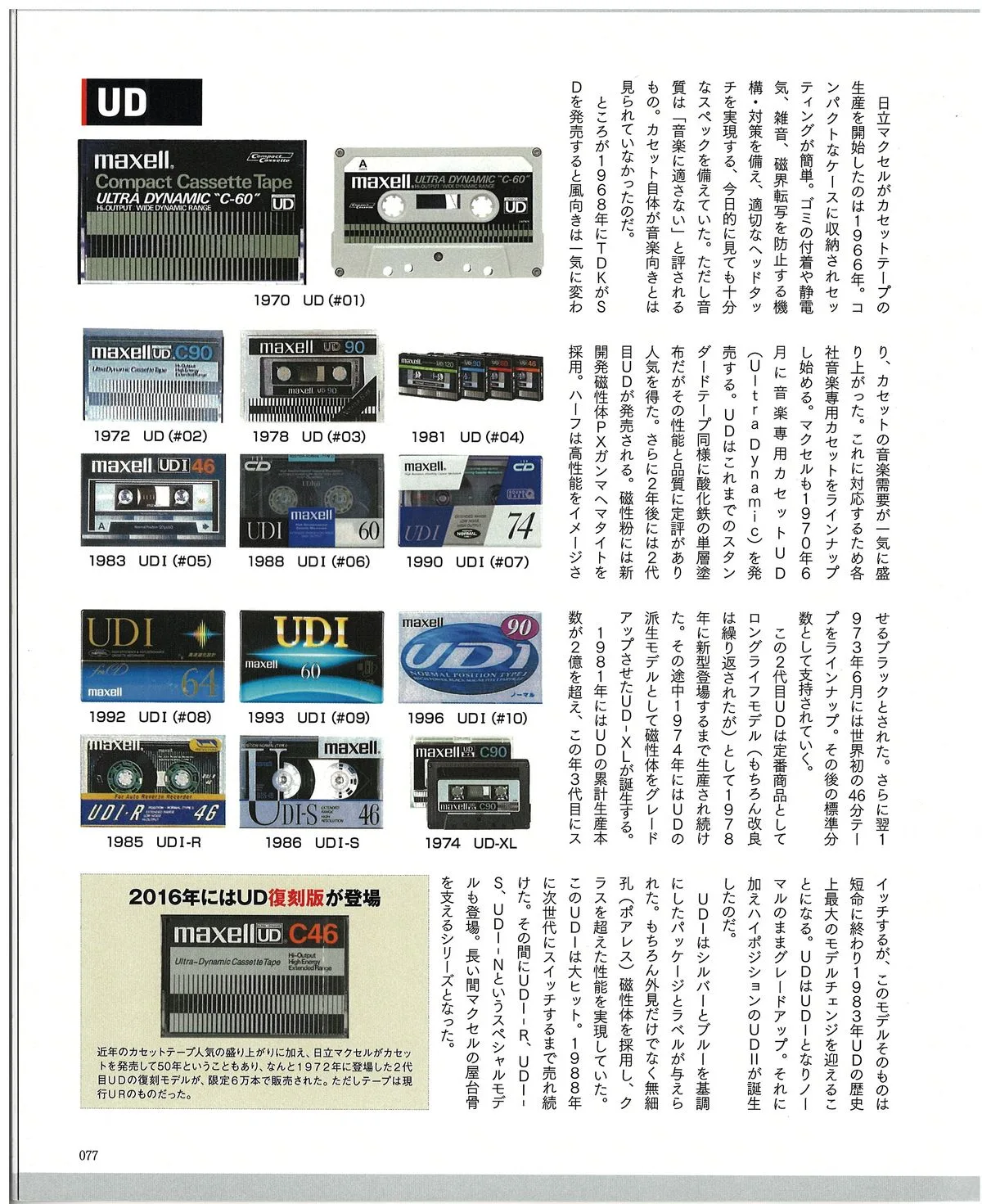
1970 UD (#01); 1972 UD (#02); 1978 UD (#03); 1981 UD (#04); 1983 UD I (#05); 1988 UD I (#06); 1990 UD I (#07); 1992 UD I (#08); 1993 UD I (#09); 1996 UD I (#10); 1985 UD I-R; 1986 UD I-S; 1974 UD-XL.
UD reissued in 2016
With interest in cassettes returning and the first Hitachi Maxell cassette reaching its fiftieth anniversary, maxell reissued the second-generation 1972 UD in a limited run of 60,000. The tape inside, however, was modern UR.
UD II
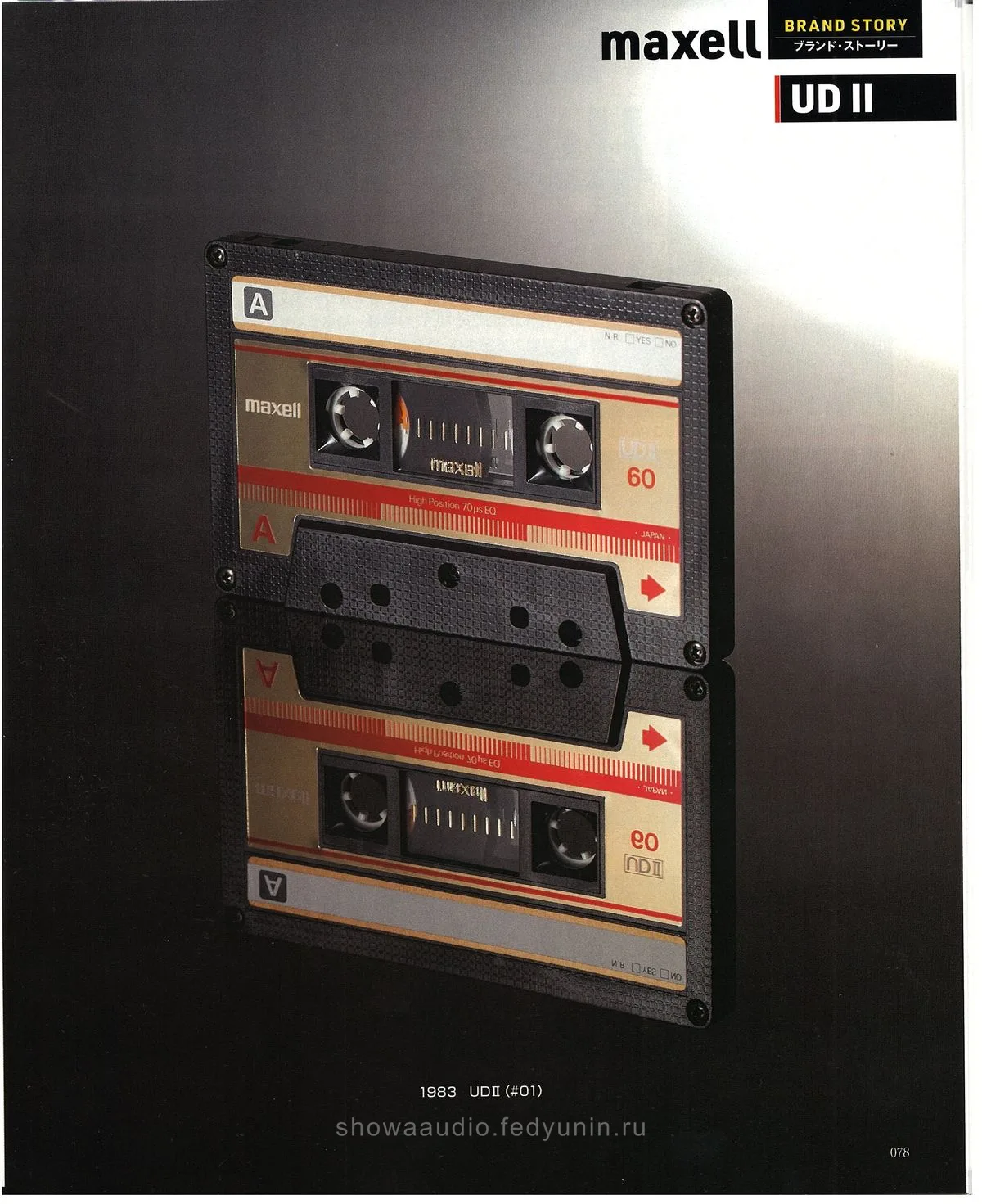
In 1983 the range split into UD I Normal and UD II High. UD II used Fine Epitaxial magnetic material, with uniformly sized particles only 0.35 micrometres across. The material grew cobalt-ferrite composite crystals on the iron-oxide particles used for normal tape. Smaller particles reduced noise, but required more binder and could reduce output, so density had to be high and even.
UD II’s great success before its 1988 update came from its price-to-performance ratio. In-house development and production reduced costs: although the list price was 500 yen for 46 minutes, it often sold for just over 300 yen, making it affordable to high-school students.
The PA (Phase Accuracy) cassette mechanism, developed for XL II and XL II-S, also helped. Every part was made more precise to improve phase and sound-image localisation. Shell parallelism was controlled to micrometre accuracy, stabilisers and ribs resisted deformation, guide rollers were round and precise, reel clearances were reduced, and a TA separator sheet with three arcs ensured smooth movement.
Serious engineering and bold marketing made UD II a cassette landmark and encouraged affordable high-position models such as TDK SF, Sony Do and Denon HD.
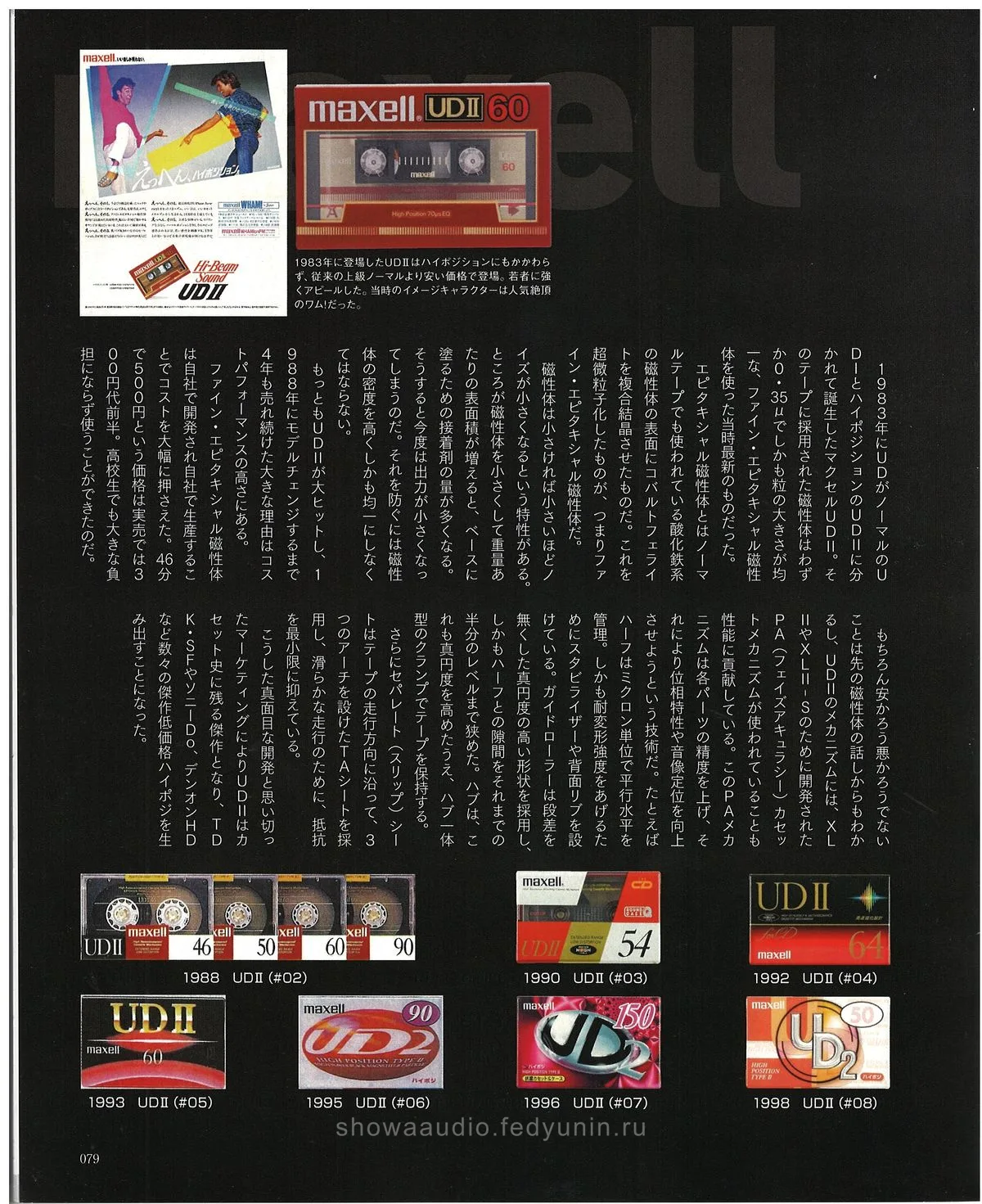
UD II appeared in 1983 and, despite being High position, cost less than earlier high-end Normal cassettes. Wham! at the height of its popularity was the advertising face.
1988 UD II (#02); 1990 UD II (#03); 1992 UD II (#04); 1993 UD II (#05); 1995 UD II (#06); 1996 UD II (#07); 1998 UD II (#08).