
TDK had its flagship MA-R and Sony its Metal Master, but maxell, one of the three largest companies, had no high-end model for a long time. In 1989, as the cassette industry approached its peak, that changed. Metal Vertex was a premium metal-powder cassette built on a different idea from its competitors.
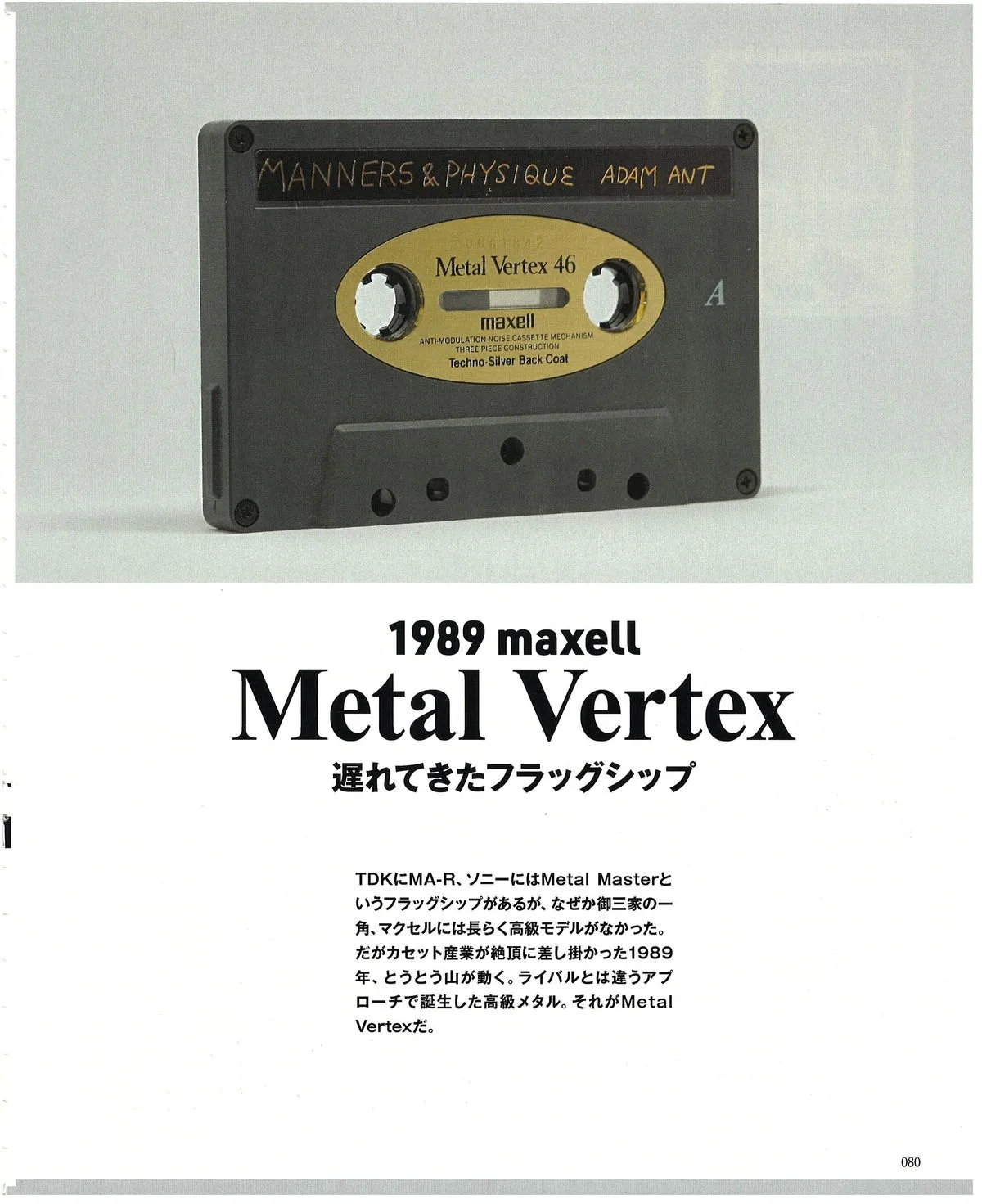
In 1989 the economy was booming before the bubble, and the audio industry was said to sell anything it could make. The cassette market, however, was changing in response to new needs. A cassette was no longer mainly for building a home collection; it carried music to a Walkman or car. Convenience, durability and fashionable appearance mattered as much as exceptional performance.
That was when Hitachi Maxell’s flagship Metal Vertex appeared. Its heavy shell had three parts, with a metal plate in the centre that also damped vibration. Super Energy Pure Metal magnetic material was applied evenly using Multi-Orientation technology. A rare TS Back Coat on the back of the tape produced extremely low distortion and outstanding magnetic performance.
The performance was considered exceptional enough for the cassette to appear on the list of products covered by CoCom, the Coordinating Committee for export controls to communist countries. Its specifications were treated as comparable to those of strategic materials.
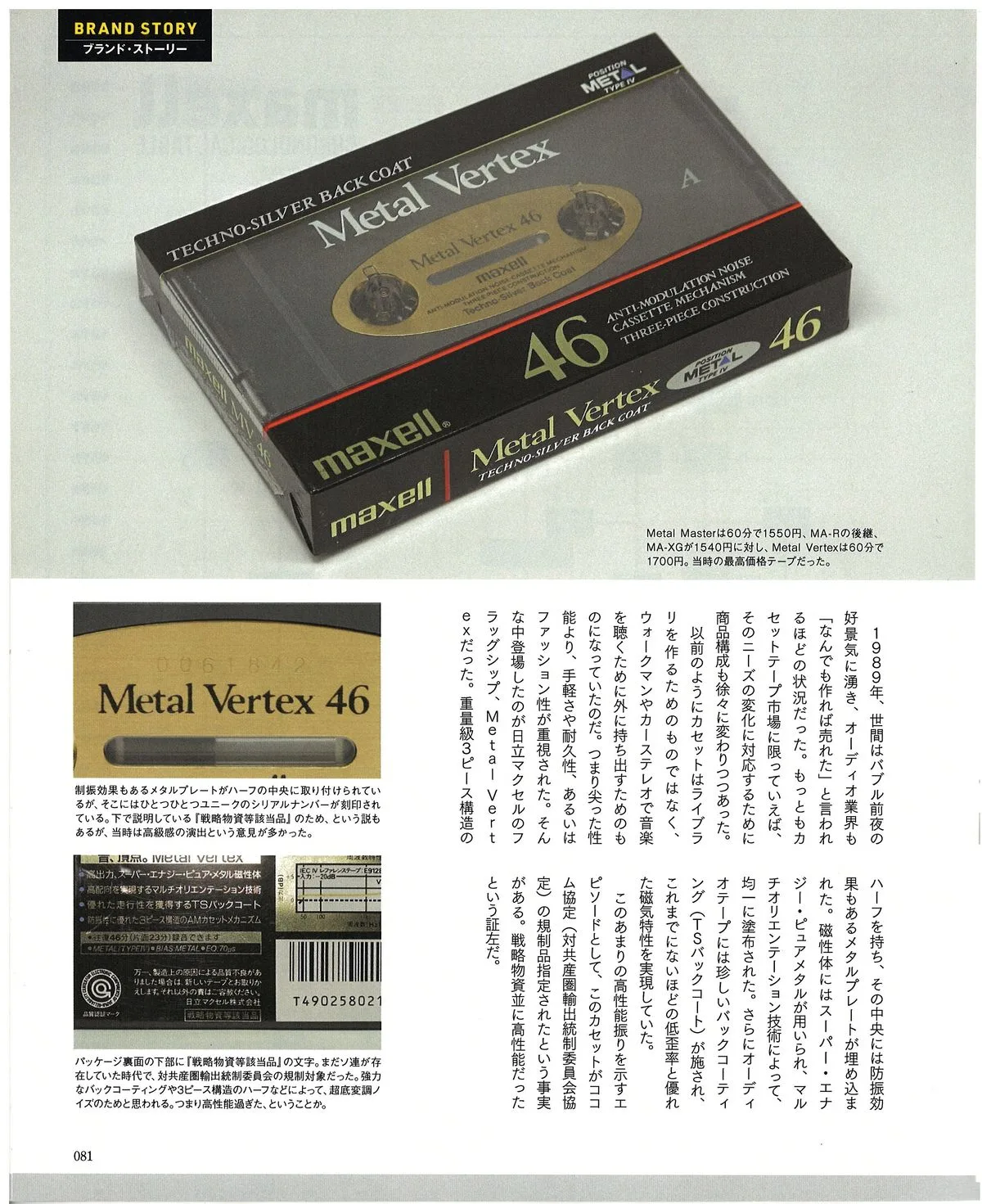
Metal Master cost 1,550 yen for 60 minutes, MA-XG, successor to MA-R, 1,540 yen, and Metal Vertex 1,700 yen for 60 minutes. It was the most expensive tape of its time.
The metal plate in the centre also damped vibration. Each cassette carried a unique engraved serial number. Some believe it was connected to the “strategic materials” designation below, although many people at the time regarded it simply as decoration for an expensive cassette.
The bottom of the package’s back states “product related to strategic materials”. While the Soviet Union still existed, the cassette was subject to CoCom restrictions. The presumed reason was its exceptionally low modulation noise, achieved through the strong back coating, three-part shell and other measures. Its performance was simply too high.
Museum note: the museum has a separate detailed feature on maxell Metal Vertex.