
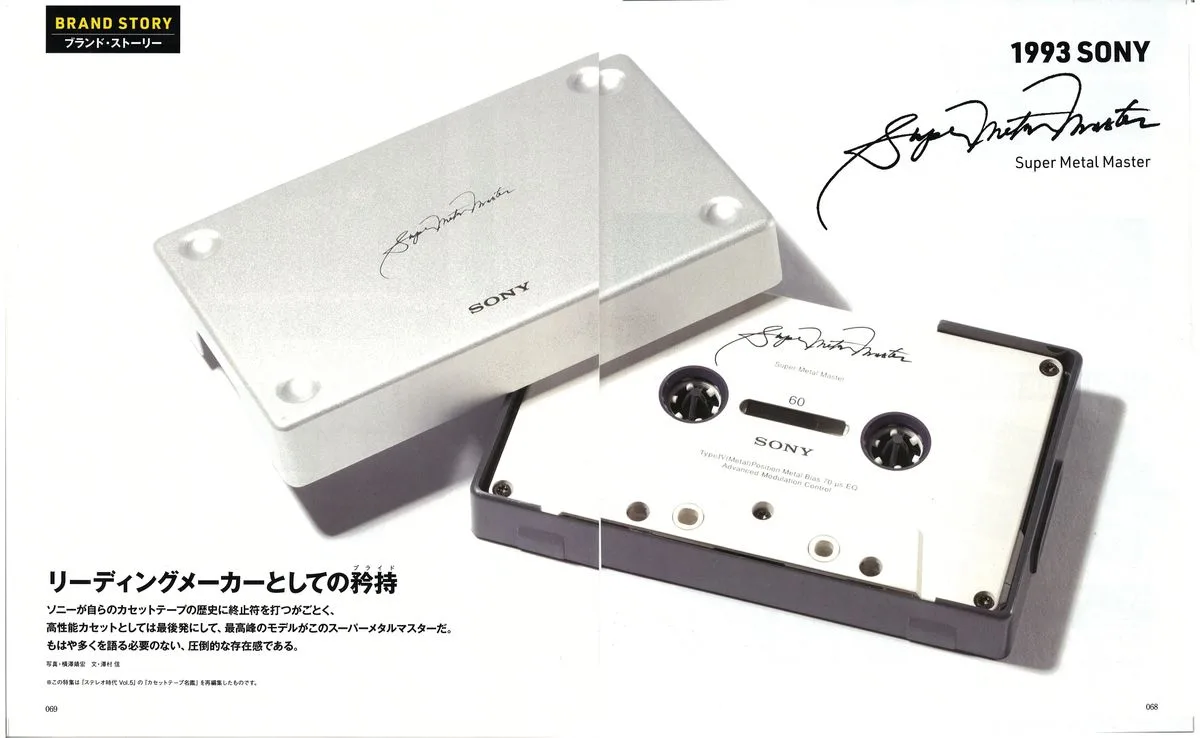
Sony seemed to put a full stop to its cassette history with Super Metal Master, the last and most accomplished of its high-end cassettes. Its imposing appearance needs no lengthy explanation.
Photo: Yasuhiro Yokozawa (横澤靖宏). Text: Makoto Sawamura (澤村信). Adapted from the revised “Cassette Catalogue” section of Stereo Generation issue 5.
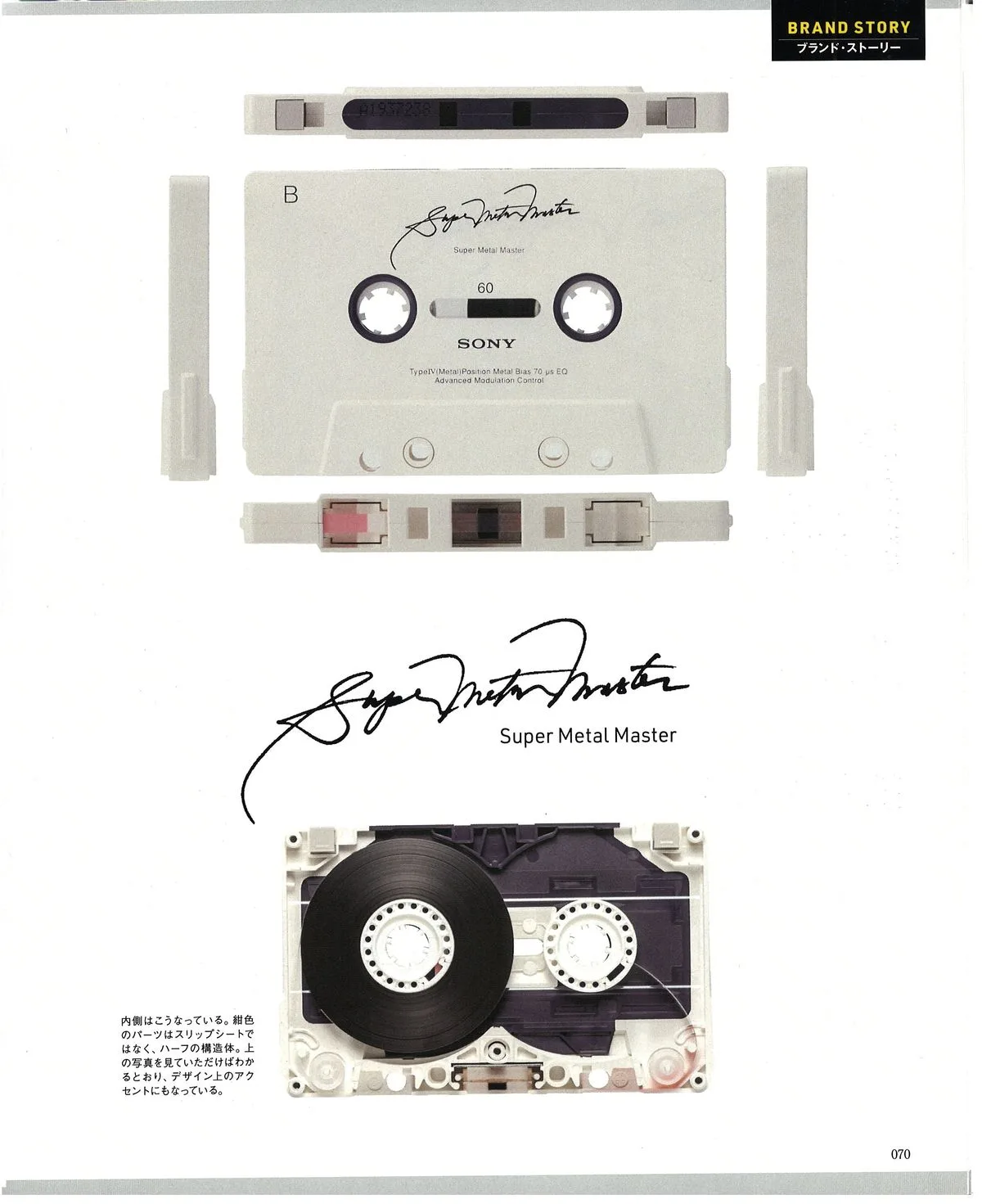
This is how the cassette is built inside. The dark-blue part is not a sliding slip sheet but part of the shell itself. As the upper photograph shows, it is also a colour accent in the design.
With the spread of CDs, demand for cassettes peaked in 1989-1990 and then began to decline. In the second half of the 1990s MiniDisc appeared, and cassette quickly lost its position.
In 1993, when cassettes were already on the edge of losing their place, Super Metal Master appeared. To understand it, we first need to look at its predecessor.
In October 1986 Sony surprised the industry with Metal Master, its answer to MA-R and the peak of its metal-powder range. Its white ceramic-composite shell looked even more striking and refined than MA-R’s die-cast frame between transparent panels. The centre window was made exceptionally narrow to emphasise the design. At 1,600 yen for 46 minutes it surpassed the MA-R, by then replaced by MA-XG, and took the position of the most expensive cassette.
Its high-precision shell and tape with two different magnetic layers also gave it outstanding performance. But Metal Master did not need such arguments. Smooth, cool and distinctly heavy, it seemed to reject even adhesive labels. It may have gone beyond the idea of a cassette and become a medium of its own.
After the market peak around 1990, competitors disappeared. TDK MA-XG became MA-XG Fermo, an ordinary cassette with a slightly more complicated shell. maxell Metal Vertex disappeared soon after the early 1990s, and Sony itself seemed to be moving toward inexpensive metal-powder tapes such as Metal XR.
Then Super Metal Master appeared. It had no real rival. The former Metal Master tape had two magnetic layers; this one had five. The shell was also composite, made from two kinds of ceramic. Only 46-, 60- and 90-minute versions were offered. The 46-minute cassette cost 2,000 yen and the 90-minute version 2,600 yen, enough to buy a CD. The price felt like an honest statement that the design had reached its limit.
Such a cassette could never sell in large numbers. Very few were probably made, and today an unopened example can sell for more than 10,000 yen at online auctions. More than twenty years later, Super Metal Master can be seen as the pride of Sony, the manufacturer that led cassette and cassette-deck culture.
Super Metal Master became the last high-end cassette in the world.
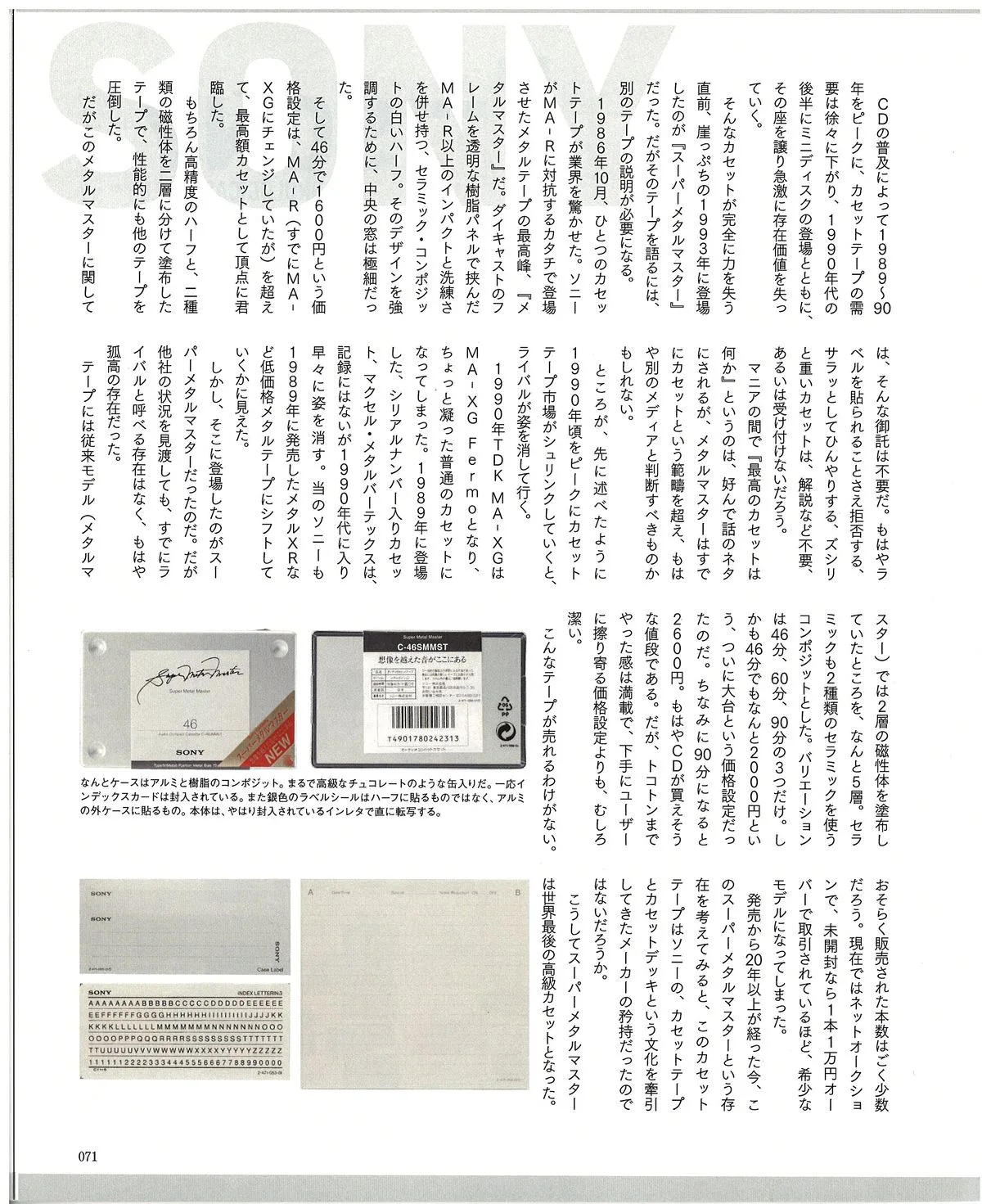
The case is made of aluminium and plastic, like a metal box for expensive chocolate. An index card is included. The silver sticker is for the outer aluminium case, not the cassette shell; lettering for the cassette is supplied as transfer type.
Museum note: the museum has a separate detailed feature on Sony Super Metal Master.