
Ferrite was invented by Dr Yōgorō Katō (加藤与五郎), head of the Electrochemistry Department at Tokyo Institute of Technology, and Dr Takeshi Takei (武井武). In 1935 Tokyo Denki Kagaku Kogyo, later TDK, was founded for industrial ferrite production. It inherited the two scientists’ idea: “Create a new industry through Japanese ingenuity.” Research into magnetic materials that began with ferrite continued to develop, and in 1952 the company started producing magnetic tape. In September 1966 it began producing シンクロテープ (Synchro Tape) cassettes.
In October 1968 the company released SD, a tape made specifically for music. Its contribution to raising the cassette to the level of a musical medium was enormous. TDK also applied AVILYN (アビリン), a magnetic material developed for video tape in 1973, to cassette tape, and in 1975 released the high-position SA without chrome. The company led cassette development, but in 2007 transferred its recording-media business and TDK brand to Imation, which had spun off from 3M. TDK completely left the cassette market it had helped create.
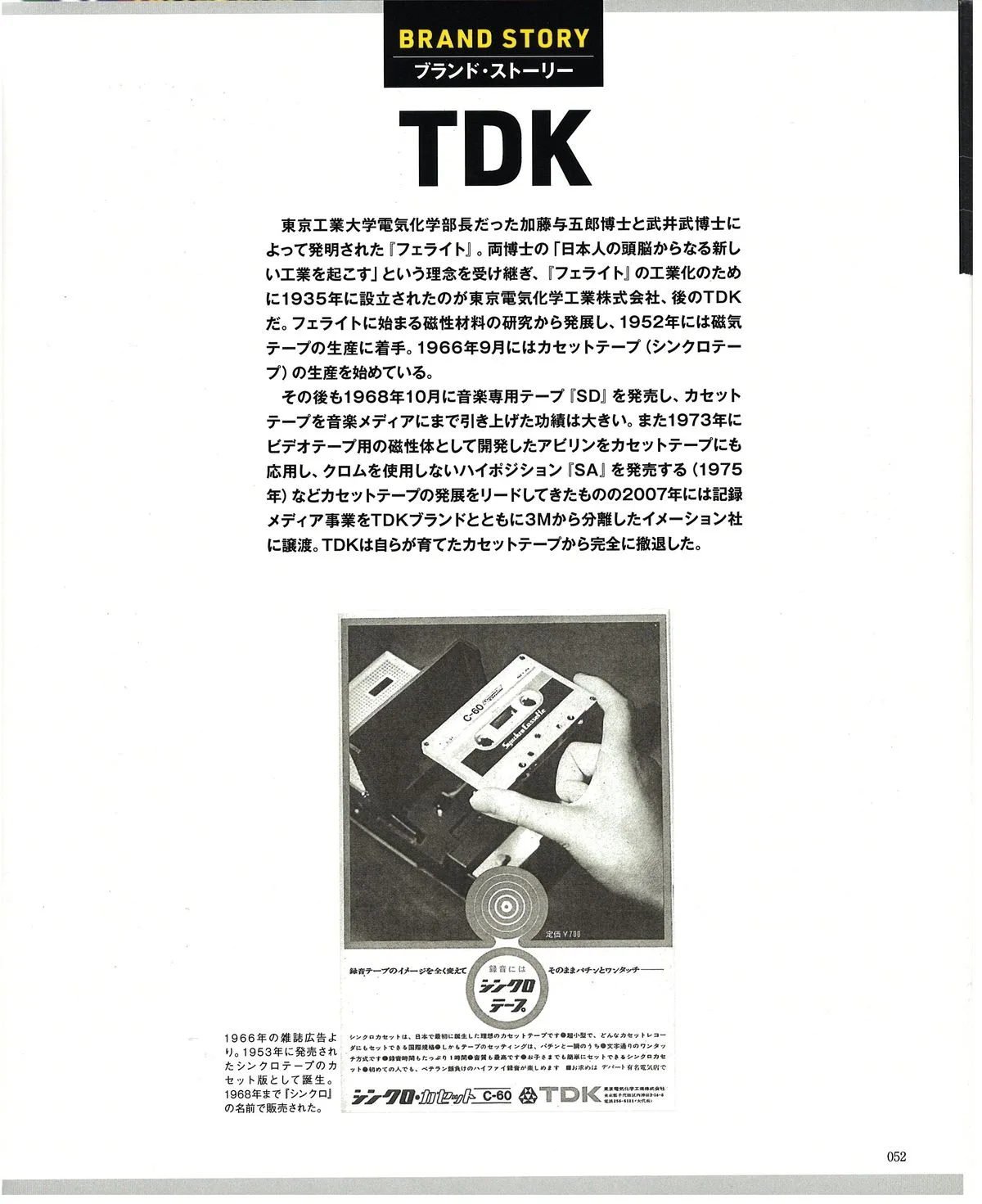
From a 1966 magazine advertisement. The cassette appeared as a cassette version of Synchro Tape, released in 1953. Until 1968 it was sold under the name “Synchro”.
D/SD
At first the cassette was considered an accessory to a tape recorder, a consumable. TDK also increased sales through OEM supplies to home-appliance manufacturers. But as the number of cassette makers and cases where tape-recorder manufacturers produced their own cassettes grew, some recorder makers began making cassette tape themselves. TDK therefore presented cassettes under its own brand and made “specially for music” its main message.
Until then the cassette was considered suitable mainly for recording speech. A needle-shaped magnetic material developed by the company, which could be coated at high density, sharply improved its performance. The material’s prototype designation, SD (Single Domain), was reinterpreted as Super Dynamic, and the cassette was shown at CES in North America in 1968. First sales began in the United States. Thanks to its outstanding performance, SD won recognition among enthusiasts.
The cassette market continued to grow and the number of competitors increased. To address buyers directly, especially while competing with large home-appliance makers that had their own sales channels, TDK used its distinctive striped pattern as part of its corporate-identity strategy. It was shared by D, SD and KR.
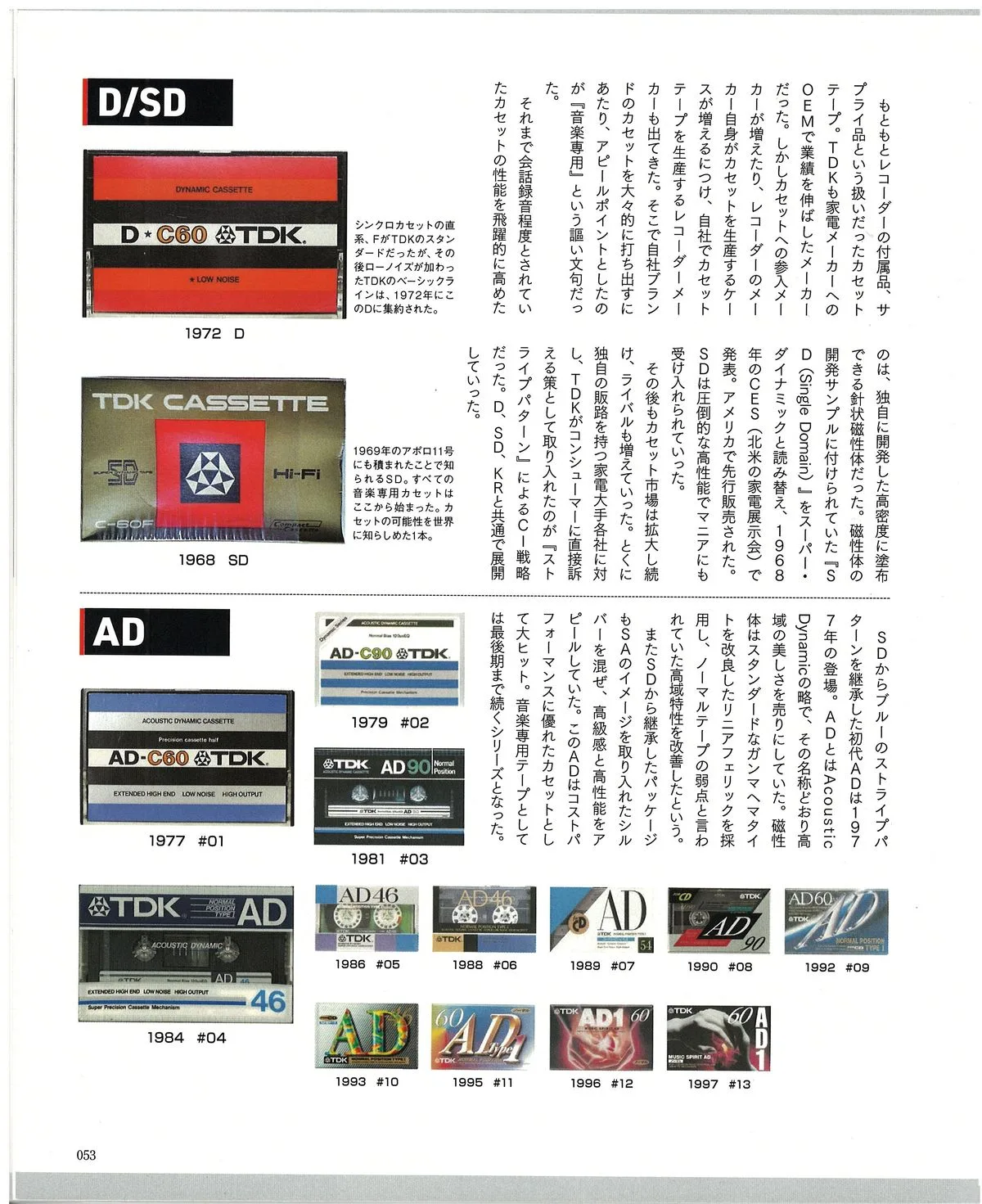
1972 D - The direct descendant of Synchro Cassette and TDK’s standard model was F. A low-noise model was later added, and in 1972 TDK’s basic range was consolidated as D.
1968 SD - SD is known for having travelled aboard Apollo 11 in 1969. All music-oriented cassettes began with it. This cassette showed the world what the format could do.
AD
The first-generation AD, inheriting SD’s blue stripes, appeared in 1977. AD stood for Acoustic Dynamic, and, as the name suggests, the cassette was sold by emphasising the beauty of its high frequencies. Its magnetic material was リニアフェリック (Linear Ferric), an improved standard gamma-haematite that was claimed to improve high-frequency performance, a weak point of normal-position tape.
The SD-derived packaging also gained silver, borrowed from the image of SA, to stress high performance and a premium feel. AD became a major hit as a cassette with an excellent price-to-performance ratio. The music-cassette series lasted until the very end of the era.
AD - 1977 #01; 1979 #02; 1981 #03; 1984 #04; 1986 #05; 1988 #06; 1989 #07; 1990 #08; 1992 #09; 1993 #10; 1995 #11; 1996 #12; 1997 #13.
AD-S/DS
In 1984, as cassettes continued to become cheaper, TDK updated D. Alongside D in a heavy black plastic shell came DS (D Spirit) with a transparent shell. The RC-II mechanism developed for the transparent shell, with a new transparent pad and more precise parts, ensured smooth tape movement. AD-S, which had appeared a year earlier in 1983, used the SP-XC mechanism created to reduce resonance. A special plastic shell improved rigidity and tape-motion accuracy and further reduced resonance. AD-S was therefore considered a class above AD even though it used the same tape.
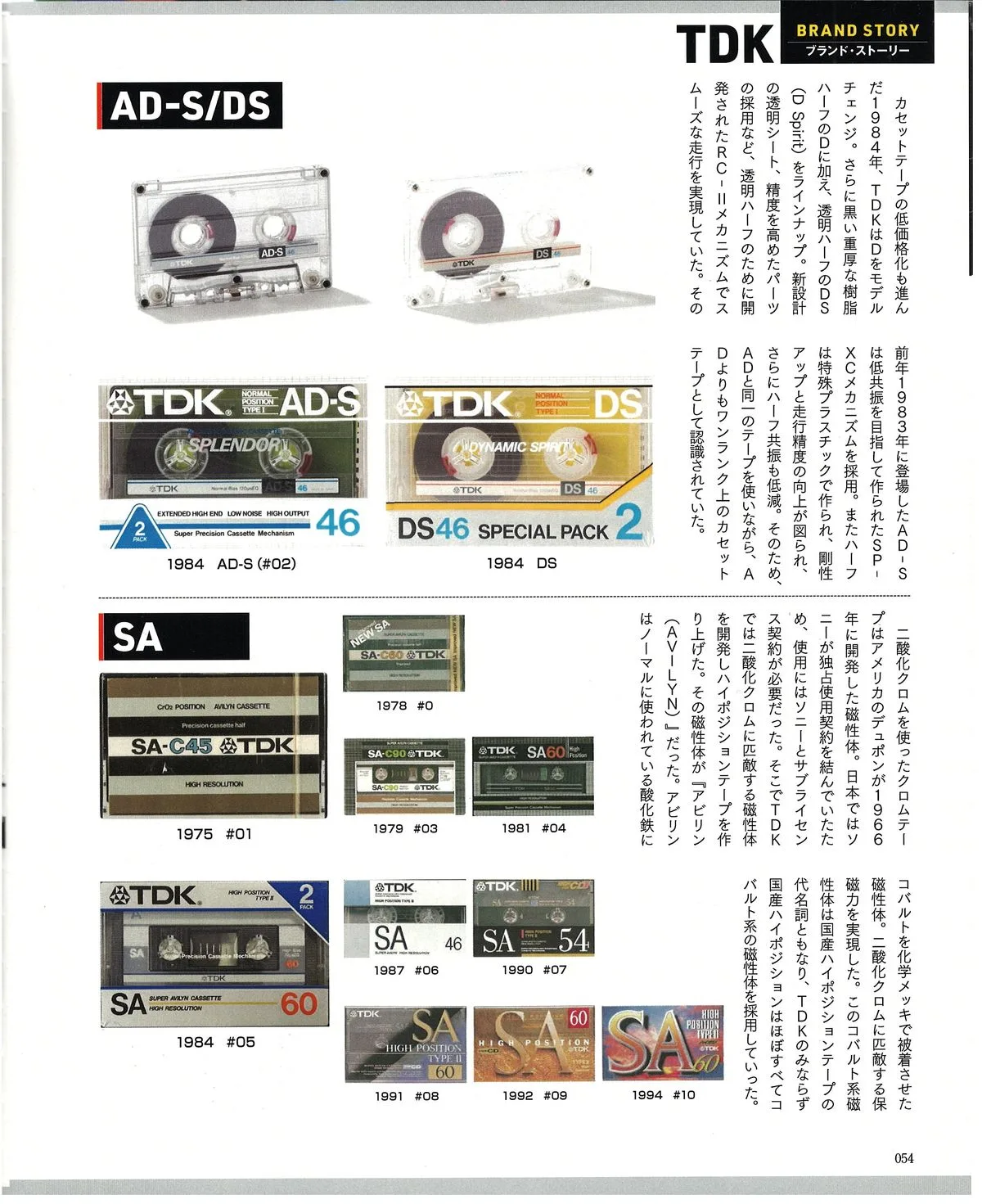
1984 AD-S (#02); 1984 DS.
SA
The American company DuPont developed chromium-dioxide tape material in 1966. In Japan Sony signed an exclusive-use agreement for it, so other companies needed a sublicense from Sony. TDK developed a magnetic material comparable to chromium dioxide and created a high-position tape. This material was AVILYN. In AVILYN, the iron oxide used in normal-position tape was chemically coated with cobalt. The material reached coercivity comparable to chromium dioxide. This cobalt magnetic material became synonymous with Japanese high-position tape: not only TDK but almost every Japanese high-position tape maker used cobalt-based materials.
SA - 1975 #01; 1978 #0; 1979 #03; 1981 #04; 1984 #05; 1987 #06; 1990 #07; 1991 #08; 1992 #09; 1994 #10.
AR
AR (Acoustic Response) appeared as a high-end normal-position tape replacing OD (Optimum Dynamic), formerly the top model in TDK’s normal range. It used ノンポア・フェリック (non-porous ferric magnetic material), eliminating pores in the tape’s magnetic layer. Flux density was 1,700 gauss, and sensitivity was 1.0 dB higher than AD across the whole range.
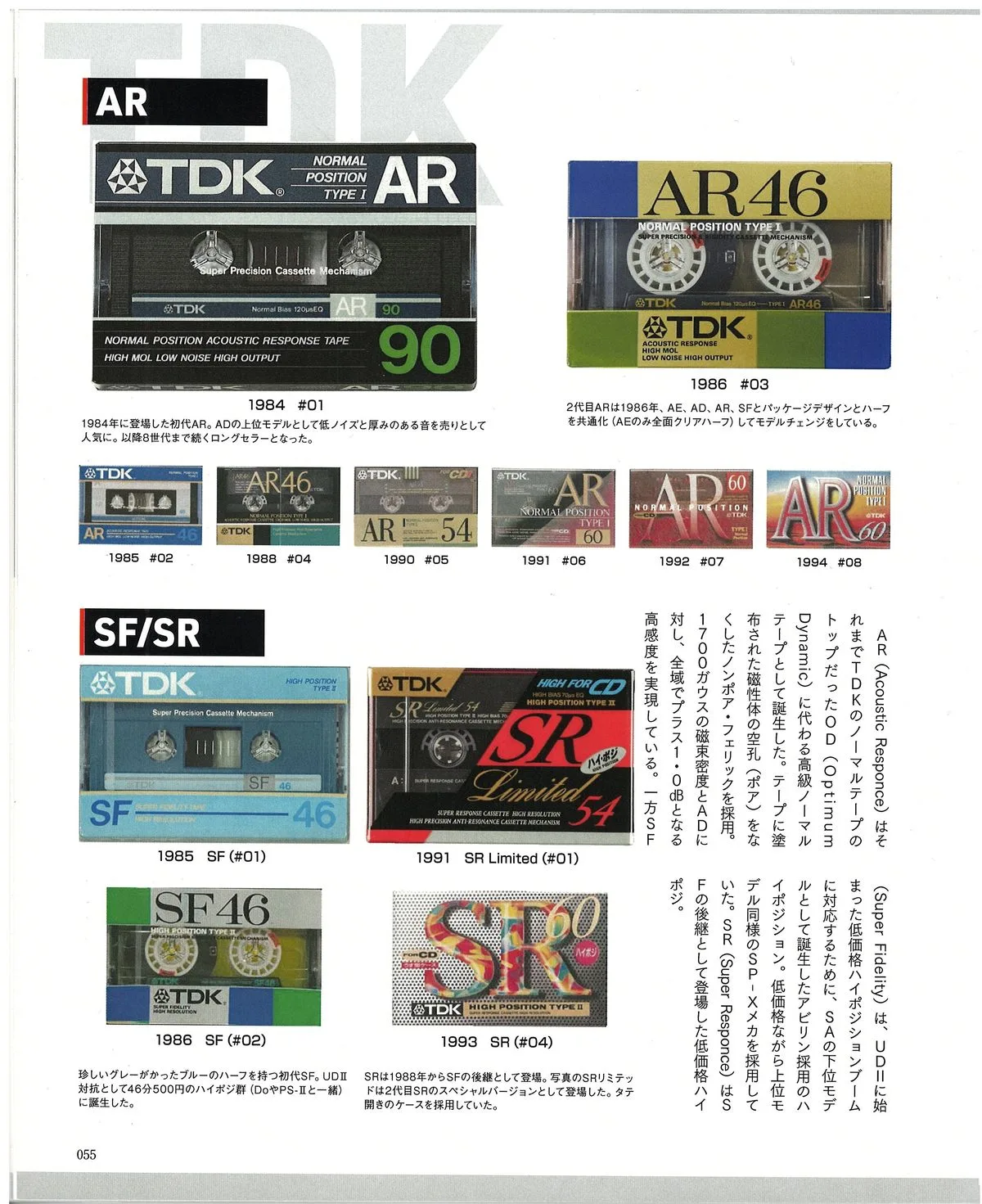
1984 #01 - The first AR appeared in 1984. As AD’s senior model it became popular for its low noise and dense sound. The series remained on sale through its eighth generation.
1986 #03 - In 1986 the second-generation AR was updated, unifying the design of the packaging and shells for AE, AD, AR and SF. Only AE had a completely transparent shell.
AR - 1985 #02; 1988 #04; 1990 #05; 1991 #06; 1992 #07; 1994 #08.
SF/SR
SF (Super Fidelity), by contrast, appeared as an inexpensive AVILYN high-position cassette below SA, responding to the affordable-high-position boom that began with UDII. Despite its low price it used the SP-X mechanism, like the senior models. SR (Super Response) appeared as an inexpensive high-position cassette replacing SF.
1985 SF (#01); 1986 SF (#02) - The first SF had an unusual grey-blue shell. It appeared as a UDII competitor among high-position cassettes priced at 500 yen for 46 minutes, alongside Do and PS-II.
1991 SR Limited (#01); 1993 SR (#04) - SR replaced SF from 1988. The SR Limited in the photograph was released as a special version of second-generation SR. It used a case that opened vertically.