BASF
バーゼフ
BASF SE is a German chemical corporation founded on 6 April 1865 in Mannheim, in the Grand Duchy of Baden, by Friedrich Engelhorn under the name Badische Anilin- & Soda-Fabrik - the Baden Aniline and Soda Factory. Its head office has been in Ludwigshafen on the Rhine since its first years of operation. From 1925 to 1952 BASF was part of the IG Farben combine; following Allied demonopolisation it returned to operating independently as Badische Anilin- & Soda-Fabrik AG, and adopted its current legal form BASF SE in 2008. The group's magnetic-media arm, BASF Magnetics, was spun off as a separate company in 1991, sold to the South Korean textile firm KOHAP, Ltd. in 1997 and renamed EMTEC Magnetics. Audio-cassette production under both names was finally discontinued in 2005. … more
- Japanese name
- バーゼフ
- Catalogs in the Museum:
- 1
- Catalog years:
- 1995-1995
- Equipment types
- Cassette Tapes
About the brand
BASF SE is a German chemical corporation founded on 6 April 1865 in Mannheim, in the Grand Duchy of Baden, by Friedrich Engelhorn under the name Badische Anilin- & Soda-Fabrik - the Baden Aniline and Soda Factory. Its head office has been in Ludwigshafen on the Rhine since its first years of operation. From 1925 to 1952 BASF was part of the IG Farben combine; following Allied demonopolisation it returned to operating independently as Badische Anilin- & Soda-Fabrik AG, and adopted its current legal form BASF SE in 2008. The group’s magnetic-media arm, BASF Magnetics, was spun off as a separate company in 1991, sold to the South Korean textile firm KOHAP, Ltd. in 1997 and renamed EMTEC Magnetics. Audio-cassette production under both names was finally discontinued in 2005.
While part of IG Farben (BASF division), in the early 1930s the company developed a flexible-base tape with iron-oxide coating - the medium that ran on the AEG Magnetophon K1, the first practical reel-to-reel machine, unveiled at the 1935 Berlin Radio Show; the underlying invention of magnetic tape itself belongs to Fritz Pfleumer, who patented it in Germany in 1928 (patent no. 500900). The pivotal move into modern cassette media came in 1970, when BASF released the first commercial chromium-dioxide (CrO2) audio cassette, built on a formulation licensed from DuPont, which had developed the industrial CrO2 process from 1968 onward; the very same tape supplied the first Type II cassette deck on the market, the Advent Model 200. With that release BASF became one of the two global pioneers of chromium-dioxide media alongside DuPont, and set the framework for the Type I / Type II / Type IV classification that the entire cassette industry would adopt.
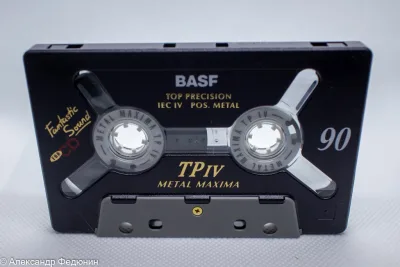
Through the 1970s and 1980s BASF’s audio-cassette catalogue centred on four core lines: Ferro Extra (Type I normal-bias, gamma-ferric-oxide), Chrome Extra and Chrome Super (Type II chromium-dioxide tapes, direct descendants of the CrO2 programme) and the mid-tier Sound 1 / Sound 2 series. In 1995 the BASF brand released a late-period Type IV metal cassette, the TPIV Metal Maxima Top Precision: a Precision Metal particle coating, a shell rated for heat resistance up to 95°C and a 3-Component Azimuth Stabilizer for tape guidance. After the 1997 sale, these same product lines continued under the EMTEC label until cassette manufacture ended in 2005.
- Founded:
- 1865, Ludwigshafen, Germany
- Founder:
- Friedrich Engelhorn
- Full name:
- BASF SE (Badische Anilin- & Soda-Fabrik)
- Links:
- Wikipedia