marantz
マランツ
Marantz Company was founded in 1953 in Queens, New York City, by Saul Marantz (11 July 1911 - 17 January 1997). A year earlier, in 1952, Marantz had built the prototype of his first tube preamplifier, the Consolette, in his Kew Gardens home; that design became the basis for the company's first commercial product. In 1964 Superscope Inc. of California acquired the firm, and in 1966 Marantz set up a manufacturing partnership with Tokyo's Standard Radio Corp.; in 1975 that Japanese partner was renamed Marantz Japan Inc. Superscope sold the Marantz brand to the Dutch group Philips Electronics in 1980, and in 2001 Marantz Japan bought back both the brand and the overseas subsidiaries. In May 2002 Marantz Japan merged with DENON to create D&M Holdings. Saul Marantz himself remained president of the company he had founded until 1968. … more
- Japanese name
- マランツ
- Catalogs in the Museum:
- 2
- Catalog years:
- 1969-1988
- Equipment types
- Cassette Decks, Boomboxes
About the brand
Marantz Company was founded in 1953 in Queens, New York City, by Saul Marantz (11 July 1911 - 17 January 1997). A year earlier, in 1952, Marantz had built the prototype of his first tube preamplifier, the Consolette, in his Kew Gardens home; that design became the basis for the company’s first commercial product. In 1964 Superscope Inc. of California acquired the firm, and in 1966 Marantz set up a manufacturing partnership with Tokyo’s Standard Radio Corp.; in 1975 that Japanese partner was renamed Marantz Japan Inc. Superscope sold the Marantz brand to the Dutch group Philips Electronics in 1980, and in 2001 Marantz Japan bought back both the brand and the overseas subsidiaries. In May 2002 Marantz Japan merged with DENON to create D&M Holdings. Saul Marantz himself remained president of the company he had founded until 1968.
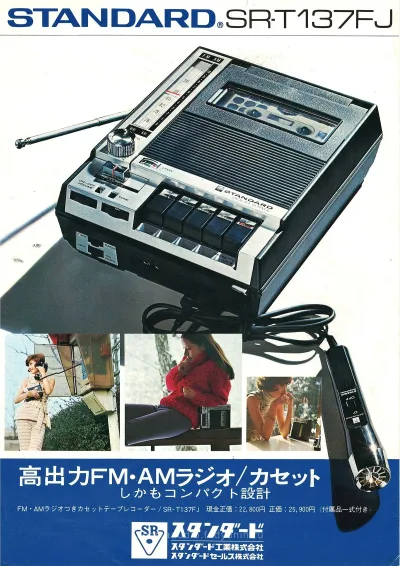
Marantz’s first commercial product was the Consolette tube preamplifier, and through the mid-1960s the firm operated out of its New York workshop as a small-batch maker of audiophile-grade tube hi-fi. After the 1964 Superscope deal, development and manufacturing migrated step by step to Japan: from 1966 Standard Radio Corp. built Marantz product to contract, and after the 1975 rename to Marantz Japan Inc. the company carried its own engineering capacity for both the Japanese domestic market and exports. That transition - from American tube hi-fi of the 1950s and 1960s to Japanese transistor mass-market engineering of the 1970s and 1980s - shapes the whole corporate arc of Marantz.
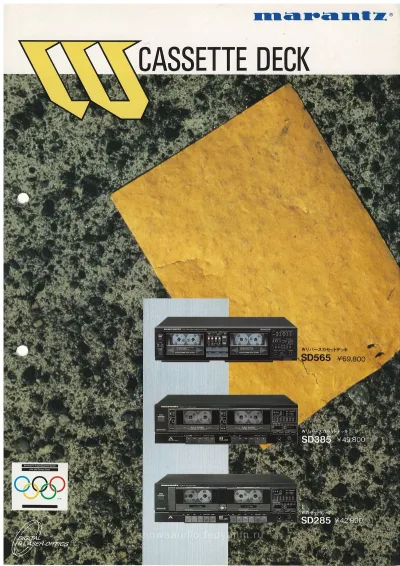
In the Japanese period the consumer catalogue used type-coded series names: PM for integrated amplifiers, ST for FM/AM tuners, SD for cassette decks, LS for loudspeakers. The dual-cassette SD-W line carried W Reverse (Wリバース, double auto-reverse on both play and record), led by the SD-565 flagship at ¥69,800, built on the chassis of the top-tier SD-585 - dual capstan transport (デュアルキャプスタン), two-speed synchro dubbing (2スピードシンクロダビング), Dolby C noise reduction and Quick Music Sensor (QMS) for automatic track-start detection. The mid-range SD-385 at ¥49,800 offered the same feature set in a simpler chassis, and the entry-level SD-285 at ¥42,900 dropped the reverse mechanism. Sold alongside the cassette line were the LS-60GX speakers and the ST-54 FM/AM tuner.
- Founded:
- 1953, Queens, New York City
- Founder:
- Saul Marantz
- Full name:
- Marantz Company / Marantz Japan Inc. (part of D&M Holdings since 2002)
- Links:
- Wikipedia Official site