MAXELL
マクセル
Maxell, Ltd. (マクセル株式会社) is a Japanese maker of magnetic media and batteries. The brand name comes from a line of dry-cell batteries that Nitto Electric Industrial (now Nitto Denko) had produced from 1950 onward; "Maxell" is a contraction of Maximum Capacity Dry Cell, and the same brand carried the first alkaline batteries sold in Japan. In 1961 the battery and magnetic-tape divisions of Nitto Denko were spun off into a separate company, Maxell Electric Industrial Co., Ltd.; in 1964 it joined the Hitachi group and was renamed Hitachi Maxell, Ltd. The firm traded under that name for nearly half a century: the Hitachi prefix was only dropped in 2021, after which it has operated as Maxell, Ltd. Its head office is in the Iidabashi district of Chiyoda, Tokyo; through the 2010s much of its product was also sold under its parent's badges, Hitachi and Lo-D. The full history of the Maxell cassette catalogue is set out in the translated mook article [History of Maxell cassette tapes](/en/articles/history-of-maxell/). … more

- Japanese name
- マクセル
- Catalogs in the Museum:
- 4
- Catalog years:
- 1989-1989
- Equipment types
- Cassette Tapes, Portable Players
About the brand
Maxell, Ltd. (マクセル株式会社) is a Japanese maker of magnetic media and batteries. The brand name comes from a line of dry-cell batteries that Nitto Electric Industrial (now Nitto Denko) had produced from 1950 onward; “Maxell” is a contraction of Maximum Capacity Dry Cell, and the same brand carried the first alkaline batteries sold in Japan. In 1961 the battery and magnetic-tape divisions of Nitto Denko were spun off into a separate company, Maxell Electric Industrial Co., Ltd.; in 1964 it joined the Hitachi group and was renamed Hitachi Maxell, Ltd. The firm traded under that name for nearly half a century: the Hitachi prefix was only dropped in 2021, after which it has operated as Maxell, Ltd. Its head office is in the Iidabashi district of Chiyoda, Tokyo; through the 2010s much of its product was also sold under its parent’s badges, Hitachi and Lo-D. The full history of the Maxell cassette catalogue is set out in the translated mook article History of Maxell cassette tapes.
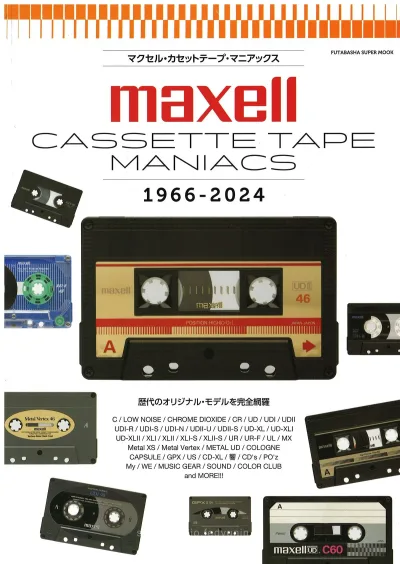
Maxell’s first cassette, the C-60, shipped in July 1966. The company had a strategic advantage over its Japanese rivals: it bought the format drawings and original tooling directly from the inventor, Philips of the Netherlands, and combined those moulds with the precision metalworking of Hitachi’s factories. That gave Maxell exceptional mechanical accuracy and a head start on extended-length tapes - the C-90 followed in 1967 and the C-120 in 1968. In 1973 Maxell became the first Japanese maker to launch the C-46 format, one minute longer than the competing C-45 so that users would have headroom when dubbing one side of an LP; C-46 went on to become a worldwide standard. The 1979 launch of the metal tape MX (Metaxial) used in-house Stabilized Pure (SP) magnetic particles of 0.3 micron, each coated with an ultra-thin protective film - Maxell deliberately held the product back relative to competitors until the oxidation problem inherent in metal media had been fully solved. In 1991 the XL-SI series introduced what the company claimed was the world’s first Dual Surface Film, with an ultra-smooth magnetic layer on one side and a tape-stabilising coating on the back.
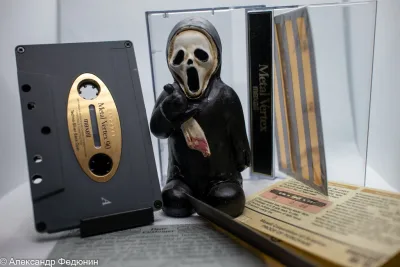
The core music line at Maxell from 1970 onward was the UD (Ultra Dynamic) series, built on a pure PX gamma-ferric-oxide formulation developed specifically for music recording. The second-generation UD of 1972 changed the inner hub colour from cream to black (to allow polymer blending that suppressed internal resonance), and added a head-cleaning section, a five-second start-line marker and printed A/B side labels on the transparent leader. September 1974 brought the UD-XL series on the new Epitaxial magnetic material, with a fully transparent shell and replaceable labels - its design concept came from the American stylist of the Ford Thunderbird, who happened to be a Maxell collector. Type II ran through UD-XL II in 1976 (Epitaxial, the class reference), the premium XL II-S of 1980 aimed at classical-music listeners, and the entry-level UD II of 1984 with bright top-end characteristics for jazz and pop. The metal flagship was Metal Vertex of 1989, the first Maxell tape with a rear-coated magnetic layer, a Super Composite shell of double the usual density and a unique serial number engraved by a diamond cutter on each cassette’s metal insert. Advertising followed the same scale: FM-radio sponsorship from the early 1970s, the 1980 TV spot with Tatsuro Yamashita and his song “RIDE ON TIME” (the artist’s first television appearance), endorsements from Wham!, Thompson Twins, Namie Amuro and Toshinobu Kubota, and the 1980 American “Man in the Chair” campaign which delivered Maxell dominant market share in the United States.
- Founded:
- 1961, Chiyoda, Tokyo
- Full name:
- Maxell, Ltd. (マクセル株式会社, formerly Hitachi Maxell, Ltd. 1964-2021)
- Links:
- Wikipedia Official site