That's
ザッツ
That's (ザッツ) was a Japanese audio-cassette brand from Taiyo Yuden Co., Ltd. (太陽誘電株式会社). The parent company itself was founded on 23 March 1950 in the Suginami ward of Tokyo by Hikohachi Sato, an engineer who had been researching ceramic materials since well before the war. Taiyo Yuden has historically traded as a maker of electronic components - multilayer ceramic capacitors (MLCC) and inductors - and only entered the magnetic-media business in the late 1970s, responding to the spread of the Walkman and home VCRs. From 1983 onward, under the in-house That's name, the firm shipped a full audio-cassette range for the Japanese and European markets; in the United States the same product carried the TRIAD label in its early years, and only in the 1990s did the name unify across markets. In 1993 Taiyo Yuden shut down cassette production and moved the That's brand over to recordable optical media - first CD-R, then DVD-R - where it ran for many years as one of the most respected names in writable media. On 11 June 2015 Taiyo Yuden announced its withdrawal from the recordable-media business as a whole, and the That's name finally left the market. The full cassette story, from the first EM through to the Giugiaro-designed SUONO, is set out in the translated mook article [History of That's cassette tapes](/en/articles/history-of-thats/). … more

- Japanese name
- ザッツ
- Catalogs in the Museum:
- 4
- Catalog years:
- 1988-1988
- Equipment types
- Cassette Tapes, Portable Players
About the brand
That’s (ザッツ) was a Japanese audio-cassette brand from Taiyo Yuden Co., Ltd. (太陽誘電株式会社). The parent company itself was founded on 23 March 1950 in the Suginami ward of Tokyo by Hikohachi Sato, an engineer who had been researching ceramic materials since well before the war. Taiyo Yuden has historically traded as a maker of electronic components - multilayer ceramic capacitors (MLCC) and inductors - and only entered the magnetic-media business in the late 1970s, responding to the spread of the Walkman and home VCRs. From 1983 onward, under the in-house That’s name, the firm shipped a full audio-cassette range for the Japanese and European markets; in the United States the same product carried the TRIAD label in its early years, and only in the 1990s did the name unify across markets. In 1993 Taiyo Yuden shut down cassette production and moved the That’s brand over to recordable optical media - first CD-R, then DVD-R - where it ran for many years as one of the most respected names in writable media. On 11 June 2015 Taiyo Yuden announced its withdrawal from the recordable-media business as a whole, and the That’s name finally left the market. The full cassette story, from the first EM through to the Giugiaro-designed SUONO, is set out in the translated mook article History of That’s cassette tapes.
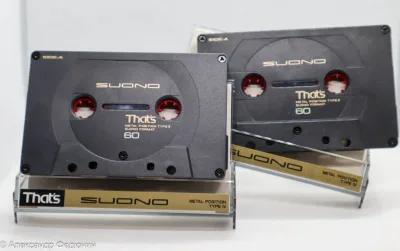
What Taiyo Yuden is most often credited with technologically is the first commercial recordable Compact Disc. In October 1988 the firm released the world’s first CD-R under the That’s brand; the organic cyanine dye for the recording layer was developed by engineers Takashi Ishiguro and Emiko Hamada, and the very name “CD-R” was proposed by Taiyo Yuden staff. On the cassette side, the brand’s identity ran on visual design that most audio makers of the time did not attempt. The 1984 FX cassette introduced a triangular window in the shell that became the visual signature of the line. The 1987 Pas·de·deux model came in white and pink, aimed at female listeners (the name is the ballet term for a dance for two) and built on a monolithic transport for tracking stability. The peak of the design experiments was the 1988 SUONO, whose shell was designed by the studio of the Italian designer Giorgetto Giugiaro: the centre of the cassette rose like an amphitheatre in a deliberate reference to the Roman Colosseum, with contrasting red hubs, and the model won that year’s Good Design Award. Part of the SUONO transport sat fractionally outside the strict Compact Cassette spec, which caused playback problems in the slot-loading car decks of the time; in 1990 the CD-F line shipped with a shell trimmed back inside the standard, the packaging carrying the line “uses SUONO format” as a deliberate point of pride.
The That’s cassette catalogue opened in 1983 with three models: the high-bias EM and the metal MG and MR. In 1984 the normal-bias FX joined the range with its triangular window; in 1985 the RX added a white shell and logos in blue, red and green. From 1986 the EVE and CD ranges ran side by side: normal-bias EVE-I, CD-I and FX; high-bias EVE-II, CD-II and EM-X; metal EVE-IV, CD-IV and MR-X. 1987 brought the high-bias Q on a cobalt magnetic layer and the normal-bias Pas·de·deux. 1988 was the busiest year of the brand: SUONO with Giugiaro styling, plus the Si (SOUND INDIVIDUAL), PH (PH-I, PH-II, PH-IV) and OW series alongside the AM (FOR AMENITY) and FM (FOR FAVORITE MUSIC) specials. From 1989 the LN-class PH line pushed That’s into the mass-market price segment, going head-to-head with the TDK AE. By 1991-1992 the catalogue closed out with the OW-I, OW-II and OW-IV, the CD-IF, CD-IIF and CD-IVF, the FX-XP, EM-XP and MR-XP, and finally the H2 hybrid model branded HH and METAL HIGH POSITION - a Type IV metal magnetic layer applied inside a Type II high-position cassette. That model was the final significant release of the line, and cassette production at That’s closed in 1993.
- Founded:
- 1983, Chuo, Tokyo
- Full name:
- That's (ザッツ) - cassette tape brand of Taiyo Yuden Co., Ltd. (太陽誘電株式会社)
- Links:
- Wikipedia