DENON HiFi Component (Stradivari) January 1987
https://storage.yandexcloud.net/showaaudio-media/images/items/denon-hifi-component-stradivari-1987/main-01.webp19875denon
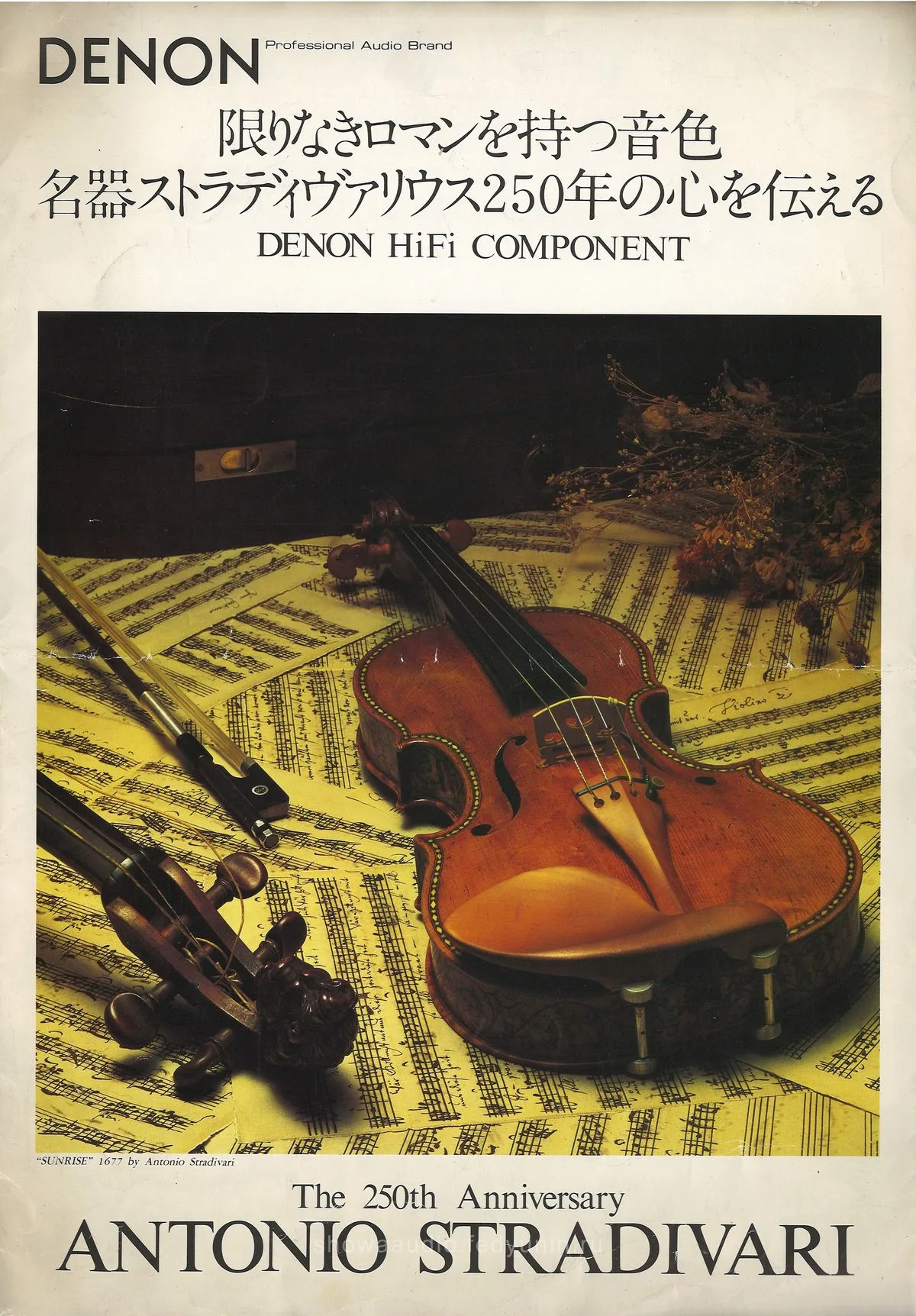
An unusual image catalog: DENON sets its equipment next to the violins of Antonio Stradivari. A3 format, heavy paper, eight pages. The play is on homophones: 名器 (meiki) - the “masterpiece instrument”, meaning the violin, and 名機 (meiki) - the “masterpiece machine”, meaning DENON’s equipment. They sound alike, they are written differently, and the whole booklet rests on that pair. Three pages go to Stradivari’s violins with long stretches of Japanese text - below, the photo of the page and its full translation.
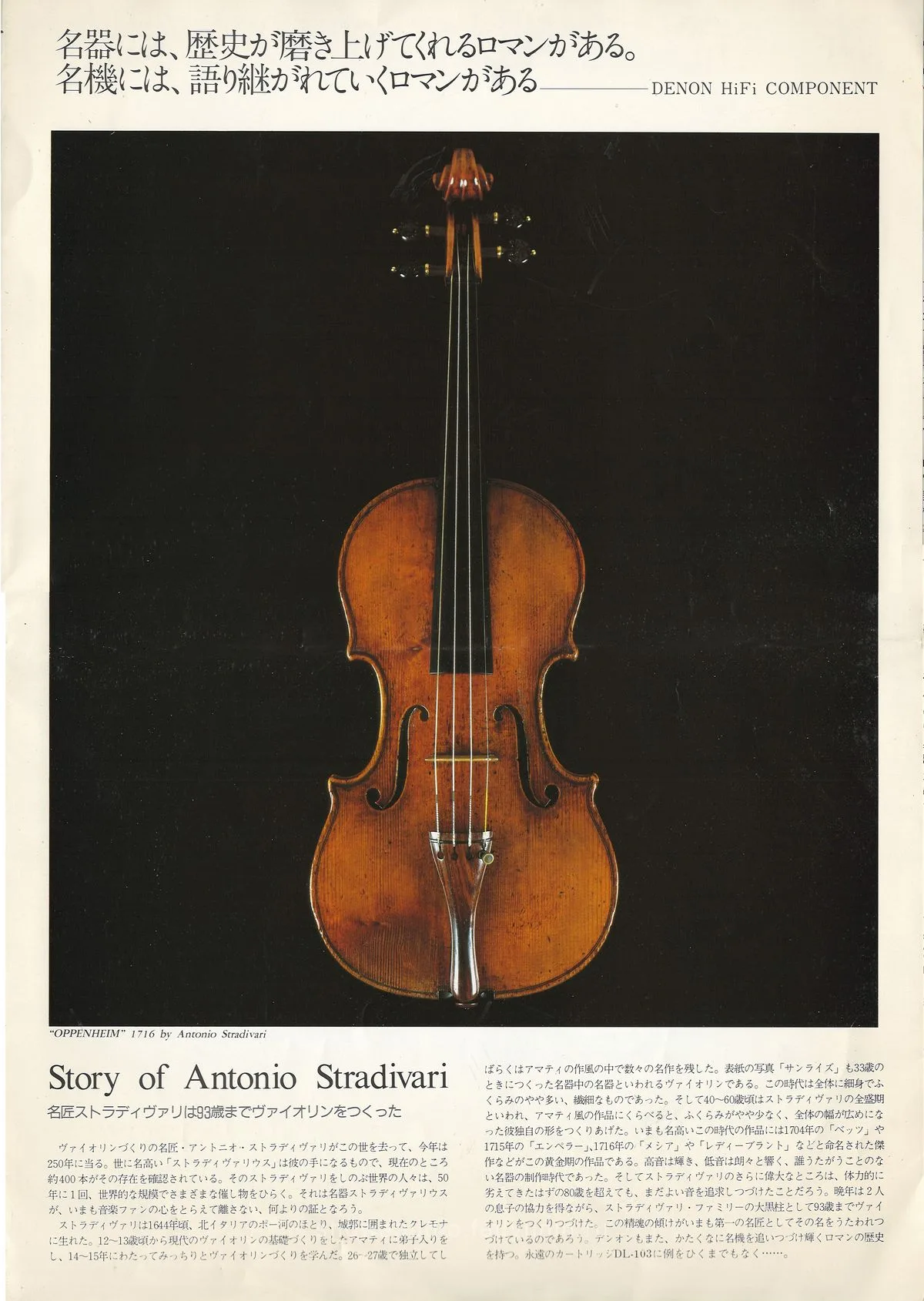
"A masterpiece instrument holds a romance that history has polished to a shine. A masterpiece machine holds a romance that will be passed on by word of mouth."
The master Stradivari made violins until the age of 93
This year marks 250 years since the death of Antonio Stradivari, master of violin-making. The "Stradivariuses" famous the world over came from his hands; at present about 400 are confirmed to exist. People around the world who cherish Stradivari's memory hold various worldwide-scale events once every 50 years. That is the clearest proof that the masterpiece instrument, the Stradivarius, still holds the hearts of music lovers and will not let go.
Stradivari was born around 1644 in Cremona, ringed by fortress walls, on the banks of the Po river in northern Italy. From about age 12-13 he became a pupil of Amati, who laid the foundations of the modern violin, and for 14-15 years he studied violin-making thoroughly. Setting up on his own at 26-27, for a while he worked in the Amati manner and left a number of fine works. The "Sunrise" on the cover was also made when he was 33 and is called an instrument among instruments. The works of that period are on the whole slender, with slightly more arching, delicate. The years around 40-60 are called Stradivari's prime: compared with the Amati-style works, the arching is a little less and the overall width greater - he built his own form. Famous to this day among works of this time are the 1704 "Betts", the 1715 "Emperor", the 1716 "Messiah" and "Lady Blunt"; these masterpieces are the works of the golden period. The highs shine, the lows ring out full and clear - an era of instrument-making that no one would question. And what is greater still in Stradivari is that even past 80, when his strength should already have been failing, he kept pursuing good sound. In his final years, with the help of his two sons, as the mainstay of the Stradivari family he kept making violins until 93. It is probably for that devotion that his name is still called the first among masters. DENON, too, has its own shining romance - a stubborn pursuit of the masterpiece machine. There is no need even to cite the eternal DL-103 cartridge as an example...
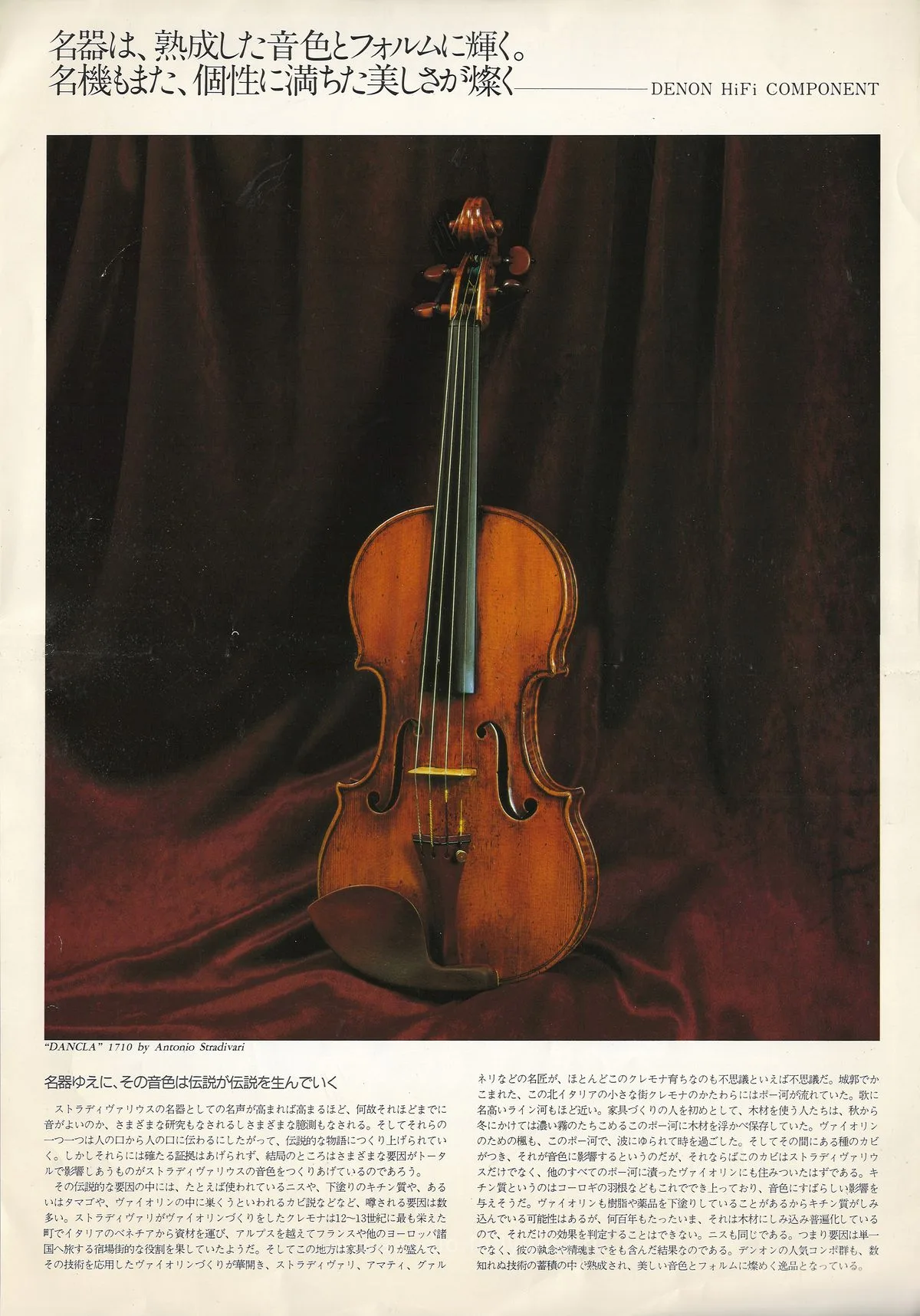
"A masterpiece instrument shines with matured timbre and form. A masterpiece machine likewise glows with a beauty full of character."
Because the instrument is a masterpiece, its timbre breeds legend upon legend
The higher the Stradivarius's fame as a masterpiece instrument rises, the more research and the more guesswork there is about why it sounds so good. And each of these, as it passes from mouth to mouth, is built up into a legend. But no firm proof is offered for them, and in the end the Stradivarius timbre is probably created by the combined influence of many factors.
Among these legendary factors are, for example, the varnish used, the chitin in the ground coat, egg, and also the theory of a mold said to nest inside the violin - the rumoured factors are without number. Cremona, where Stradivari made violins, was the most prosperous town of the 12th-13th centuries: materials were carried in from Venice, and the town served as a staging post on the route across the Alps to France and other European countries. Furniture-making also flourished in this region, and violin-making blossomed by applying that craft - and the fact that masters such as Stradivari, Amati and Guarneri were almost all raised in this Cremona is, when you think about it, also a wonder. Beside this small walled town in northern Italy ran the Po river. The Rhine, famous in song, is also close by. Furniture-makers and wood-workers generally would store timber by floating it on this Po river, over which thick fog settles from autumn into winter. The maple for violins also spent time on this Po, rocked by the waves. And during that time a certain mold would form on it, which is said to affect the timbre; but then that mold ought to have settled not only on the Stradivarius but on every other violin soaked in the Po. Chitin is what the wings of a cricket are made of, and it does seem as if it would have a wonderful effect on timbre. Violins are sometimes ground-coated with resin or chemicals, so it is possible that chitin has soaked in; but after hundreds of years it has soaked into the wood and become universal, so its effect alone cannot be judged. It is the same with varnish. In other words the factor is not a single one: it is a result that includes even his obsession and his soul. DENON's popular combination sets, too, have matured within countless accumulated technologies to become pieces that glow with beautiful timbre and form.
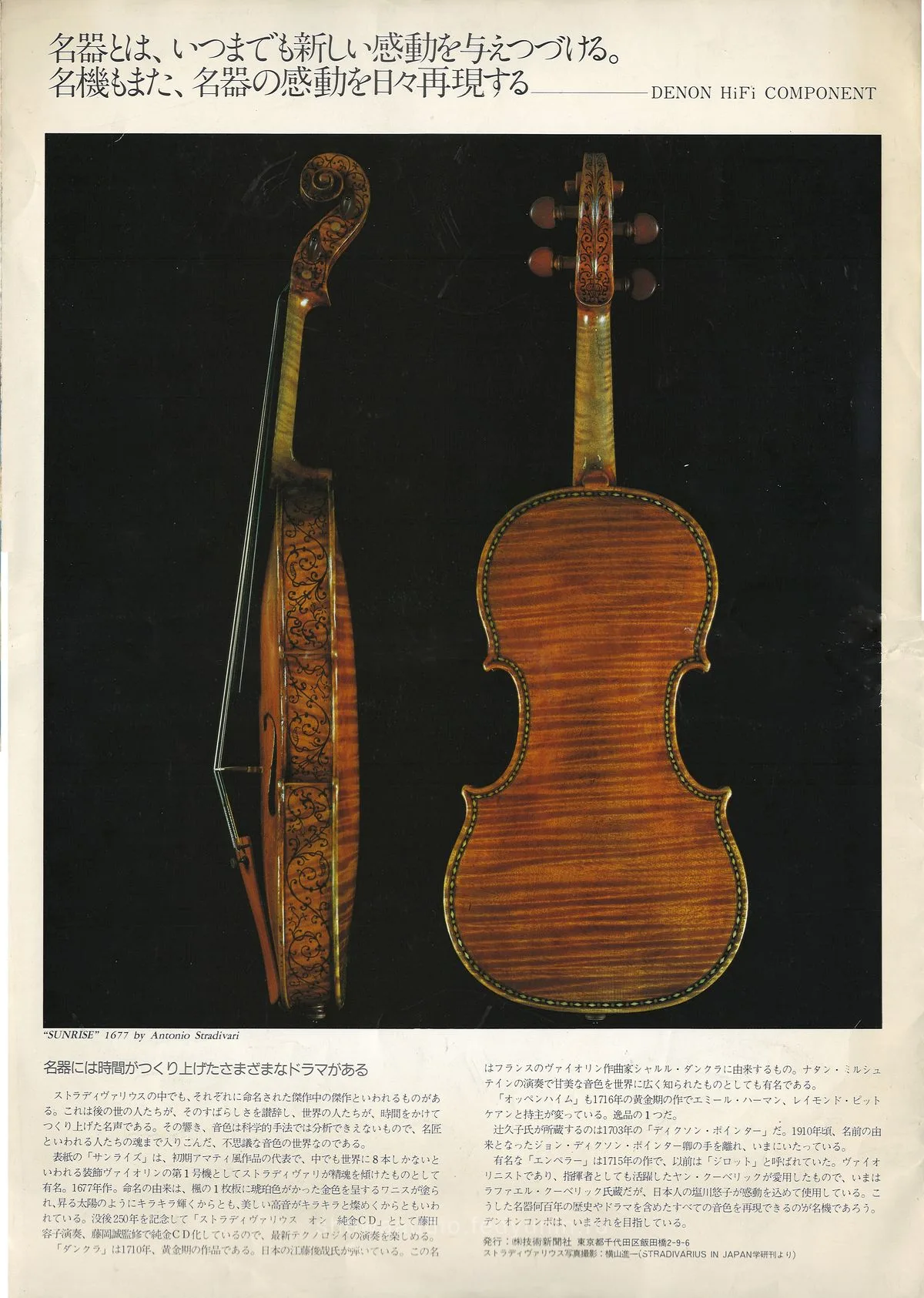
"A masterpiece instrument keeps giving new emotion forever. A masterpiece machine, too, reproduces the emotion of the masterpiece instrument day after day."
A masterpiece instrument carries the many dramas that time has built up
Even among Stradivariuses there are some called a masterpiece among masterpieces, and each has been given a name. This is fame that later generations, praising their excellence, built up over years. Their resonance and timbre cannot be broken down by scientific method - it is a mysterious world of timbre into which even the souls of those called masters have entered.
The cover's "Sunrise" is representative of the early Amati-style works, famous as the number-one instrument among the decorated violins of which only 8 are said to exist in the world, into which Stradivari poured his soul. Made in 1677. The name is said to come either from the amber-gold varnish on the one-piece maple back that sparkles like the rising sun, or from the beautiful highs that sparkle. To mark the 250th anniversary of the master's death it has been issued as "Stradivarius on Pure Gold CD" (performed by Yoko Fujita, edited by Makoto Fujioka, pressed on pure gold), so a performance on the latest technology can be heard.
"Dancla" is a golden-period work of 1710. Japan's violinist Toshiya Eto plays it. The name comes from the French violin composer Charles Dancla. It is also famous for its sweet timbre, which became widely known around the world through Nathan Milstein's playing.
"Oppenheim" is also a golden-period work, of 1716; its owners have changed - Emil Herrmann, Raymond Pitcairn. One of the gems.
Hisako Tsuji owns the 1703 "Dixon-Pointer". Around 1910 it left the hands of Sir John Dixon-Pointer, after whom it is named, and has come down to the present.
The famous "Emperor" is a 1715 work, formerly called the "Gillott". It was used by Jan Kubelik, a violinist who was also active as a conductor; it is now owned by Rafael Kubelik, but Japan's Yuko Shiokawa uses it with feeling. The machine that can reproduce the whole timbre together with the centuries of history and drama of such masterpiece instruments would be the masterpiece machine. The DENON combination set is now aiming at exactly that.
Published by Gijutsu Shimbunsha Co., Ltd., 2-9-6 Iidabashi, Chiyoda-ku, Tokyo. Stradivarius photography: Shinichi Yokoyama (from "STRADIVARIUS IN JAPAN", Gakken).
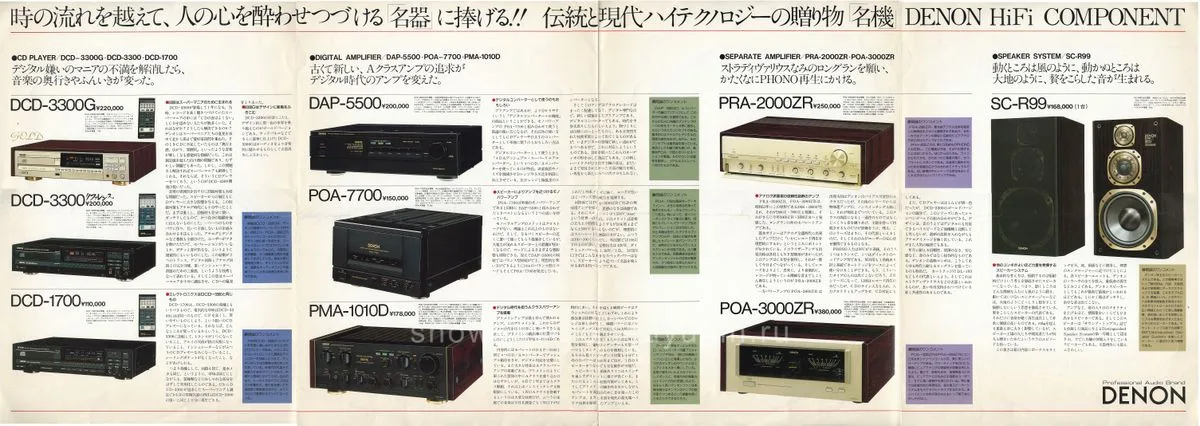
| Model | Type | Price |
|---|---|---|
| DENON DCD-3300G | CD player | ¥220,000 |
| DENON SC-R99 | speaker system | ¥168,000 (1 unit) |
| DENON DAP-5500 | preamplifier | ¥200,000 |
| DENON PRA-2000ZR | preamplifier | ¥250,000 |
| DENON DCD-3300 | CD player | ¥200,000 |
| DENON POA-7700 | power amplifier | ¥150,000 |
| DENON DCD-1700 | CD player | ¥110,000 |
| DENON PMA-1010D | integrated amplifier | ¥178,000 |
| DENON POA-3000ZR | power amplifier | ¥380,000 |
Zoom in on the details