SONY, May 1973 TC-2850SD - cassette decks
https://storage.yandexcloud.net/showaaudio-media/images/items/sony-tc-2850sd-1973-05/main-01.webp19735sony
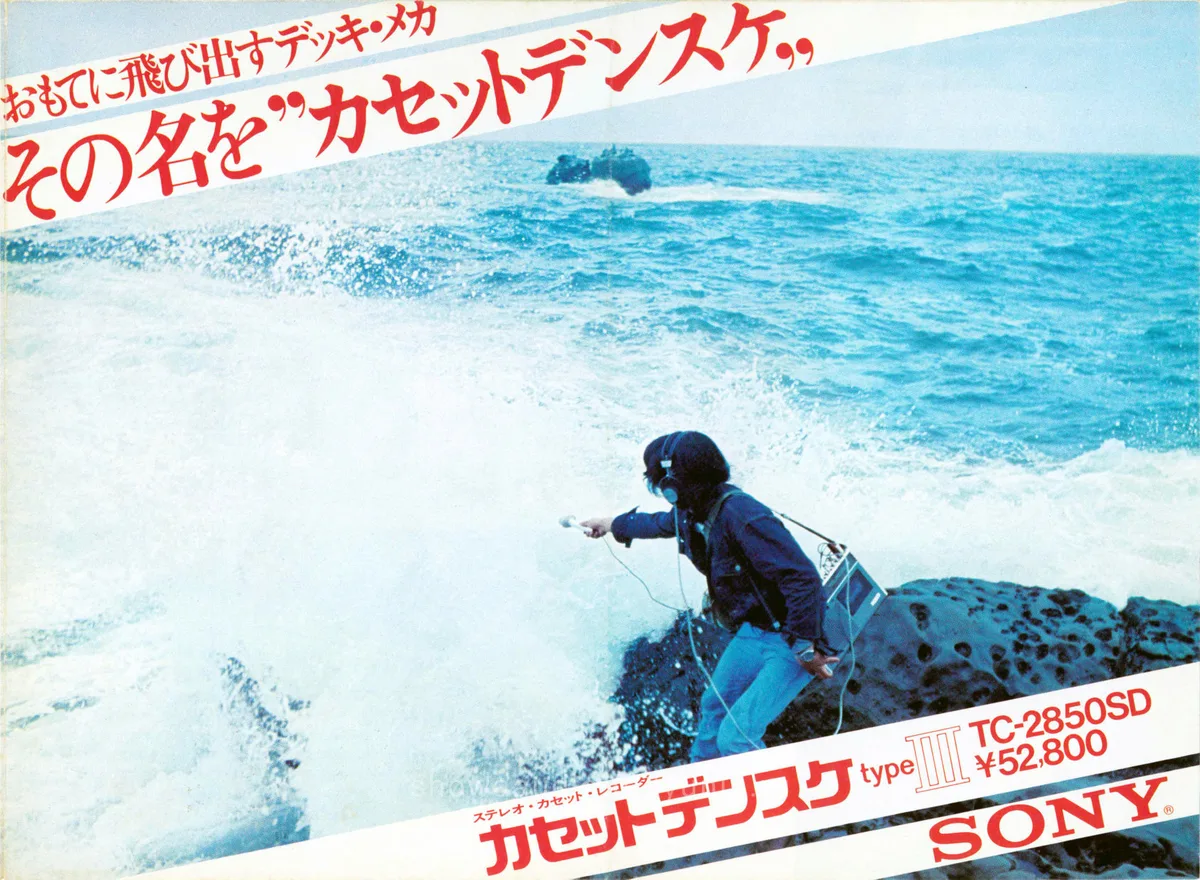
ソニー カタログ・カセットデンスケ・昭和48年5月
A SONY brochure about the TC-2850SD cassette recorder, called “カセットデンスケ” (portable cassette recorder for field recording) in the text, covers stereo field recording. A separate page lists carrying cases, headphones, a microphone, a battery pack and a car power cable.
| Model | Type | Price |
|---|---|---|
| SONY TC-2850SD | cassette recorder | ¥52,800 |
| SONY LC-28 | accessory - case | ¥5,000 |
| SONY LC-5 | accessory - case | ¥6,000 |
| SONY DR-4A | headphones | ¥4,200 |
| SONY ECM-99A | stereo microphone | ¥7,900 |
| SONY BP-8 | accessory - battery | ¥5,200 |
| SONY DCC-128 | accessory - cable | ¥4,200 |
| Technical terms | Translation |
|---|---|
| ドルビー・システム | Dolby system |
| フェライト&フェライト・ヘッド (F&Fヘッド) | ferrite & ferrite head (F&F head) |
| DCサーボ・モーター | DC servo motor |
| DC-DCコンバーター | DC-DC converter |
| オート・シャット・オフ機構 | automatic shut-off mechanism |
| ソニーリミッター録音 | Sony limiter recording |
| Marketing terms | Translation |
|---|---|
| カセットデンスケ | Cassette Densuke |
| おもてに飛び出すデッキ・メカ その名を”カセットデンスケ” | A deck mechanism that bursts outside. Its name: "Cassette Densuke" |
| 徹底的に計算された生録音メカニズム | A thoroughly calculated live-recording mechanism |
The catalog was kindly provided by the admin of the VK group Вселенная SONY. Below is the full text of his post.
1973 SONY TC-2850SD
Hello, everyone! I scanned a brochure for the Sony TC-2850SD cassette recorder, released in 1973. Let's turn the pages and get to know this fascinating device from the last century.
Imagine the year 1973. A flight into space aboard Soyuz, abbreviations like AM and FM not yet displaced by digital, and music that is not a subscription stream but something tangible: vinyl, open reels, and compact cassettes that were already gaining ground.
A young man in Tokyo carefully sets his Sony TC-2850SD on the edge of a table. The recorder is heavy - more than five kilograms of steel - but there is something about it like a treasure box: chrome keys, the warm glow of the meters, the characteristic light click of the Dolby switch. He inserts a chrome cassette and presses PLAY. The level meter's needle will swing smoothly to the right, and first a silence will burst into the room, about to become music.
In Japan, the TC-2850SD was a recorder for people who took sound seriously but did not want to be tied to a wall outlet. The motor with DC servo control held its speed rock steady, and the cassette tape did not waver during playback, making it possible to record a live concert from a microphone and listen to it later without a doubt that the live music recording had succeeded. Chrome tape with the "Dolby B" system delivered a clarity ordinary portables could not come close to at the time: the highs stayed transparent, while hiss receded into the background.
Recording from a microphone is a story of its own. Two inputs, a separate limiter so an unexpected peak would not turn the drums into mush, and a 20 dB attenuator if the hall's acoustics exceeded the dynamic range. A jazz fan would bring the TC-2850SD to a small club in Shinjuku, set it on the edge of a table, connect a pair of condenser microphones, and get a stereo recording for a home collection that sounded more honest than some records. Or a journalist in the field, with neither a studio nor electricity: four D-size batteries, and the recorder would work for several hours straight, steadily, without the tape slowing as the batteries ran down.
And then there was the car. The cigarette lighter, a DC-DC converter, and the same deck became a car stereo for a long trip. You could record an album from vinyl at home and then listen to it in the car with almost no loss of quality - in 1973, all of this felt like magic. The cassette fit in a jacket pocket and sounded almost like an open reel on this device.
Late in the evening, when all that activity and the concerts had fallen silent, and recording had come to an end, the person would switch off the recorder and the mechanism would stop smoothly. He would take out the cassette, label it with a ballpoint pen or pencil - "Live, 17.05.1973, Shinjuku Pit Inn" - and put it on a shelf beside a dozen others just like it. Each cassette was an event: an evening, a concert, a conversation, a radio program. Nothing was erased with one easy press. Each recording was a decision or a person's story.
That is how the Sony TC-2850SD lived back in 1973 - not as a gadget, but as a tool. Heavy, precise, honest. With it, people did not just listen to music - they preserved it . . .
The Sony TC-2850SD is a portable stereo cassette recorder released by Sony in 1973. It belongs to the "Cassette Densuke Type III" series - a line of compact cassette decks with a built-in Dolby B noise reduction system.
The TC-2850SD is a collectible vintage model. On today's secondhand market, a working example in serviced condition is expensive, depending on its condition and included equipment.
This was one of the first truly "universal" cassette decks of its time, running from mains power or batteries as well as a car cigarette lighter, with a professional motor and support for Type II chrome tape. For 1973, this was serious engineering in a compact body.
Key features:
Dolby B system - reduces tape hiss by up to 10 dB at high frequencies.
F&F head (Ferrite & Ferrite) - a combined record/playback head known for its durability and stable characteristics.
DC servo motor - the same type used in professional equipment; it constantly corrects rotational speed, ensuring low wow and flutter.
Four power sources: 100 V mains, D-size batteries, a battery pack, and a car power adapter. A stabilized power supply and DC-DC converter kept the speed from sagging as the batteries ran down.
Tape type selector - supports standard (Type I) and chrome (CrO2) Type II cassettes.
Built-in Sony Limiter - protection against overload from sudden signal peaks.
Built-in 10 cm speaker and amplifier for monitoring.
Specifications:
Type: 2-head portable stereo tape recorder Track system: 4-track stereo / 2-track mono Tape speed: 4.8 cm/s Frequency response: 30 Hz - 13 kHz (Type I), 30 Hz - 15 kHz (CrO2) Signal-to-noise ratio: 48 dB without Dolby; +5 dB at 1 kHz and +10 dB above 5 kHz with Dolby Wow and flutter: 0.15% (WRMS) Inputs: 2 x microphone (0.2 mV), 2 x line (0.06 V) Outputs: 2 x line, headphone jack Amplifier: 1.5 W (mains) / 0.8 W (batteries) Dimensions: 378 x 108 x 238 mm Weight: 5.4 kg Launch price: Japan, ¥52,800 (about ¥57,800 after 1974)
Wishing everyone a good mood! More music and positivity!