Rogers LS3/5A 1987
https://storage.yandexcloud.net/showaaudio-media/images/items/rogers-ls3-5a-1987/main-01.webp19872others
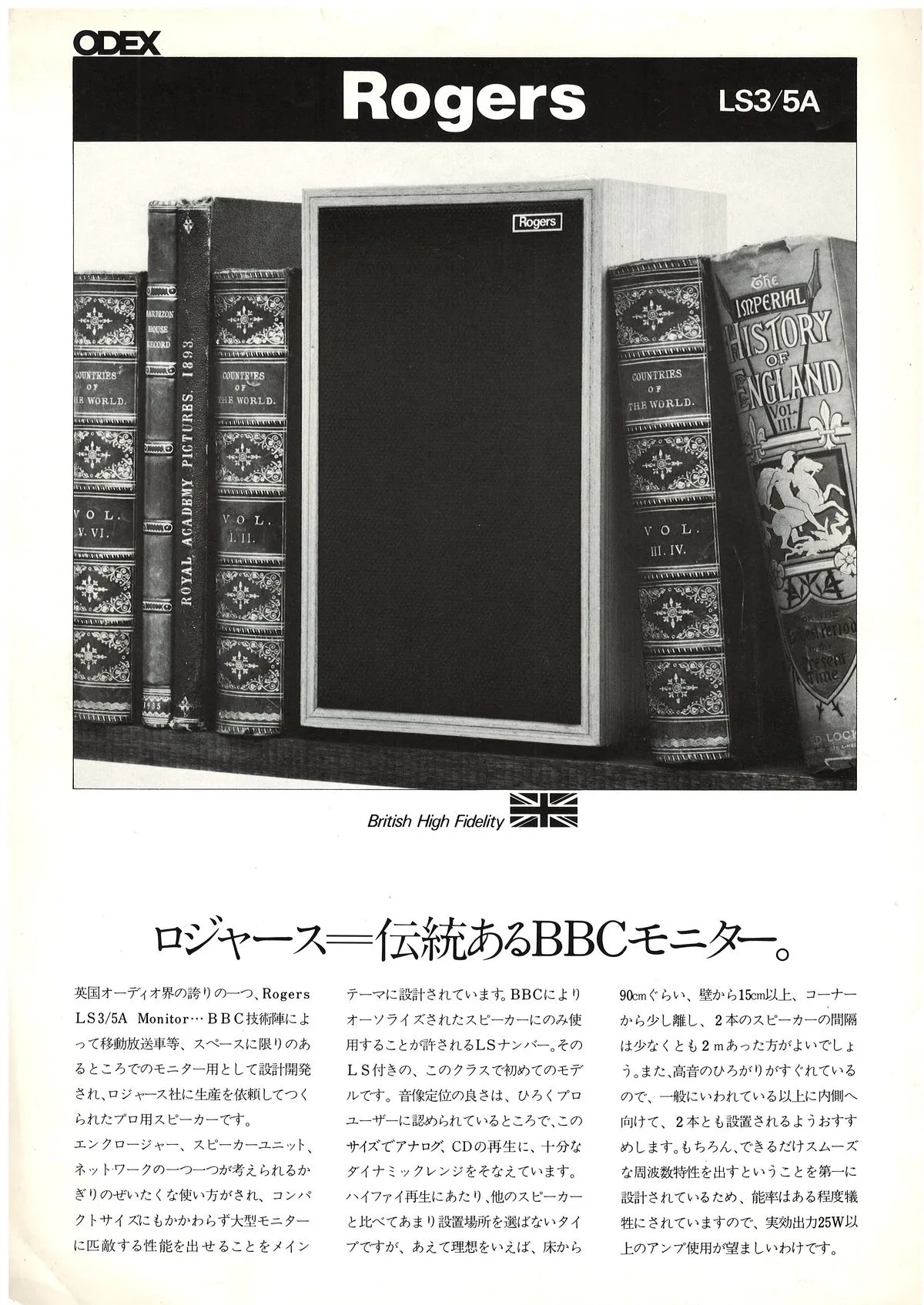
Double-sided A4 flyer by British Rogers, issued by Japanese distributor ODEX around 1987, devoted entirely to the LS3/5A BBC monitor in its canonical 15-ohm guise (after 1987 Rogers switched to the 11-ohm version). Rogers is an English company from Surrey, and the LS3/5A isn’t even their design: the speaker was engineered by BBC for monitoring in the tight cabins of outside-broadcast vehicles, and Rogers were licensed to manufacture it in production. The front shows the speaker on a shelf among antique books; the back is a detailed breakdown - 10cm bextrene woofer (KEF B110, BBC LS2/7), 2cm dome tweeter KEF T27/SP1032, BBC FL6/23 crossover with a 1dB-step tapped transformer, a birch cabinet with bitumen-lined walls, and every pair measured individually on Brüel & Kjær gear, cross-checked against the BBC reference, with the response archived per serial number.
What the leaflet says
Full translation of both sides.
Front. Headline: “Rogers = a BBC monitor with a tradition.”
One of the prides of the British audio world: the Rogers LS3/5A Monitor. It was designed and developed by BBC’s engineering staff as a monitor for use where space is limited, such as outside-broadcast vans, with production then entrusted to Rogers. It is a professional speaker. The enclosure, the drive units and the network are each treated as lavishly as could be conceived, and the main design theme was performance on par with a large monitor despite the compact size. The “LS” number may be used only on speakers authorized by the BBC, and this is the first model in its class to carry it. Its imaging is widely recognized among professional users, and for this size it has enough dynamic range for both analog and CD playback. For hi-fi use it is not very fussy about placement compared with other speakers, but if we state the ideal: about 90 cm off the floor, at least 15 cm from the wall, a little away from the corner, and the two speakers at least 2 m apart. The treble spreads well, so we recommend angling both speakers inward more than is usually advised. And since it was designed above all for the smoothest possible frequency response, efficiency has been sacrificed to a degree, so an amplifier of 25 W effective output or more is desirable.
Back. Drive units. The woofer is a 10 cm bextrene-cone type; the tweeter is a 2 cm dome. To meet the strict BBC standard, units are chosen through careful one-by-one testing, and an engineer applies the doping onto the cone by hand, one at a time. On top of that, Rogers adjusts them so the pair matches, and always ships them as a matched pair.
Network. The level balance between the bass and treble sections has, until now, been trimmed with a resistor even on fairly expensive speakers. That is unavoidable on cost grounds, but it meant musical freshness was sacrificed. The LS3/5A uses a matching transformer with 1 dB tapping steps, good enough to be sold as a component in its own right, and that makes natural, lively music reproduction possible from the low end to the high. So there is no drift with age, the capacitors are low-loss types; and the network is built only from very carefully selected parts, such as inductors held within 5% tolerance.
Testing. Rogers is headquartered at Mitcham, Surrey, on the edge of London. Every Rogers LS3/5A Monitor is measured with Brüel & Kjær equipment in its anechoic chamber, and an individual frequency-response graph is taken. Finally it is checked against “the BBC reference standard” with pink noise. The frequency-response graph of each speaker is kept permanently in the Rogers library, in manufacturing-number order.
Cabinet. The enclosure is fully sealed. The cabinet uses birch, the wood well known as piano stock, and only selected timber from northern Britain. Sound absorption was given particular attention, and the inner walls of the cabinet are coated with bitumen, so it reproduces clear low notes.
Specification. Type: sealed 2-way, 2-speaker system. Woofer: 10 cm bextrene cone, a KEF B110 meeting BBC spec LS2/7. Tweeter: 2 cm dome, KEF T27 / SP1032. Frequency range: 70 to 20,000 Hz (±3 dB). Rated input: 25 W. Crossover: 3 kHz, BBC spec FL6/23. Impedance: 15 ohms, BBC spec. Dimensions: 305 (H) x 185 (W) x 160 (D) mm, BBC spec CT4/IIA. Weight: 5.3 kg. Packing: matched-pair packaging. (Specs subject to change without notice.)
Sole agent for Japan: ODEX Japan Co., Ltd. (株式会社 オーデックス・ジャパン), Yushima, Bunkyo-ku, Tokyo. Print code on the back: 8765000.
- ベクストレーンコーン - damped polymer bextrene cone, the KEF B110 unit built to BBC LS2/7 spec
- コーンの上のドーピング(手作業) - hand-applied doping on the cone, one at a time, to keep the units within BBC tolerances
- BBC規格マッチドペア - every pair measured individually on Brüel & Kjær gear, cross-checked against the BBC reference, and the frequency response archived per serial number
- 1dBステップ・タッピング・トランス - BBC FL6/23 crossover with a 1dB-step tapped balance transformer
- ピアノ材 樺の木キャビネット - cabinet built from birch (the wood well known as piano stock) with bitumen-lined inner walls
| Model | Type | Price |
|---|---|---|
| Rogers LS3/5A | speaker system |