AKAI
赤井
Akai Electric Co., Ltd. (赤井電機) was a Japanese tape-recorder manufacturer registered in Tokyo in 1929. It was founded by Masukichi Akai (赤井益吉) and his son Saburo Akai (赤井三郎); Saburo remained the company's chief engineer and public face until his death in 1973. The firm was headquartered in Ota, Tokyo. Its first product was the AT-1 tape-recorder kit in 1954, followed in 1962 by the M-7, built around Tandberg's licensed X'Field magnetic recording system. From 1987 to 1994 Akai belonged to Mitsubishi Electric; it then passed to International Semi-Tech Microsystems. Audio production was wound down in 1991, and in November 2000 Akai filed for bankruptcy with debts of roughly USD 1.1 billion. The brand was acquired by Hong Kong's Grande Holdings, which has used it since the 2000s on consumer electronics unrelated to the Showa-era company. … more
- Japanese name
- 赤井
- Catalogs in the Museum:
- 6
- Catalog years:
- 1980-1986
- Equipment types
- Cassette Decks, Reel-to-Reel
About the brand
Akai Electric Co., Ltd. (赤井電機) was a Japanese tape-recorder manufacturer registered in Tokyo in 1929. It was founded by Masukichi Akai (赤井益吉) and his son Saburo Akai (赤井三郎); Saburo remained the company’s chief engineer and public face until his death in 1973. The firm was headquartered in Ota, Tokyo. Its first product was the AT-1 tape-recorder kit in 1954, followed in 1962 by the M-7, built around Tandberg’s licensed X’Field magnetic recording system. From 1987 to 1994 Akai belonged to Mitsubishi Electric; it then passed to International Semi-Tech Microsystems. Audio production was wound down in 1991, and in November 2000 Akai filed for bankruptcy with debts of roughly USD 1.1 billion. The brand was acquired by Hong Kong’s Grande Holdings, which has used it since the 2000s on consumer electronics unrelated to the Showa-era company.
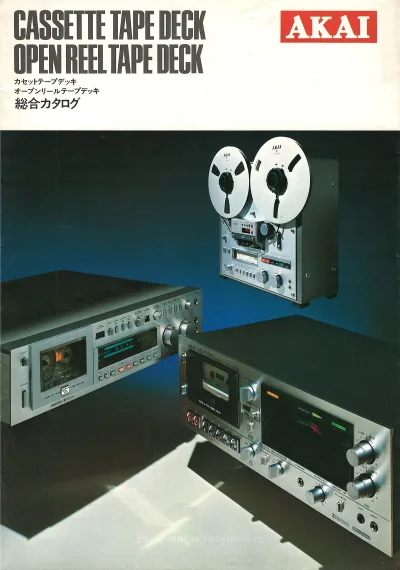
Akai’s main in-house development was the GX head. The acronym stands for Glass and X’tal (Crystal) Ferrite: a crystal-ferrite core mounted in glass, rated by the maker for 150,000 hours of service. From the 1970s the GX head ran through both Akai’s reel-to-reel machines and its cassette decks, appearing in catalogs as GX head, Super GX head and Twin Field Super GX. The brand’s other distinct mechanism was Quick Reverse, an auto-reverse cassette system in which a single head physically rotates 180° between sides of the tape rather than switching between stacked heads. It debuted on the CS-732D in 1979 and carried through the GX-Fxx R cassette series of the early 1980s. Akai’s open-reel run ended with the GX-747 (1981-1985), produced in silver and black, with LED- and VU-meter versions and a rare GX-747dbx variant; reel-to-reel production was discontinued in 1985.
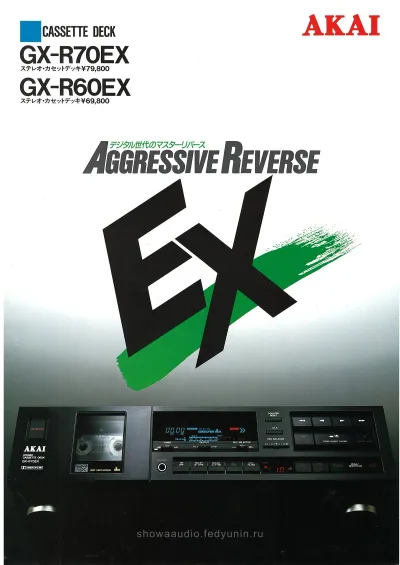
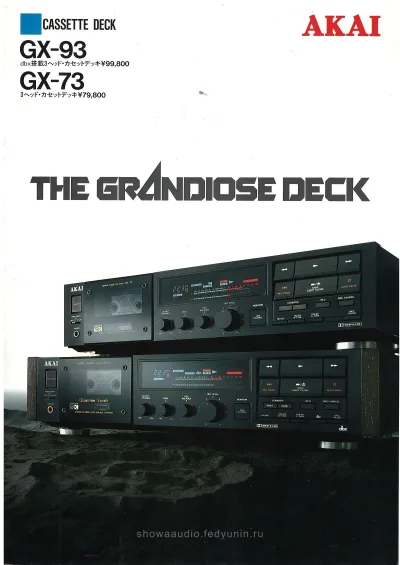
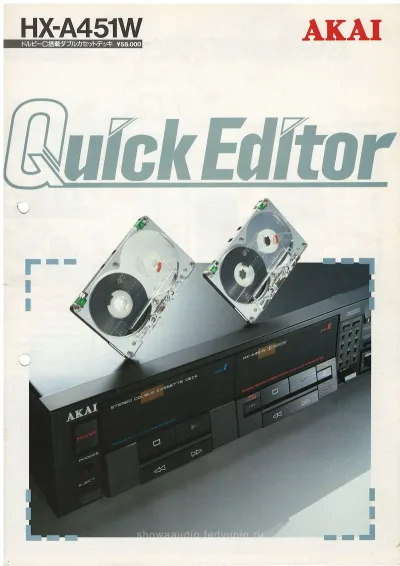
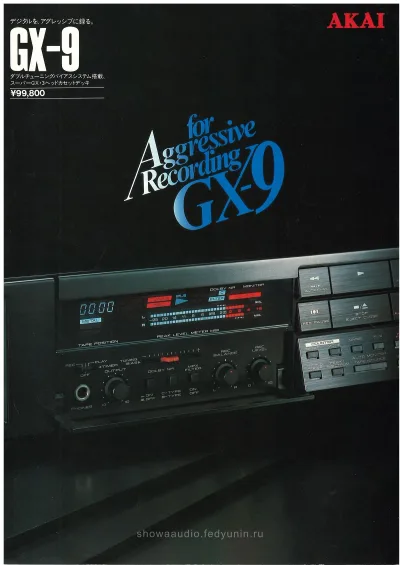
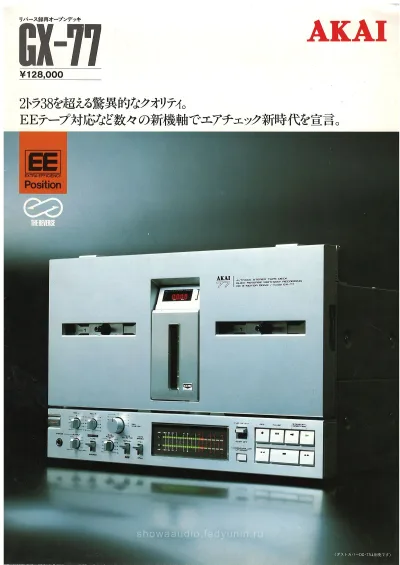
Akai’s signature lineups covered both formats. Reel-to-reel: the GX-77 at ¥128,000 (1982) with Lambda loading and auto-reverse; the GX-635D and GX-625; the professional GX-630D PRO; the 38 cm/s GX-6500; the two-track PRO 1000 at ¥398,000. Cassette: the three-head GX-9 at ¥99,800 (1984) with Super GX 3head and Double Capstan DD; the flagship pair GX-93 / GX-73 in 1986 with dbx; the three-motor GX-F90 at ¥128,000; Metal-compatible GX-M50 and CS-M40R. The auto-reverse GX-R70EX / R60EX line carried CRLP (Computer Reverse Level Processing), which re-checked the record level on every reversal of the tape, alongside a Twin Field Super GX head wound with linear-crystal oxygen-free copper (LC-OFC). The mid-tier HX twin-cassette line included Quick Editor (HX-A451W, 1986), which re-ordered tracks between two cassettes under program control.
- Founded:
- 1929, Ota, Tokyo
- Founder:
- Masukichi Akai (赤井益吉), Saburo Akai (赤井三郎)
- Full name:
- Akai Electric Co., Ltd. (赤井電機)
- Links:
- Wikipedia