Nagaoka Tetsuo Audio Review magazine clipping 1979
https://storage.yandexcloud.net/showaaudio-media/images/items/nagaoka-clipping-1979/main-01.webp1979others
Tucked inside the KEF Speakers 1979 brochure were four pages from a Japanese audio magazine, stapled together so they would not scatter. The byline column - 体験的製品ガイド (“Hands-On Product Guide”) - is signed by 長岡鉄男 (Tetsuo Nagaoka), the legendary Japanese audio critic and DIY evangelist. I am not going to translate the whole thing, just retell what is on the pages and why it is interesting.
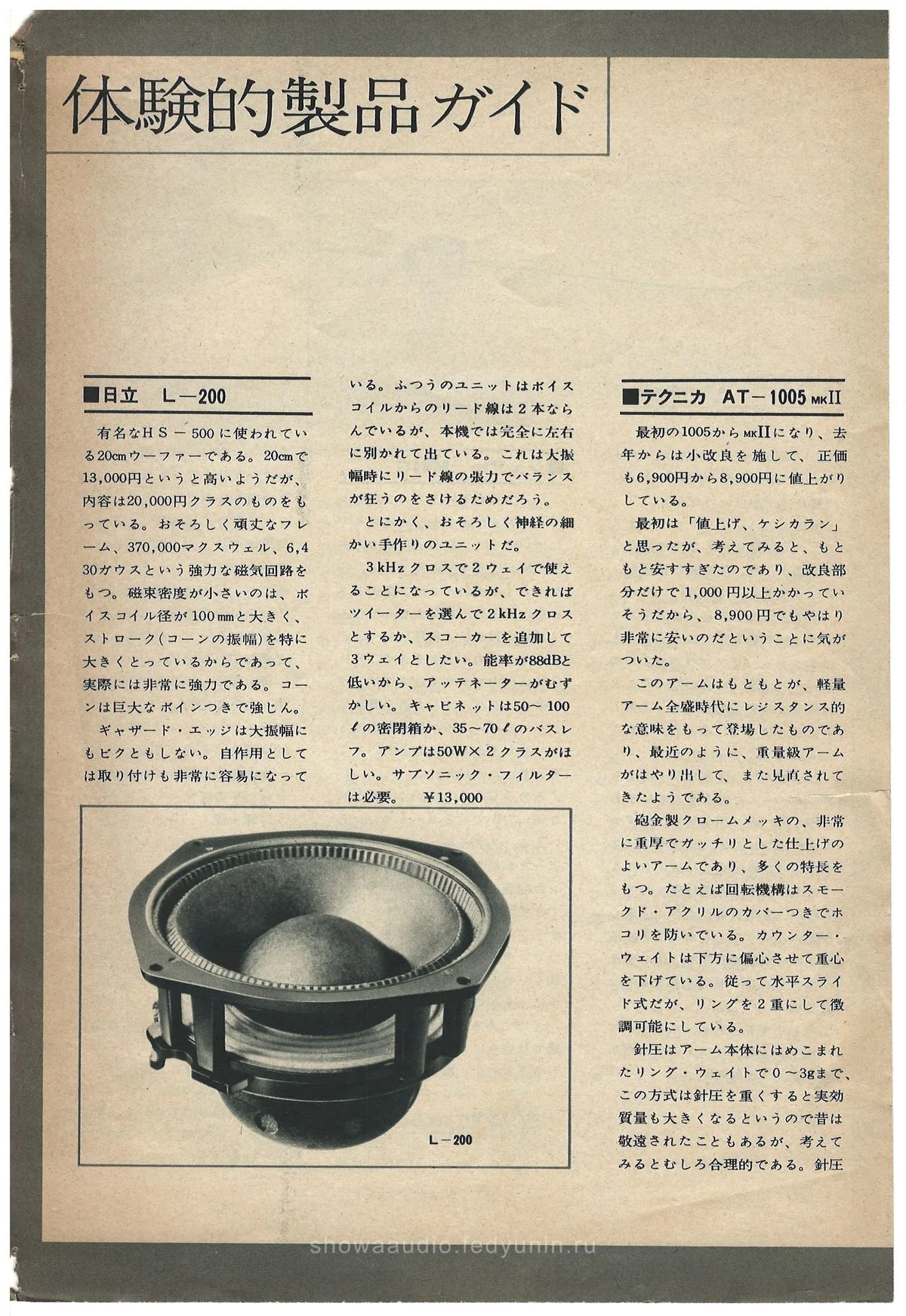
Hitachi L-200 is a 20cm woofer, the very driver that lives inside the well-known Hitachi HS-500 speaker. Priced at ¥13,000, which Nagaoka considers expensive for 1979 but justified: 20,000 maxwell magnetic flux, 370,000 max-gauss, 6,430 gauss flux density, 100mm voice coil, very strong gathered-edge suspension. His DIY recommendation: three-way system, crossover around 3 kHz, 50-100 liter bass-reflex enclosure, at least 50W × 2 per channel, subsonic filter mandatory.
Audio-Technica AT-1005 MkII is a tonearm, an evolution of the AT-1005, with the price raised from ¥6,900 to ¥8,900. Nagaoka admits his first reaction was “they cheated”, but after digging in he now considers the increase justified. A heavyweight arm in chrome-nickel-plated brass, ball bearings, sealed acrylic cover, counterweight mounted low for a low center of gravity. Tracking force is set directly on the arm itself, 0 to 3 grams, no spring mechanism. He praises the classic engineering school - “this is how you make heavyweight tonearms”.
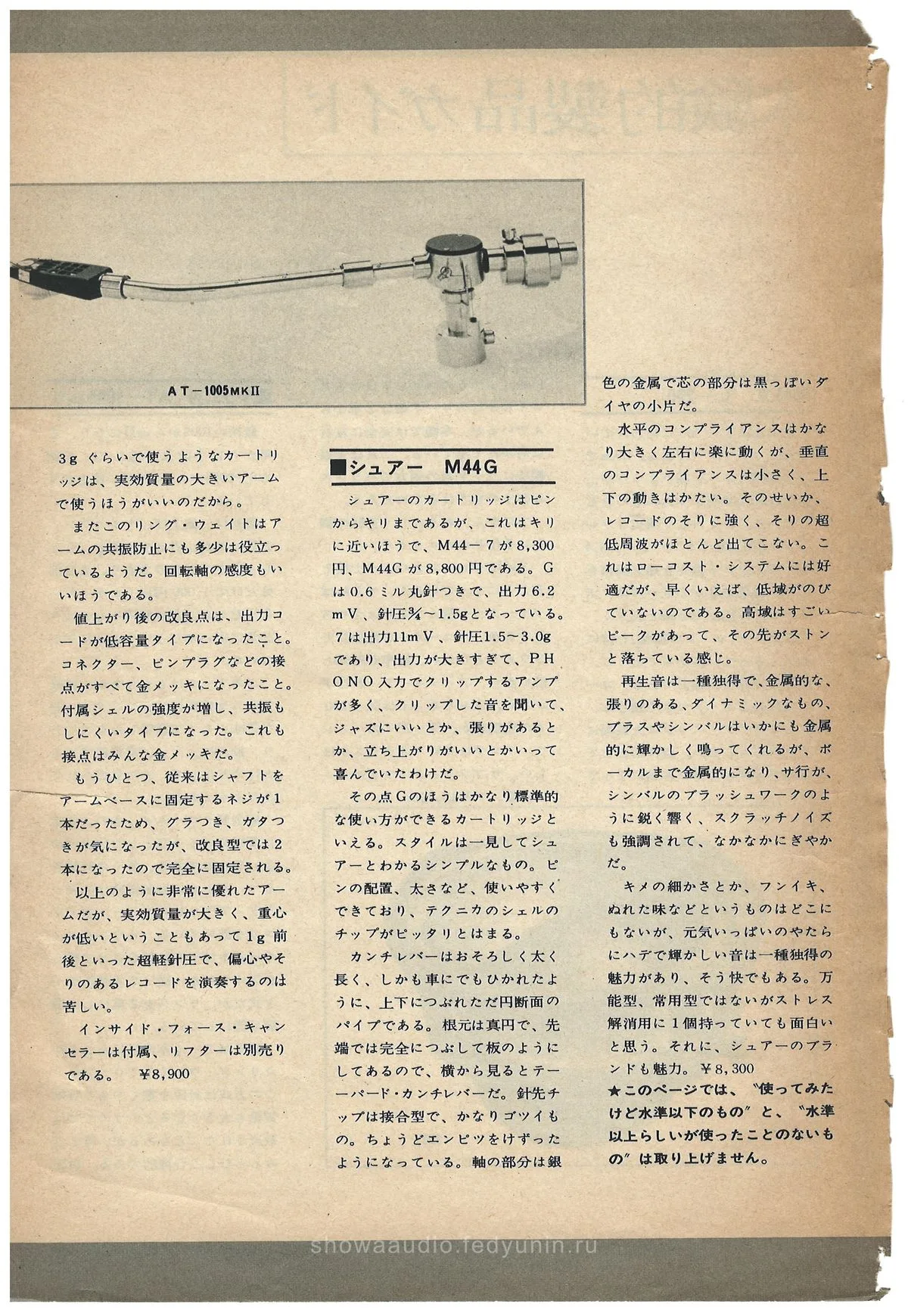
Shure M44G is an MM cartridge from Shure’s standard line, ¥8,800. Output 6.2 mV, tracking 1.5 to 3.0 g. Sensitive, loves a load, on jazz with loud “trip” passages it demands a decent phono stage. The cantilever is on the thick side and the construction is visibly basic - but it sounds honest, without any pretense. At the foot of the page there is a charming editor’s note: “this column on principle does not cover cartridges more expensive than the ones Nagaoka actually uses himself”. No hi-end snobbery, reviews strictly from the author’s own collection.
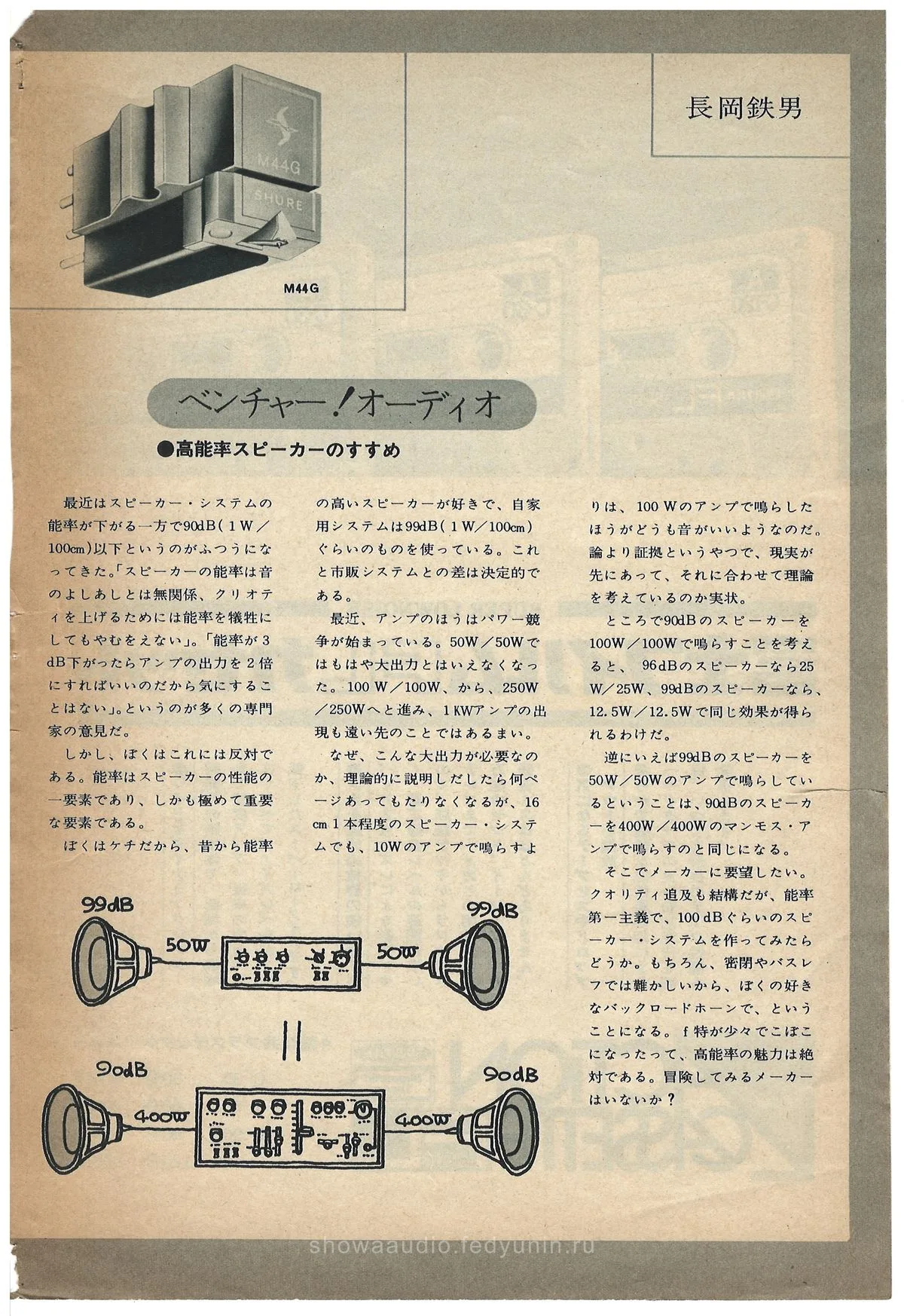
And the headline piece - ベンチャー!オーディオ (“Venture! Audio: a recommendation for high-efficiency speakers”). This is not a review, it is a manifesto. Nagaoka is upset that speaker sensitivity keeps dropping - 90 dB (1W/1m) and below has become the norm. Engineers argue that sensitivity has nothing to do with quality, and that if a flat response costs you 3 dB of efficiency, you simply double the amplifier power. Nagaoka categorically disagrees: sensitivity is a base requirement, not an option. He runs the math: 99 dB at 50 watts plays as loud as 90 dB at 400 watts - meaning the high-efficiency rig is cheaper and simpler. He closes with a direct call to manufacturers: “the niche may be small, but the appeal of high efficiency is absolute, where are the brave ones?”.
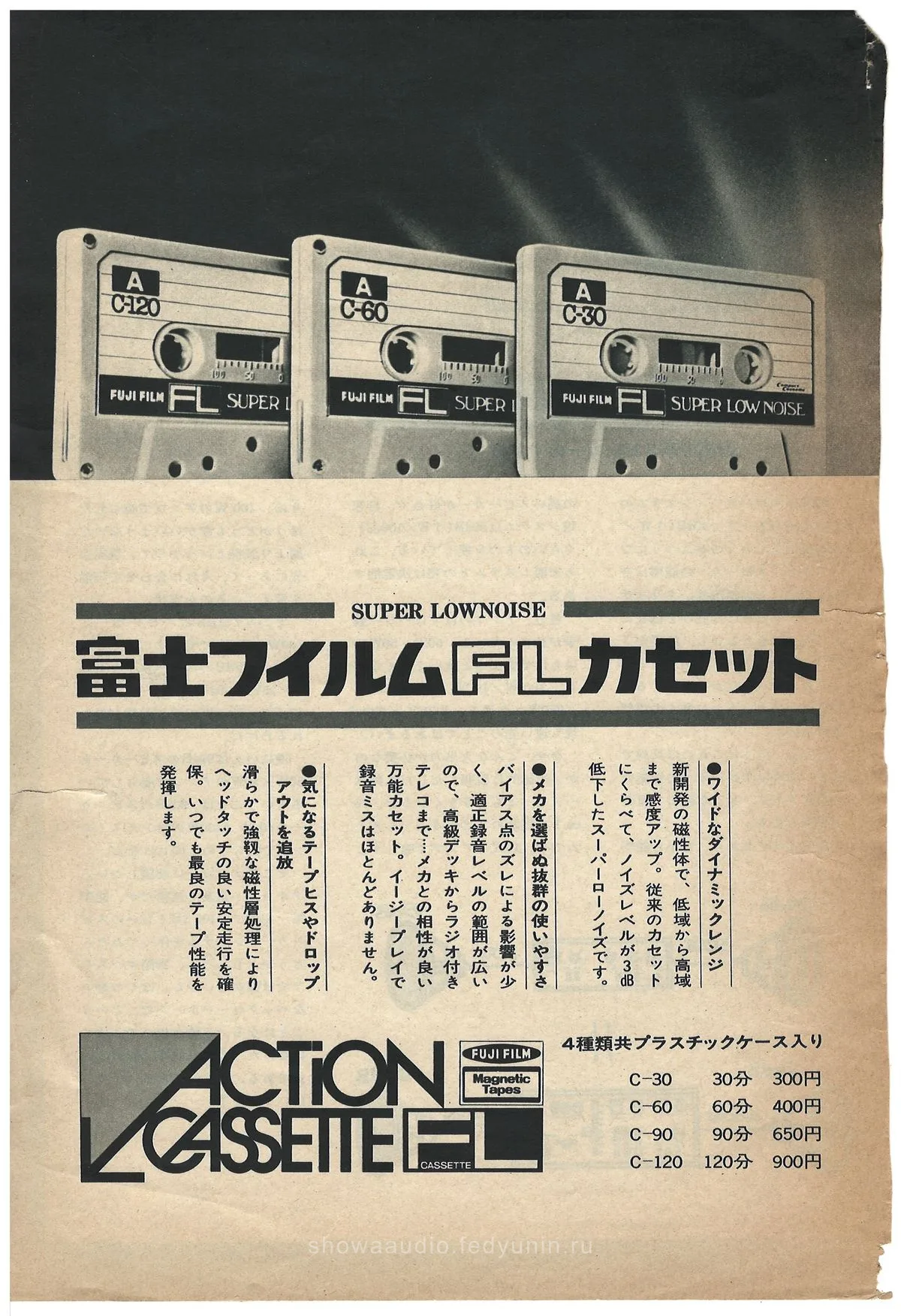
The back of the last sheet is a Fuji FL Cassette ad (Super Lownoise, C-30/60/90/120 at ¥300/400/650/900). Off-topic, just the reverse side of the magazine spread.
What is interesting is that these pages were stashed inside the KEF brochure specifically. KEF, Spendor, Rogers - that is the British BBC school, the very low-efficiency monitor lineage (the LS3/5A is 83 dB). And Nagaoka in his manifesto positions himself directly against that school, calling for the opposite - 99 dB and up. So whoever owned this catalog was thinking in both directions at once: studying British engineering through KEF while also keeping a manifesto against it within easy reach. There is a logic to that.