JVC | Victor
日本ビクター
Japan Victor Company, Ltd. (日本ビクター株式会社) was founded on 13 September 1927 in Yokohama as the Japanese subsidiary of the American Victor Talking Machine Company. When RCA bought the US parent in 1929 the Japanese arm passed under RCA control; in 1953 Matsushita Electric Industrial (Panasonic) acquired the majority shareholding, and JVC remained a Matsushita subsidiary until 2007. Within Japan all products carried the Victor (ビクター) name; for export they ran as JVC, and briefly in the 1960s as Nivico (Nippon Victor Corporation) where rival holders of the Victor trademark blocked the home brand. Since 1943 JVC has held the exclusive Japanese rights to the Nipper "His Master's Voice" logo. The company's principal global legacy is the VHS (Video Home System) format - the home video standard that JVC developed and standardised in 1976. On 1 October 2008 Matsushita spun JVC off and merged it with Kenwood Electronics to create JVCKenwood Corporation. … more

- Japanese name
- 日本ビクター
- Catalogs in the Museum:
- 8
- Catalog years:
- 1980-1989
- Equipment types
- Cassette Decks, AV / Video
About the brand
Japan Victor Company, Ltd. (日本ビクター株式会社) was founded on 13 September 1927 in Yokohama as the Japanese subsidiary of the American Victor Talking Machine Company. When RCA bought the US parent in 1929 the Japanese arm passed under RCA control; in 1953 Matsushita Electric Industrial (Panasonic) acquired the majority shareholding, and JVC remained a Matsushita subsidiary until 2007. Within Japan all products carried the Victor (ビクター) name; for export they ran as JVC, and briefly in the 1960s as Nivico (Nippon Victor Corporation) where rival holders of the Victor trademark blocked the home brand. Since 1943 JVC has held the exclusive Japanese rights to the Nipper “His Master’s Voice” logo. The company’s principal global legacy is the VHS (Video Home System) format - the home video standard that JVC developed and standardised in 1976. On 1 October 2008 Matsushita spun JVC off and merged it with Kenwood Electronics to create JVCKenwood Corporation.
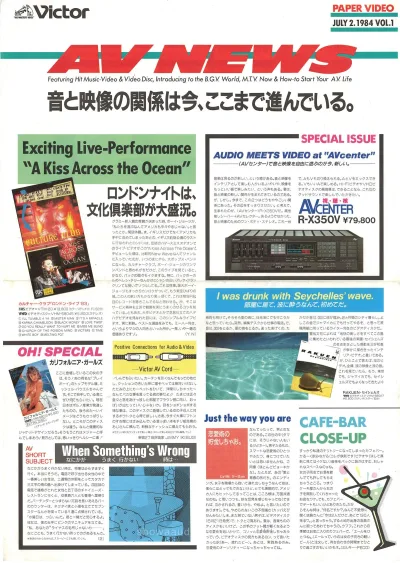
JVC’s first major audio first came in 1971 with CD-4 (Compatible Discrete 4-Channel), the first commercial discrete quadraphonic record format: where the rival SQ and QS systems used matrix encoding, CD-4 carried four independent channels on two groove walls using an extended bandwidth up to 45 kHz and a dedicated Shibata stylus. On 9 September 1976, at the Hotel Okura in Tokyo, the company publicly unveiled the first commercial VHS-format VCR, the Victor HR-3300; at the same time JVC pushed VHS as an open standard without royalty fees and brought Matsushita, Hitachi, Sharp and Mitsubishi behind it, a strategy that delivered VHS its victory over Sony’s Betamax in the format war of 1976-1988. In 1983 JVC launched the VHD (Video High Density) optical-mechanical videodisc on the Japanese market, with a 1984 release in the United Kingdom; VHD never achieved mainstream take-up and was discontinued.
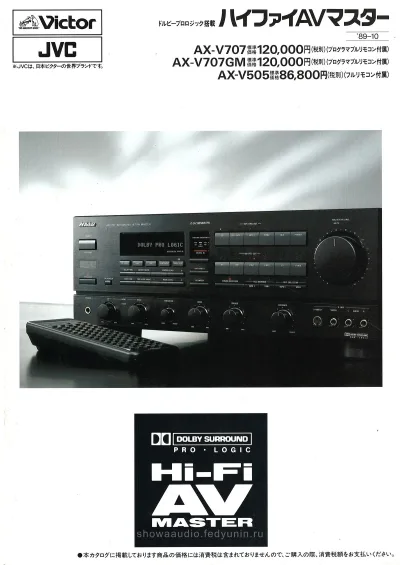
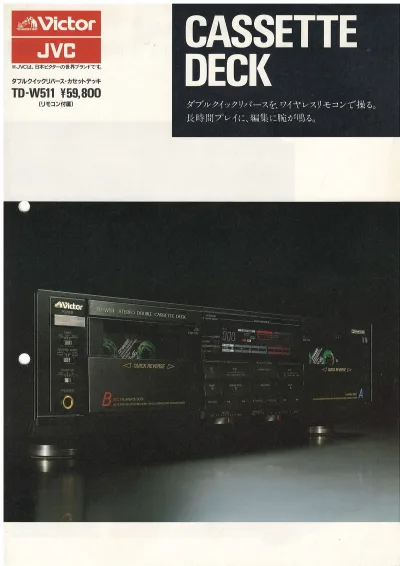
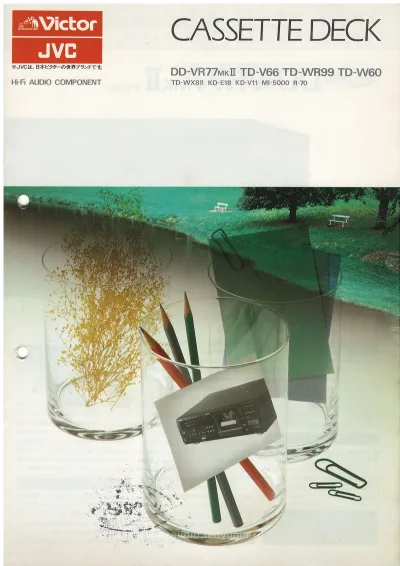
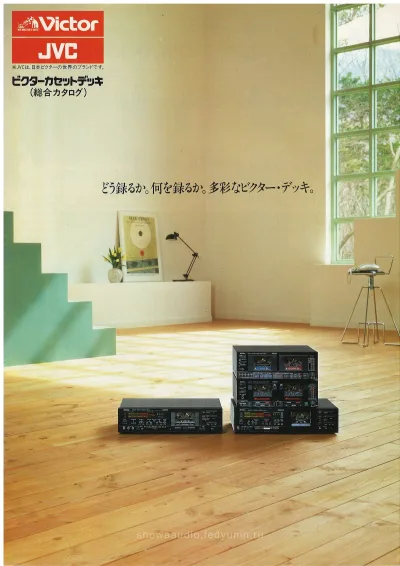
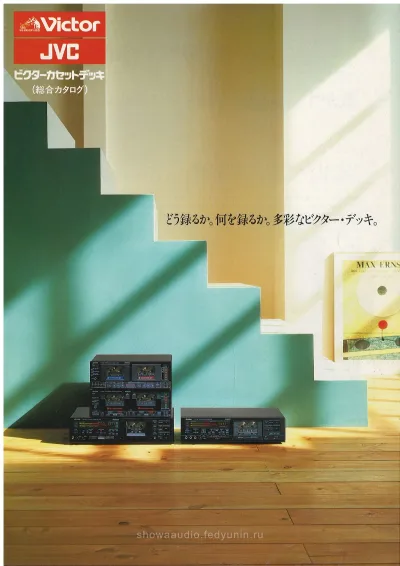
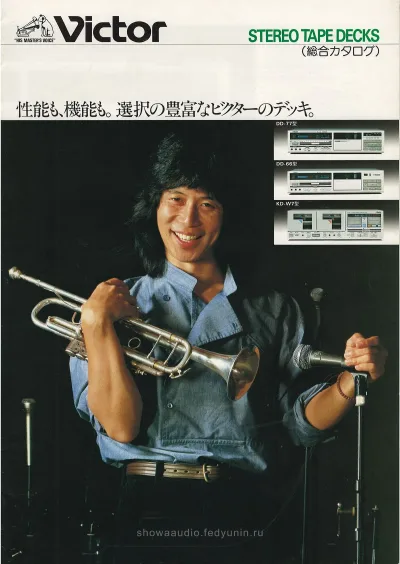
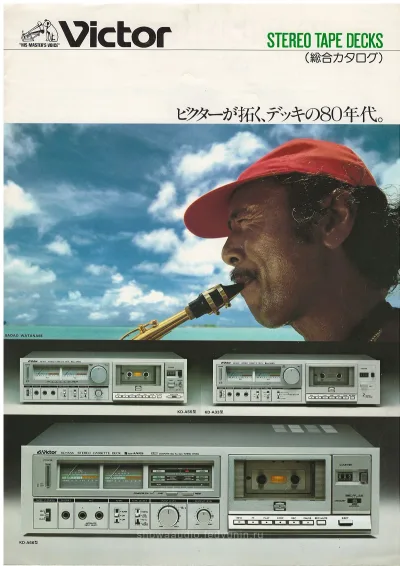
For audio components the brand was always Victor: the core cassette-deck line was the KD series (the 1980 flagship KD-A8 at ¥108,000 supported Metal tape and used heads cast from the proprietary Sen-Alloy material), with reel-to-reel TD-series flagships TD-5000SA at ¥198,000 and TD-4000SA running X-cut SA heads. The dual-cassette TD-W line, headed by the 1987 TD-W511, carried the in-house DIGIFINE (ディジファイン) signal-processing system. At the turn of the 1980s and 1990s the focus shifted to AV receivers - the AX-V series with Dolby Pro Logic Surround and the in-house D-D Converter, topped by the 1989 AX-V707 at ¥120,000 with the gun-metallic AX-V707GM variant. Alongside the components Victor sold the THEATONE complete home-cinema package: an AV amplifier, SX-700 speakers, the HR-S8600 S-VHS deck and the AV-3362 television under a single name.
- Founded:
- 1927, Yokohama, Kanagawa
- Full name:
- Japan Victor Company, Ltd. (日本ビクター株式会社)
- Links:
- Wikipedia Official site