Lo-D
ローディ
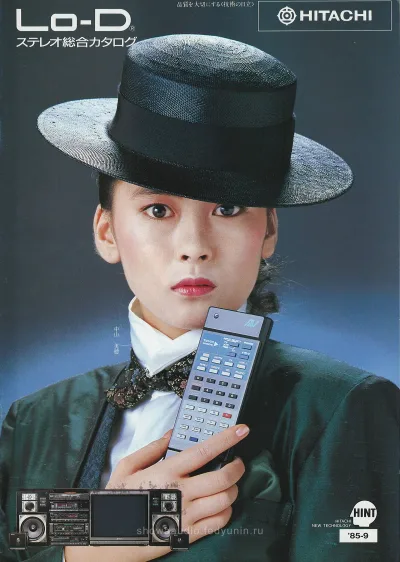
Lo-D (ローディ) was the audio brand of the Japanese conglomerate Hitachi, Ltd. (株式会社日立製作所), used exclusively for the Japanese domestic market. Hitachi itself was founded in 1910 in Ibaraki Prefecture by the electrical engineer Namihei Odaira (小平浪平); the company became independent in 1911 and has long had its head office in the Chiyoda district of Tokyo. The Lo-D name - short for Low Distortion - was introduced by Hitachi in the 1960s to keep two distinct product identities: outside Japan the same consumer equipment carried the Hitachi badge, while at home it carried Lo-D. The name remained in use until 2019, when it quietly dropped out of Hitachi's catalogues without any official discontinuation announcement. … more
- Japanese name
- ローディ
- Catalogs in the Museum:
- 14
- Catalog years:
- 1980-1992
- Equipment types
- Cassette Decks, DAT, Amplifiers, Turntables, Speakers, CD Players, Tuners, Boomboxes, Portable Players, Headphones, Stereo Systems, Mini Systems, Equalizers, Full Line, Microphones, AV / Video, Television
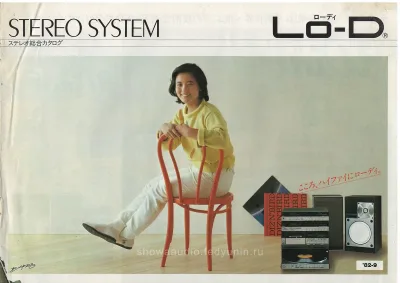
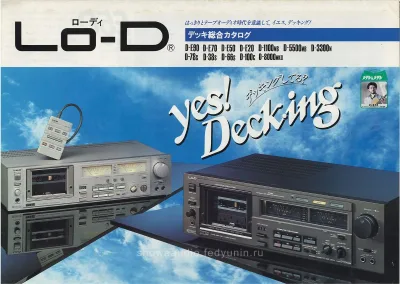
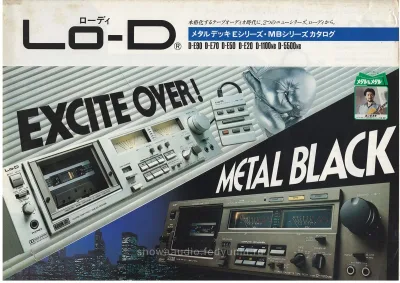
About the brand
Lo-D (ローディ) was the audio brand of the Japanese conglomerate Hitachi, Ltd. (株式会社日立製作所), used exclusively for the Japanese domestic market. Hitachi itself was founded in 1910 in Ibaraki Prefecture by the electrical engineer Namihei Odaira (小平浪平); the company became independent in 1911 and has long had its head office in the Chiyoda district of Tokyo. The Lo-D name - short for Low Distortion - was introduced by Hitachi in the 1960s to keep two distinct product identities: outside Japan the same consumer equipment carried the Hitachi badge, while at home it carried Lo-D. The name remained in use until 2019, when it quietly dropped out of Hitachi’s catalogues without any official discontinuation announcement.
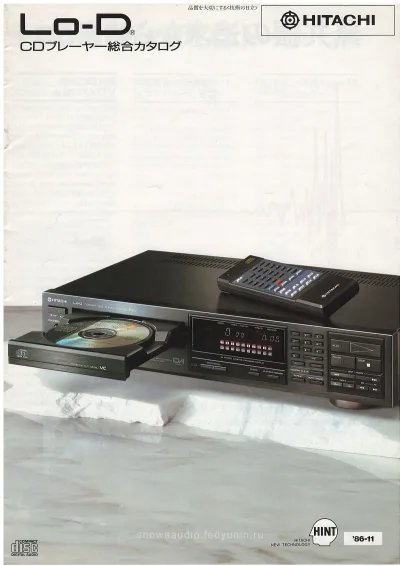
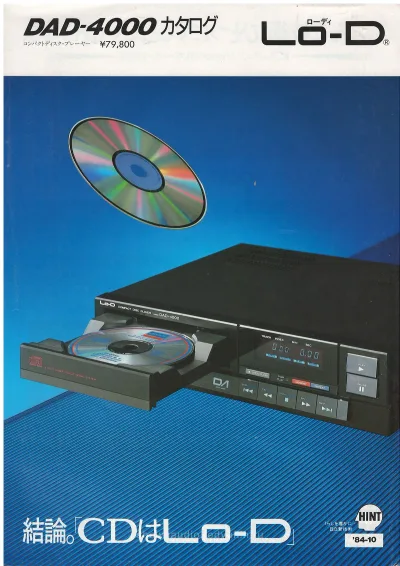
The 1968 HS-500 loudspeaker introduced Hitachi’s proprietary Gathered Edge - a V-profile pleated surround that reduced mechanical distortion of the cone and became the signature of every later Lo-D speaker. In 1973 the company released the D-4500, claimed as the world’s first compact-cassette deck with three separate heads instead of a combined record/playback head. On 1 October 1982, the day the Compact Disc format launched, Lo-D shipped the DAD-1000 - one of the very first CD players in the world, released simultaneously with Sony’s CDP-101; the DAD-001 of 1984 followed as Japan’s first separate-component CD player, alongside the compact DAD-4000 at ¥79,800 with its 3 Spot System tracking laser. The HMA amplifier line, headed by the HMA-9500MKII (¥270,000 in 1982), used Power MOS FET output stages: the audio critic Tetsuo Nagaoka took the HMA-9500MKII as the reference amplifier in his evaluation system. In 1992 Lo-D issued the DAT-8000 digital-tape deck, technically identical to the DENON DTR-2000G, the product of a joint Hitachi-DENON development.
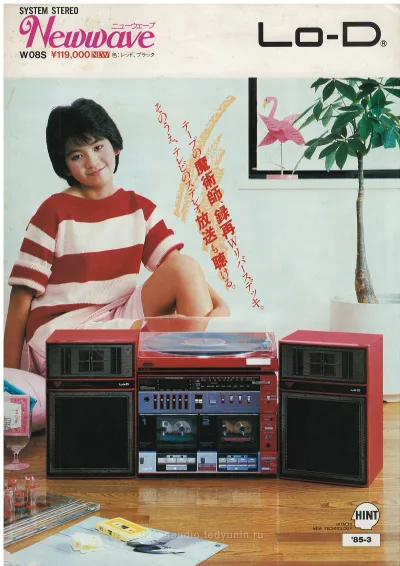
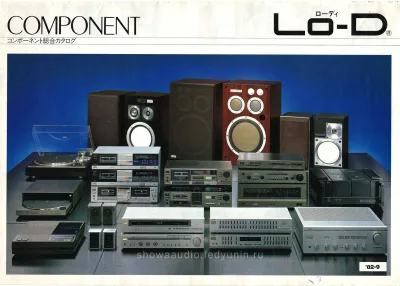
The Lo-D catalogue broke down into four working series. Power amplifiers ran the HMA line: the HMA-9500MKII at ¥270,000 as flagship, the HMA-8500 at ¥150,000 in the middle, the HMA-F3 at ¥45,000 at the entry level. Pre-amplifiers and pre-main amplifiers were the HA family, from the HA-10 at ¥28,200 to the HA-6800 at ¥69,800, all on Power MOS FET output devices and Dual Servo regulation. The HCA preamp series included the HCA-8000 at ¥70,000. Turntables ran the Unitorque motor - a single-coil direct-drive design with no cogging - paired with V.C. metal anti-vibration tonearms. D-series cassette decks used the Close Gap R/P combination head with a 1.4-micron gap for three-head operation, plus A.T.R.S. (Automatic Tape Response System) microcomputer correction to match the deck’s response to the specific tape loaded. FT-series tuners, headed by the FT-5500, ran Computer Search System for automatic preset memory and the in-house T.D. multiplex circuit to suppress FM multipath interference. The Wing mini-system arm and the Newwave System rounded out the line by the mid-1980s, including the W55DA package that paired the DAD-4000 CD player with the portable Wing W55 unit.
- Founded:
- 1910, Chiyoda, Tokyo
- Founder:
- Namihei Odaira (小平浪平)
- Full name:
- Lo-D (Hitachi, Ltd. audio brand)
- Links:
- Wikipedia